Commercial Building Access Control Systems and Guard Support
Josh Harris | March 10, 2026
A single unlocked door at 2 AM cost a Chicago manufacturing firm $340,000 in stolen equipment last year. The security guard on duty had no way of knowing that a side entrance credential reader had malfunctioned, because the building's access control system operated in isolation from the guard station. This scenario plays out daily across commercial properties, where sophisticated technology and trained personnel work in parallel rather than in concert. The real question facing facility managers and security directors isn't whether to invest in access control systems or guard services, but how to make these two elements function as a unified defense. Coordination between security technology and personnel significantly enhances incident response. Recent security operations data show that facilities using this integrated approach achieve response-time improvements of 30% to 50%, a notable gain compared with facilities where systems and teams operate independently. The challenge lies in understanding how each element strengthens the other and where traditional approaches fall short.
The Evolution of Access Control in Modern Commercial Properties
Transition from Mechanical Locks to Smart Infrastructure
Physical keys created management nightmares that facility directors still remember. Lost keys meant expensive rekeying projects. Terminated employees retained access until locks were changed. Tracking who entered which areas and at what times required manual sign-in logs that no one consistently maintained.
Electronic access control eliminated these pain points starting in the 1980s, but early systems introduced new complications. Proprietary hardware locked buildings into single-vendor ecosystems. Card readers required dedicated wiring runs. System management demanded specialized training that security guards rarely received.
Key Benefits of Integrated Digital Access Solutions
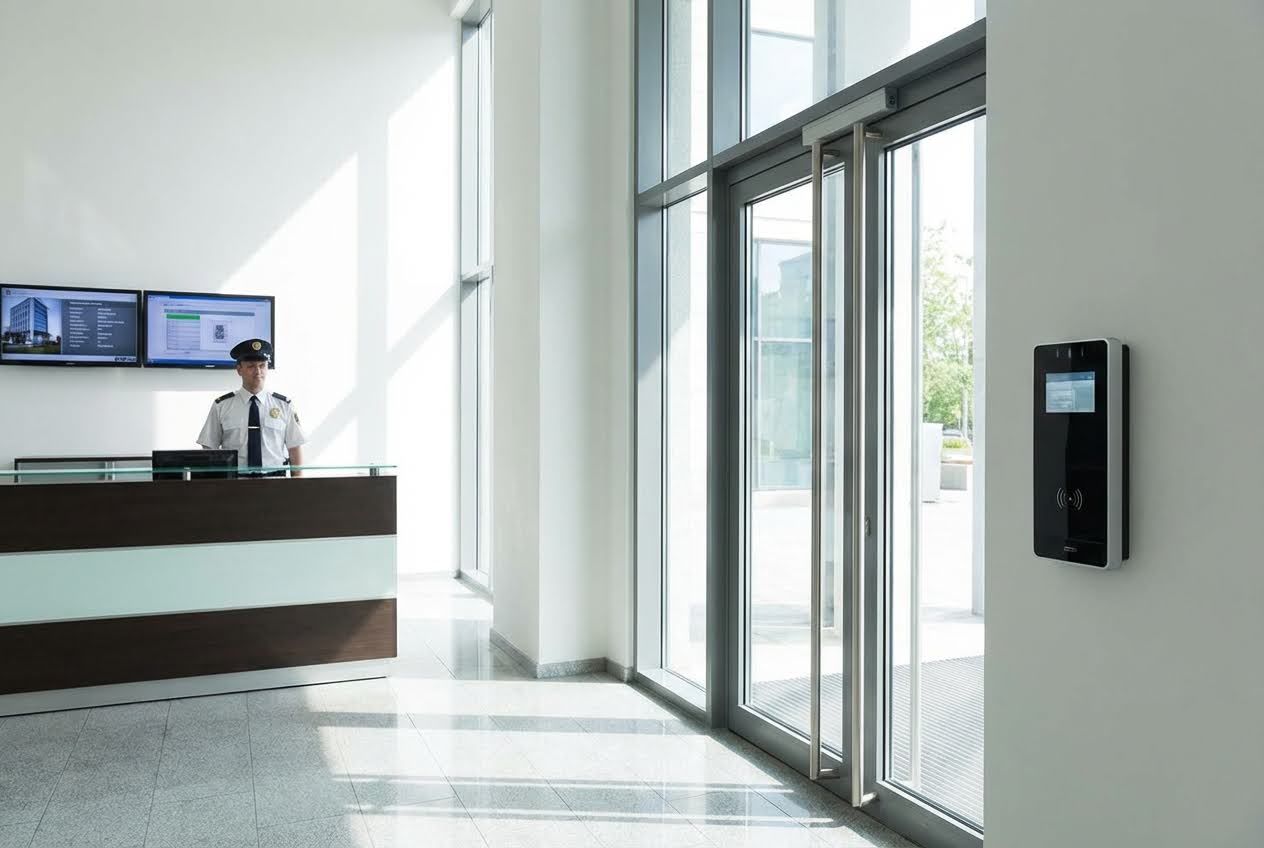
Modern access infrastructure operates on open protocols that communicate across platforms. A credential denied at a loading dock door can trigger an immediate alert to the guard station, display the denied individual's photo, and log the event for compliance review. This connectivity transforms access control from a passive barrier into an active security tool.
Buildings that use integrated access control systems have approximately 25% to 40% fewer incidents of unauthorized entry than those relying on separate, standalone components, according to recent industry benchmarking data. The difference comes from closing the gap between detection and response, something that requires both technology and trained personnel working from shared information.
Core Technologies Powering Commercial Security
Biometric and Mobile Credential Systems
Fingerprint readers, facial recognition cameras, and mobile phone credentials have moved from high-security facilities into standard commercial applications. A warehouse supervisor's smartphone can now serve as their building credential, visitor pass system, and emergency communication device.
Biometric systems eliminate credential sharing, a persistent vulnerability in card-based access control. When a fingerprint or face scan authenticates entry, security teams know exactly who entered, not just which card was used. This certainty matters during incident investigations and compliance audits.
Mobile credentials offer administrative advantages that reduce the security team's workload. Credentials can be issued, modified, or revoked remotely without physical card distribution. Temporary access for contractors or visitors can expire automatically after specified periods.
Cloud-Based Management and Real-Time Monitoring
Cloud platforms centralize access control management across multiple properties, giving security directors visibility into dozens of buildings from a single dashboard. When a guard at a corporate campus notices unusual after-hours activity, they can instantly check access logs across all connected facilities.
Real-time monitoring enables proactive security rather than reactive investigation. Unusual patterns, such as the same credential being used at two distant locations within impossible timeframes, trigger automatic alerts. Guards receiving these alerts can investigate immediately rather than discovering anomalies during next-day log reviews.
The Critical Role of On-Site Guard Support
Human Intervention in System Alerts and Breaches
Technology excels at detection but struggles with judgment. An access control system can identify that someone is holding a door open for 90 seconds, but it cannot determine whether that person is helping a colleague carry equipment or enabling unauthorized entry. Guards provide the contextual assessment that automated systems cannot.
Cascadia Global Security trains personnel specifically to interpret system alerts and make rapid decisions about appropriate responses. This training bridges the gap between what technology detects and what situations actually require.
Breach response demonstrates where human intervention becomes irreplaceable. When an access system detects a forced door, guards must assess the threat level, determine whether to approach or observe, coordinate with law enforcement if necessary, and document the incident for follow-up. No automated system effectively handles this sequence.
Managing Visitor Verification and Escort Protocols
Visitor management remains one of the most vulnerable points in commercial building security. Pre-registered visitors with valid credentials still require human verification, someone, to confirm that the person presenting identification matches the expected visitor and has legitimate business purposes.
Escort protocols for vendors, contractors, and guests require personnel who understand both the physical layout and the access control system. A guard escorting a maintenance technician needs to know which credentials to activate, which areas require additional authorization, and how to document the visit for compliance purposes.
Synergizing Automated Systems with Physical Security Personnel
Closing the Gap Between Detection and Response
Integrating access control systems significantly improves the efficiency of security response. Non-integrated facilities typically see guard response times exceeding three minutes following an access system alert. Conversely, in integrated environments, where guards receive mobile alerts with precise location data, response times are generally reduced to under two minutes. That difference determines whether security personnel intercept problems or document them afterward.
Integration requires more than connecting systems technically. Guards need training on interpreting system data, understanding alert priorities, and using technology tools effectively. Cascadia Global Security emphasizes this operational integration, ensuring personnel can maximize the value of client technology investments.
Optimizing Guard Patrols Using Access Data Insights
Access control data reveals patterns that inform intelligent patrol scheduling. If credential activity shows that a building's east wing sees minimal traffic after 7 PM while the loading dock remains active until midnight, patrol routes should reflect that reality.
Historical access data identifies vulnerability windows. Facilities that experience the most unauthorized entry attempts during shift changes can adjust guard positioning accordingly. Buildings with seasonal traffic variations can scale patrol intensity to match actual risk levels rather than arbitrary schedules.
Compliance, Liability, and Safety Standards
Meeting Fire Code and Emergency Egress Requirements
Access control systems must balance security with life safety requirements. Fire codes mandate that egress paths remain unobstructed and that doors open automatically upon fire alarm activation. Security teams need to understand how their access systems interact with fire safety infrastructure.
Guards play essential roles during emergency evacuations, directing occupants to appropriate exits, confirming that areas have been cleared, and preventing re-entry into dangerous zones. This coordination requires familiarity with both the building's emergency systems and its access control configuration.
Data Privacy and Secure Credential Management
The collection of biometric data is governed by strict privacy regulations, including the Illinois
Biometric Information Privacy Act (BIPA) and the
California Consumer Privacy Act (CCPA). This regulatory landscape is expected to expand as similar emerging federal standards emerge. Buildings collecting fingerprints or facial recognition data must comply with these laws, which vary substantially across jurisdictions. Security personnel handling this data need training on proper procedures and legal obligations.
Credential management extends beyond technical security to include personnel practices. Guards with administrative access to credential systems pose a potential vulnerability if procedures aren't properly controlled. Background screening, access logging, and separation of duties all contribute to credential security.
Frequently Asked Questions
What is the difference between standalone access control and integrated security systems?
Standalone access control operates independently, logging entries and denials without communicating with other security components. Integrated systems share data with guard stations, video surveillance systems, and alarm monitoring systems, enabling coordinated responses to security events.
How do guards add value to automated access control systems?
Guards provide contextual judgment that technology cannot replicate. They assess whether system alerts represent genuine threats, respond appropriately to breaches, verify visitor identities, and handle situations requiring human interaction or discretion.
What credentials work best for commercial building access control?
Mobile credentials and biometrics offer the strongest security because they cannot be easily shared or duplicated. Card-based systems remain common but create vulnerabilities when credentials are lost, stolen, or shared among employees.
How often should access control systems and guard protocols be reviewed?
Quarterly reviews of access patterns and incident data help identify emerging vulnerabilities. Annual comprehensive assessments should evaluate whether technology and personnel deployment still match actual security requirements.
What training do security guards need for access control system integration?
Guards require training on interpreting system alerts, using management interfaces, understanding credential types, and coordinating technology data with physical response protocols. Ongoing training should address system updates and emerging threat patterns.
Future-Proofing Commercial Security Investments
Security technology evolves rapidly, but buildings last for decades. Smart investment decisions account for future adaptability as well as current functionality. Systems built on open protocols can integrate new technologies as they mature, while proprietary platforms may require complete replacement when vendors discontinue support.
The most future-resistant approach combines adaptable technology with well-trained personnel. Guards who understand security principles rather than just specific system operations can work effectively as technology changes. Cascadia Global Security develops personnel who adapt to client technology environments rather than requiring clients to adapt to guard limitations.
Buildings investing in commercial building access control with coordinated guard support position themselves for security challenges that don't yet exist. The threats facing commercial properties in five years will differ from today's concerns, but the combination of intelligent technology and capable personnel will remain the foundation of effective protection.
For organizations evaluating their security posture, Cascadia Global Security offers professional guard services and off-duty law enforcement personnel trained to work within integrated security environments. As a veteran-owned firm with locally managed teams, they bring operational discipline to commercial security challenges. Learn more about coordinating your access control systems with professional security personnel.