How Long CPR Certification Takes and Why Security Teams Train for Emergencies
Josh Harris | February 6, 2026
A cardiac arrest can happen anywhere: a corporate lobby, a crowded concert venue, a construction site at dawn. When someone collapses, the clock starts immediately. Brain damage can begin within approximately 4 minutes without oxygen-rich blood flow, and irreversible injury may occur after 6 to 10 minutes. For security professionals stationed at these locations, the ability to perform CPR isn't optional. Understanding how long CPR certification takes and why security teams train for emergencies reveals a critical truth about modern security work: protecting people means being prepared to save lives, not just deter threats.
Security guards often serve as the first line of response before paramedics arrive. This reality shapes hiring standards, training requirements, and operational protocols across the industry. A certified team doesn't just check a compliance box. They become a genuine safety asset capable of bridging the gap between emergency and professional medical intervention.
Understanding CPR Certification Timeframes
The time required for CPR certification varies by format, certification level, and provider. Most professionals complete their training in a single day, though the exact hours depend on the credentials they pursue.
Traditional In-Person vs. Blended Learning Formats
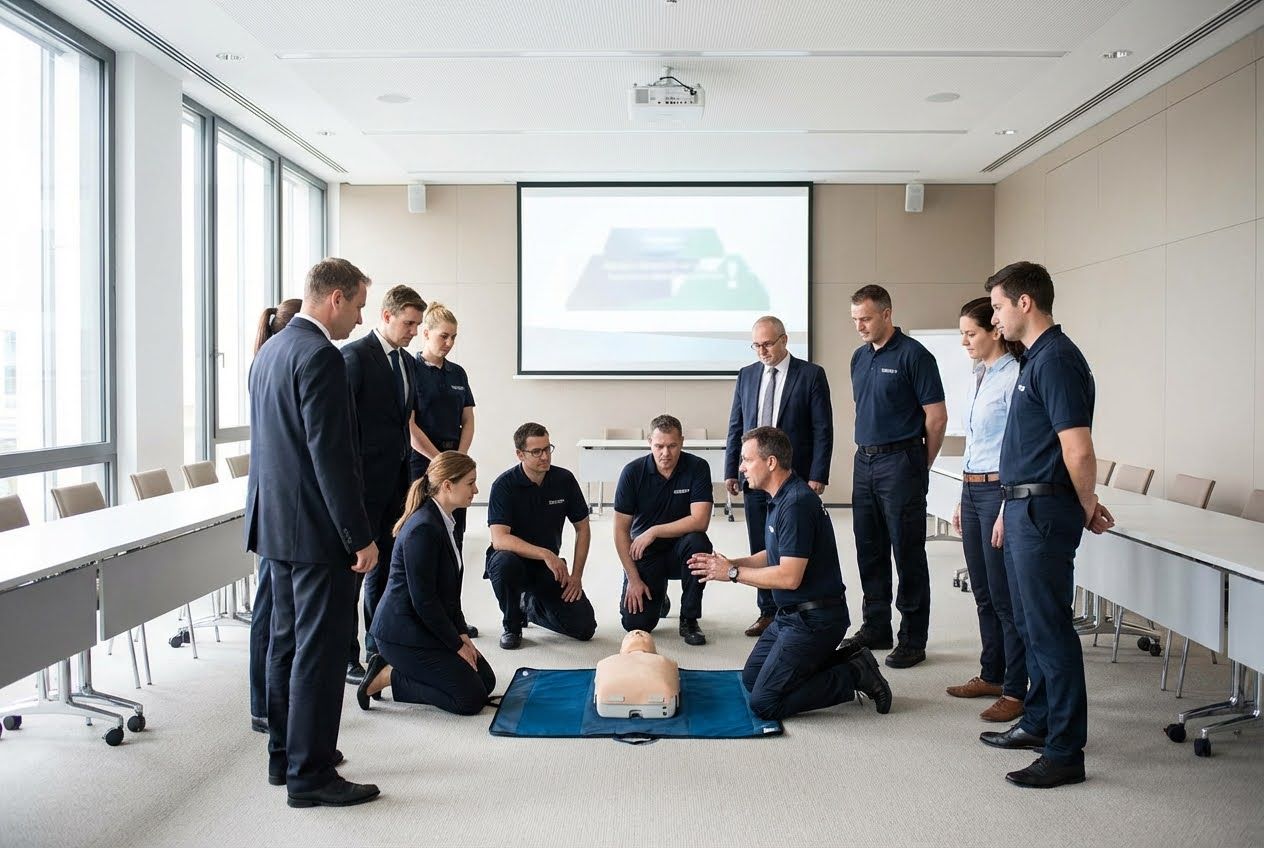
Traditional classroom courses run between 4 and 8 hours, depending on the certifying organization and the curriculum depth. These sessions combine lecture content, video demonstrations, hands-on practice with manikins, and skills testing into a single continuous block.
Blended learning splits the process differently:
- Online coursework typically takes two to three hours at your own pace
- In-person skills sessions add another one to two hours
- Total time commitment remains similar but offers scheduling flexibility
For security companies coordinating training across multiple shifts, blended formats often prove more practical. Guards can complete the didactic portion independently, then gather for supervised skills verification without pulling entire teams offline simultaneously.
Breakdown of Class Hours by Certification Level
Basic CPR certification for adults requires approximately two to three hours. Adding pediatric and infant CPR extends this by another hour. The most common credential for security professionals,
BLS (Basic Life Support) for Healthcare Providers, typically runs four to five hours and includes:
- Adult, child, and infant CPR techniques
- Two-rescuer CPR protocols
- Bag-mask ventilation fundamentals
- Team dynamics during resuscitation
First Aid certification, often bundled with CPR courses, adds an additional 2 to 4 hours. Combined CPR/First Aid/AED courses from organizations such as the American Heart Association or the American Red Cross generally take 6 to 8 hours.
The Duration of Skills Testing and Written Exams
Skills testing accounts for roughly 30-45 minutes in any certification course. Candidates demonstrate proper hand placement, compression depth and rate, rescue breathing technique, and AED operation. Instructors evaluate each skill against standardized checklists.
Written exams typically contain 25 to 50 multiple-choice questions and take 20 to 30 minutes to complete. Most programs require 80% accuracy for passing. The combination of practical demonstration and written assessment ensures guards can both perform techniques correctly and understand the reasoning behind each step.
Why CPR Training is a Critical Requirement for Security Professionals
Security work has evolved beyond simple observation and access control. Modern security teams function as integrated safety resources, and emergency medical response capability has become a baseline expectation.
The Security Guard as a First Responder
When emergencies occur at secured facilities, security personnel typically arrive first. They're already on-site, monitoring cameras, conducting patrols, or staffing entry points. This positioning creates both opportunity and responsibility.
Cascadia Global Security recognizes this reality in its training standards. Their guards receive comprehensive emergency response preparation because proximity to incidents demands the capability to act. A security officer who witnesses a cardiac arrest but cannot perform CPR fails the fundamental duty of protection.
The statistics support this emphasis. Bystander CPR can double or even triple survival rates for out-of-hospital cardiac arrest victims, according to the American Heart Association (AHA) 2025 data. Security guards aren't random bystanders; they're trained professionals expected to respond effectively.
Managing High-Stress Scenarios Until EMS Arrives
Average EMS response times in the U.S. typically range from seven to ten minutes in urban areas and may exceed fourteen minutes in rural regions, depending on traffic and call volume (National EMS Information System, 2025). Those minutes determine outcomes. Security teams trained in CPR provide continuous care during this critical window, maintaining blood circulation and oxygen delivery until advanced medical intervention arrives.
High-stress performance requires:
- Repetitive training that builds muscle memory
- Scenario-based practice simulating real conditions
- Clear protocols eliminating decision paralysis
- Confidence is developed through demonstrated competence
Key Components of Emergency Response
Training
Effective emergency response training extends beyond basic CPR mechanics. Comprehensive programs address equipment operation, legal considerations, and integration with broader emergency protocols.
Mastering AED Operation and Chest Compressions
Automated External Defibrillators have become standard equipment in commercial buildings, schools, and public venues. Security guards must quickly locate, retrieve, and operate these devices. Training covers pad placement, voice prompt interpretation, and coordination between
AED analysis cycles and chest compressions.
Compression quality directly impacts survival. According to the 2025 AHA guidelines, the recommended compression depth for adults is about 2 inches (5 cm) and no more than 2.4 inches (6 cm). Current guidelines specify:
- Depth of at least two inches for adult victims
- Rate between 100 and 120 compressions per minute
- Full chest recoil between compressions
- Minimal interruptions during CPR cycles
These technical standards require practice to execute correctly under pressure. Quality training programs use feedback devices that measure compression depth and rate in real-time, allowing guards to calibrate their technique accurately.
Legal Protections and Good Samaritan Laws
Security professionals sometimes hesitate to provide emergency care due to liability concerns. Training addresses these fears directly. All U.S. states and the District of Columbia have Good Samaritan laws that generally protect individuals who provide emergency assistance in good faith, though specific provisions and coverage vary by state.
Key protections include:
- Immunity from civil liability for unintentional harm during rescue attempts
- Coverage for trained and untrained rescuers acting reasonably
- Protection extending to AED use by lay responders
Understanding these protections removes a psychological barrier to action. Guards who know they're legally protected respond more confidently and quickly.
The Business Value of a Certified Security Team
CPR certification delivers measurable business benefits beyond the obvious humanitarian value. Organizations that invest in certified security teams gain competitive advantages and risk reduction.
Reducing Liability and Meeting Compliance Standards
Many industries require documented emergency response capabilities. Healthcare facilities, schools, fitness centers, and large public venues often mandate CPR-certified security staff. Meeting these requirements protects organizations from regulatory penalties and potential litigation.
Insurance carriers increasingly factor emergency preparedness into premium calculations. Documented training programs, maintained certifications, and regular drills demonstrate proactive risk management. Cascadia Global Security maintains current certifications across its workforce, ensuring clients receive properly credentialed personnel.
Enhancing Client Trust and Site Safety Reputation
Clients selecting security providers evaluate capabilities beyond basic guard services. A company that emphasizes emergency medical training signals commitment to comprehensive protection. This differentiation matters in competitive bidding situations and contract renewals.
Site occupants, whether employees, visitors, or residents, feel safer knowing security personnel can respond to medical emergencies. This perception enhances overall satisfaction with facility management and security services.
Maintaining Readiness Through Recertification and Drills
CPR certifications issued by major organizations such as the American Heart Association and the American Red Cross remain valid for 2 years, after which recertification is required. Skills degrade without practice. Maintaining emergency response readiness requires systematic approaches to recertification and ongoing training.
Effective maintenance programs include:
- Calendar tracking for certification expiration dates
- Scheduled recertification courses before credentials lapse
- Quarterly skills refreshers between formal certifications
- Tabletop exercises reviewing emergency protocols
- Full-scale drills testing response coordination
Cascadia Global Security integrates these elements into its ongoing training programs, ensuring guards maintain proficiency throughout their employment rather than treating certification as a one-time event.
Frequently Asked Questions
How much does CPR certification cost for security guards?
CPR certification courses typically cost between $60 and $130, depending on the provider, course type, and inclusion of First Aid or AED training. Many security employers cover certification expenses as part of onboarding and continuing education programs.
Can security guards perform CPR without certification?
Legally, anyone can attempt CPR during an emergency. Good Samaritan laws protect rescuers regardless of certification status. Professionally, most security positions require documented certification to meet employer standards and client expectations.
How often must security guards renew CPR certification?
Most CPR certifications remain valid for two years. Some employers require annual refresher training even when certifications remain current, maintaining higher readiness standards than minimum requirements.
What happens if a security guard performs CPR incorrectly?
Good Samaritan laws protect rescuers acting in good faith from liability for unintentional harm. Proper training minimizes the risk of technique errors while legal protections address the rare cases where complications occur despite reasonable efforts.
Do all security positions require CPR certification?
Requirements vary by employer, client contract, and jurisdiction. Most professional security companies mandate certification as a baseline standard regardless of specific assignment requirements.
Building a Safer Security Operation
The time investment for CPR certification, typically one day or less, delivers disproportionate value. Security teams equipped with emergency response skills protect lives, reduce organizational liability, and demonstrate professional capability that distinguishes quality providers from basic guard services.
For organizations seeking security partners who prioritize comprehensive training and emergency preparedness, Cascadia Global Security offers locally managed services with documented certification standards. Learn more about their approach to professional security staffing.