Retail Loss Prevention Services and Security Staffing
Josh Harris | March 19, 2026
The Evolving Landscape of Retail Loss Prevention
Retail shrinkage costs American retailers tens of billions of dollars each year, and the losses continue to rise as theft methods become more sophisticated. For store operators watching margins compress, the difference between profitability and loss often comes down to how effectively they protect their inventory.
Retail loss prevention services and security staffing have become essential investments rather than optional expenses, particularly as organized retail crime rings target everything from luxury goods to everyday consumables.
The challenge extends beyond simply catching shoplifters. Modern loss prevention requires a coordinated approach combining trained personnel, technology integration, and employee awareness programs. Retailers who treat security as an afterthought typically discover their mistake in quarterly inventory counts, when unexplained losses reveal gaps in their protection strategy. The stores that thrive are those treating security staffing as a core operational function, not a line item to minimize.
Understanding Shrinkage and Its Impact on Profitability
Shrinkage encompasses more than theft. It includes administrative errors, vendor fraud, and damaged goods, though theft remains the largest contributor, accounting for roughly 65–70% of total losses. For a retailer operating on 3% margins, every dollar lost to shrinkage requires $33 in additional sales to recover. This math makes prevention efforts one of the highest-return investments available.
The National Retail Federation reports average shrinkage rates hovering around 1.6% of sales. High-risk categories like electronics, cosmetics, and apparel often experience rates double or triple that figure. Understanding where losses originate allows security teams to allocate resources strategically rather than spreading coverage thin across low-risk areas.
Differentiating Internal vs. External Theft Risks
External theft captures headlines, but internal theft often causes greater financial damage. Employees have access, knowledge of security gaps, and time to execute schemes. Studies consistently show that employee theft incidents average higher dollar amounts than shoplifting events.
External threats range from opportunistic shoplifters to organized crews using coordinated distraction techniques. Each requires different countermeasures. A uniformed guard deters casual theft but may not identify sophisticated ORC operatives. Effective programs address both threat vectors with appropriate personnel and protocols.
Core Components of Professional Security Staffing
Building an effective security team requires matching personnel types to specific threats and store environments. The right staffing mix varies significantly between a luxury boutique and a big-box retailer, even when both face similar shrinkage percentages.
Uniformed Guards vs. Plainclothes Undercover Agents
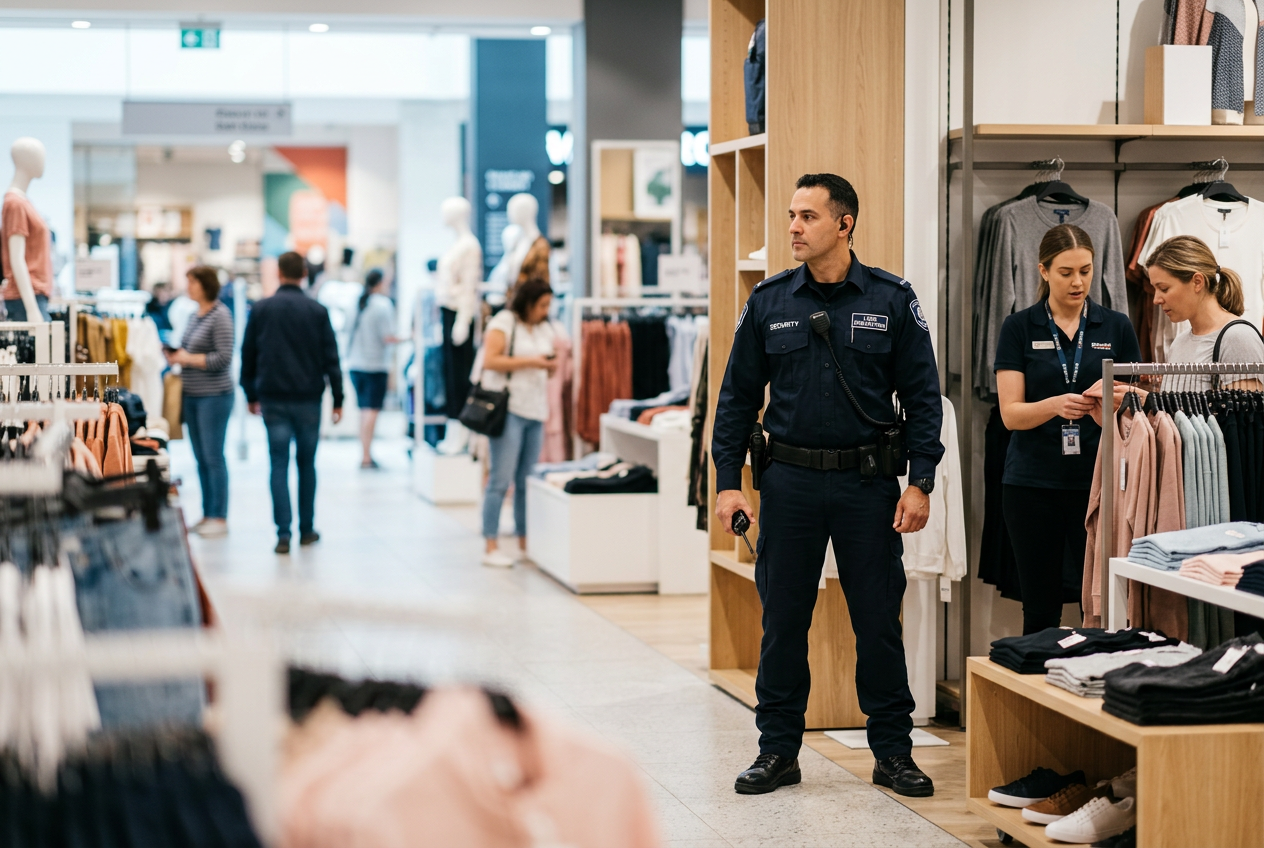
Uniformed security officers serve primarily as deterrents. Their visible presence deters opportunistic theft and gives customers a sense of safety. They're ideal for entrance monitoring, receipt checking, and incident response after detection.
Plainclothes agents operate differently, blending with shoppers to observe suspicious behavior undetected. They're particularly effective against organized theft groups who scout stores before striking.
Cascadia Global Security deploys both uniformed and plainclothes personnel based on client-specific threat assessments, recognizing that most retailers benefit from a combined approach rather than relying on a single strategy.
De-escalation Training and Conflict Resolution
Physical confrontations create liability exposure and negative publicity regardless of the outcome. Professional security staff receive extensive de-escalation training, learning to defuse tense situations through verbal techniques and body language rather than physical intervention.
This training proves especially valuable during apprehensions, where emotions run high, and suspects may react unpredictably. Guards who can calmly communicate consequences while maintaining control of situations reduce the severity of incidents and protect both the retailer and themselves from legal complications.
The Role of Floor Walkers in Active Deterrence
Floor walkers occupy a middle ground between uniformed guards and plainclothes agents. They move throughout the sales floor, engaging with customers while maintaining
surveillance. Their presence signals attentiveness without the intimidation factor of uniformed officers.
Effective floor walkers develop pattern recognition skills, identifying the behavioral cues that precede theft attempts. They position themselves near high-value merchandise during peak theft periods and relay observations to other team members via discreet radio contact.
Technology Integration in Modern Loss Prevention
Human security personnel work most effectively when supported by technology that extends their capabilities. The best systems multiply the effectiveness of each guard rather than entirely replace human judgment.
Leveraging AI-Powered Surveillance and CCTV
Modern video analytics can automatically identify suspicious behavior, alerting security staff to potential incidents in real time. These systems track loitering near high-value displays, detect concealment motions, and flag known offenders through facial recognition or other biometric analysis, subject to applicable privacy and data protection laws.
The technology serves as a force multiplier, allowing a smaller security team to monitor larger spaces effectively. AI systems require human oversight for response decisions. The combination of automated detection with trained personnel response creates coverage that neither could achieve alone.
Electronic Article Surveillance (EAS) Systems
EAS tags and sensors remain foundational loss prevention tools. Hard tags on apparel, spider wraps on electronics, and source-tagged merchandise create multiple opportunities for detection before items leave the store.
The key lies in proper implementation. Tags must be applied correctly, sensors calibrated accurately, and staff trained to respond appropriately to alarms. Many retailers invest in EAS hardware but fail to maintain systems or investigate alarms consistently, undermining their investment.
Strategic Staffing Solutions for High-Risk Environments
Security needs fluctuate based on seasons, events, and emerging threat patterns. Static staffing models often leave stores under-protected during high-risk periods while overspending during slower times.
Seasonal Scalability and Event-Based Security
Holiday shopping seasons can see theft rates spike 25–35% above baseline. Black Friday, back-to-school periods, and pre-Christmas weeks require augmented security presence. Retailers need staffing partners who can scale coverage rapidly without sacrificing personnel quality.
Cascadia Global Security provides scalable security solutions that adjust to client needs, whether that means doubling coverage for a major sale event or providing emergency response when threats emerge unexpectedly. This flexibility allows retailers to match security spending with actual risk levels.
Organized Retail Crime (ORC) Task Forces
ORC represents the fastest-growing threat category, with criminal enterprises treating retail theft as a business operation. These groups employ scouts, boosters, and fencing operations to steal and resell merchandise on an industrial scale.
Combating ORC requires coordination between individual store security teams, corporate loss prevention departments, and law enforcement. Dedicated task forces share intelligence across retailers, track repeat offenders, and build cases that support felony or enhanced charges where statutory thresholds are met rather than catch-and-release misdemeanor charges.

Developing a Culture of Compliance and Safety
Loss prevention extends beyond dedicated security personnel. Every employee plays a role in protecting inventory and creating an environment where theft becomes difficult.
Employee Training Programs and Awareness
Staff who understand theft indicators become additional eyes throughout the store. Training programs teach associates to recognize suspicious behavior, use customer service as a deterrent, and report concerns through proper channels.
The goal isn't to transform sales associates into security guards, but rather to create awareness that makes theft harder to carry out undetected. Simple practices like greeting every customer and maintaining organized displays significantly impact shrinkage rates.
Incident Reporting and Data-Driven Security Audits
Every security incident generates data that should inform future decisions. Tracking theft locations, timing patterns, and suspect descriptions reveals vulnerabilities that might otherwise go unaddressed.
Regular audits compare actual shrinkage against industry benchmarks and identify specific problem areas. This data-driven approach allows security resources to target genuine weaknesses rather than relying on assumptions about where losses occur.
Frequently Asked Questions
What is the difference between loss prevention and security guards?
Loss prevention focuses specifically on protecting inventory and reducing shrinkage through detection, deterrence, and apprehension. Security guards may perform broader functions, including access control, emergency response, and customer safety. Many retail security programs combine both roles.
How much do retail loss prevention services typically cost?
Costs vary based on coverage hours, personnel types, and service complexity. Uniformed guards typically range from $20–35 per hour, while specialized plainclothes agents or off-duty law enforcement command higher rates. Most retailers find that prevention costs pay for themselves through reduced shrinkage.
When should retailers consider adding security staffing?
Warning signs include rising shrinkage rates, employee safety concerns, visible theft incidents, or expansion into higher-risk product categories. Seasonal retailers often benefit from temporary security during peak periods, even if year-round coverage isn't justified.
Can security guards legally detain shoplifters?
Merchant privilege laws in most states allow reasonable detention of suspected shoplifters for investigation. However, specific requirements vary by jurisdiction, and improper detention creates significant liability. Professional security personnel receive training on legal apprehension procedures.
How do retailers measure loss prevention program effectiveness?
Key metrics include shrinkage percentage, apprehension rates, incident frequency, and return on security investment. Effective programs track these indicators over time and benchmark against industry standards to evaluate performance.
Future Trends in Retail Asset Protection
The retail loss prevention field continues evolving as both threats and countermeasures grow more sophisticated. Automated checkout systems, RFID and smart shelf technology, and predictive analytics will reshape how retailers protect assets. However, trained security personnel will remain central to any effective program.
Technology identifies threats, but humans make judgment calls about response. The retailers best positioned for the future are those building integrated programs combining professional security staffing with supporting technology and company-wide awareness.
For organizations seeking to strengthen their retail security posture, partnering with experienced professionals makes the difference between reactive firefighting and proactive protection.
Cascadia Global Security offers veteran-owned, locally managed security services tailored to retail environments of all sizes. Reach out to
explore solutions that match your specific operational needs.