Retail Theft Prevention Through Security Services
Josh Harris | March 20, 2026
Retail theft costs American businesses over $121.6 billion annually, a figure that continues climbing as criminal tactics grow more sophisticated. For store owners and operations managers, the question isn't whether theft will occur but how effectively they can minimize losses while maintaining a welcoming shopping environment. Retail theft prevention through security services has emerged as the most reliable approach, combining human judgment with strategic positioning to deter criminals before they act. The difference between stores that hemorrhage inventory and those that maintain healthy margins often comes down to one factor: professional security presence. Unlike passive measures like cameras or sensors alone, trained security personnel adapt in real-time, reading body language, identifying suspicious patterns, and intervening before merchandise walks out the door. This investment pays dividends not just in recovered goods but in employee safety, customer confidence, and operational stability.
The Evolving Landscape of Retail Shrinkage
Shrinkage rates have increased by 19% since 2019, driven by economic pressures, reduced store staffing, and increasingly organized criminal networks. Understanding what you're fighting against shapes how you fight it.
Understanding Internal vs. External Theft
External theft grabs headlines, but internal theft accounts for roughly 28% of retail losses. Employees know blind spots, shift changes, and which managers pay attention. External threats range from opportunistic shoplifters to professional boosters who can clear shelves in under 90 seconds. Effective security strategies address both simultaneously.
Cascadia Global Security trains personnel to monitor customer and employee behavior without creating a hostile atmosphere, recognizing that most workers and shoppers are honest.
Impact of Organized Retail Crime (ORC)
ORC represents a different threat entirely. These aren't individuals pocketing merchandise for personal use. They're coordinated teams targeting specific high-value items for resale through online marketplaces or black markets. A single ORC hit can cost a retailer tens of thousands of dollars in minutes. These groups scout locations, identify security gaps, and execute with military precision. Standard loss prevention measures designed for casual shoplifters prove inadequate against this level of organization.
On-Site Security Personnel as a Visible Deterrent
The presence of professional security changes behavior before any confrontation occurs. Studies consistently show that visible security reduces theft attempts by approximately 40–60% in retail environments.
Uniformed Guards vs. Undercover Loss Prevention
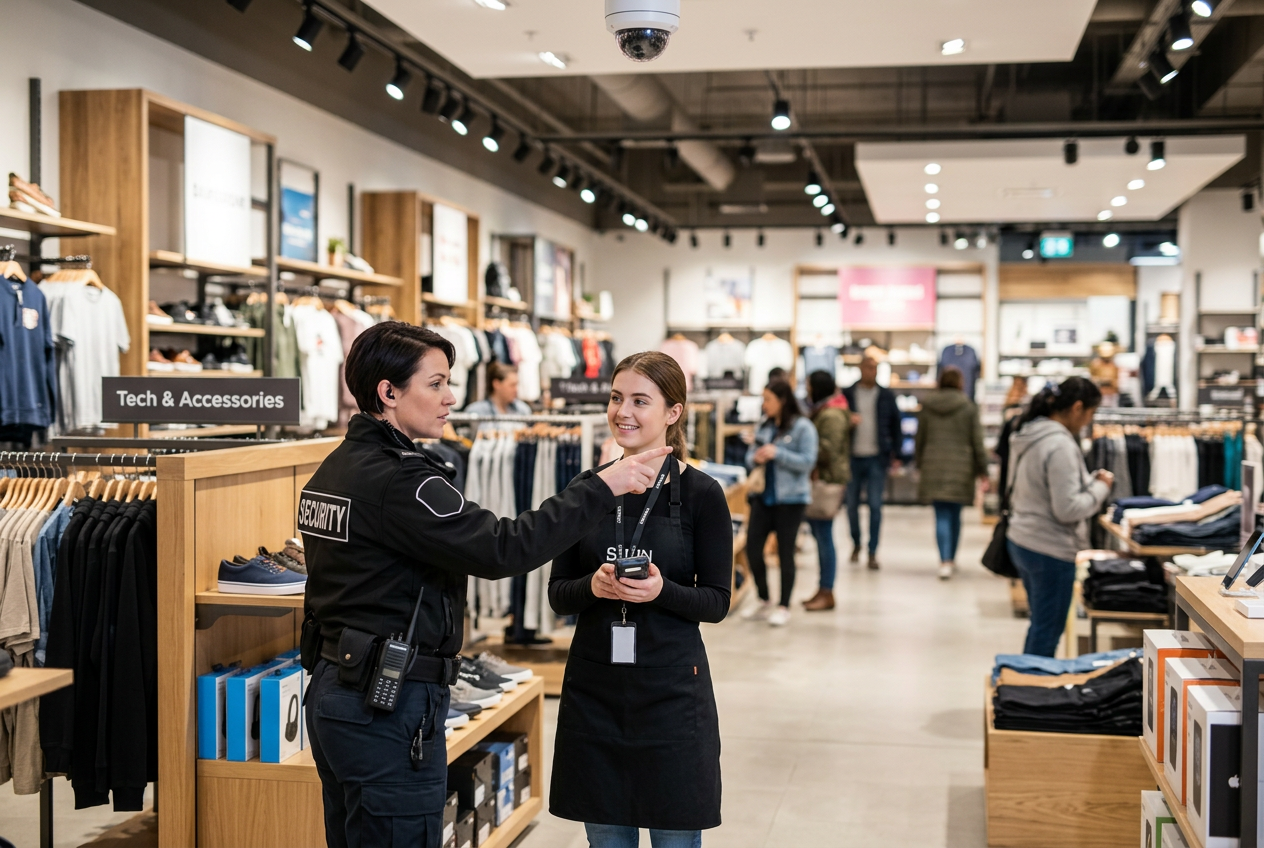
Uniformed guards serve primarily as deterrents. Their visibility signals that a store takes security seriously, discouraging casual theft and making organized crews reconsider their target selection. Undercover loss prevention officers serve a different function: detection and apprehension. They blend in with shoppers, observe concealment attempts, and build cases for prosecution. Most effective retail security programs deploy both approaches. Uniformed personnel at entrances and high-traffic areas create the deterrent effect, while plainclothes officers work the floor to catch those who proceed despite visible security.
De-escalation and Conflict Resolution Strategies
Apprehending shoplifters carries risks. Confrontations can escalate quickly, endangering employees, customers, and the suspects themselves. Professional security personnel receive extensive training in verbal de-escalation, recognizing when situations are becoming volatile, and knowing when apprehension isn't worth the liability risk. A trained guard understands that a minor theft incident isn't worth a physical altercation that could result in injury lawsuits costing thousands. This judgment call, knowing when to engage and when to document and release, separates professional security from untrained staff attempting loss prevention.
Integrating Technology with Professional Security Services
Technology amplifies human capabilities rather than replacing them. The most effective loss prevention programs combine trained personnel with supporting systems.
Remote Video Monitoring and Virtual Guarding
Remote video monitoring allows security professionals to watch multiple locations simultaneously from a central command center. When suspicious activity is detected, they can issue audio warnings through speakers, contact on-site personnel, or dispatch response teams. This approach extends coverage without proportionally increasing costs. A single remote monitoring specialist can oversee multiple sites, alerting local guards only when intervention is needed. For retailers with multiple sites, this creates consistent security coverage that would be cost-prohibitive with traditional staffing alone.
Access Control and Electronic Article Surveillance (EAS)
EAS systems, the tags that trigger alarms at exits, remain valuable but require human response to be effective. Without security personnel positioned to respond, alarms become background noise that thieves learn to ignore. Access control systems restrict employee movement to authorized areas, reducing opportunities for internal theft. When integrated with security personnel who enforce protocols and investigate violations, these systems create layered protection that addresses multiple threat vectors simultaneously.
Developing a Comprehensive Loss Prevention Strategy
Effective theft prevention requires systematic planning rather than reactive measures. The retailers achieving the best results approach security as an ongoing program, not a one-time installation.
Conducting Regular Security Audits and Risk Assessments
Security needs to change. New product lines, seasonal fluctuations, staffing changes, and neighborhood developments all affect risk profiles. Quarterly security audits identify emerging vulnerabilities before criminals exploit them.
Cascadia Global Security provides comprehensive risk assessments that examine physical layout, current procedures, employee practices, and external factors. These assessments often reveal simple fixes, such as repositioning displays or adjusting lighting, that significantly reduce opportunities for theft without major investment.
Employee Training and Security Awareness Programs
Employees witness theft attempts daily, but without training, they often don't recognize them or know how to respond appropriately. Security awareness programs teach staff to identify concealment behaviors, recognize return fraud patterns, and report suspicious activity through proper channels. Training also covers what employees shouldn't do: chasing suspects, physically confronting thieves, or putting themselves at risk. Clear protocols protect both the business and its workers while ensuring consistent responses across all shifts and locations.
Measuring ROI on Professional Security Investments
Security spending must justify itself through measurable results. The most straightforward metric is shrinkage reduction: comparing inventory loss percentages before and after implementing professional security services. Beyond direct theft prevention, security investments generate returns through reduced employee turnover in high-crime locations, decreased workers' compensation claims from confrontation injuries, lower insurance premiums, and improved customer experience scores. A store where customers feel safe generates more revenue than one where they rush through their shopping.
Frequently Asked Questions
How much does professional retail security cost?
Costs vary based on coverage hours, guard qualifications, and service complexity. Basic uniformed guard services typically range from $25–45 per hour, while armed guards or off-duty law enforcement command higher rates. Most retailers find that security costs represent 2–4% of revenue, offset by shrinkage reductions of 20–40%.
Should retail stores use armed or unarmed security guards?
Most retail environments are best served by unarmed guards, who provide deterrence without risking escalation. Armed security makes sense for high-value retailers such as jewelry stores, pharmacies that handle controlled substances, or locations in high-crime areas where the risk of robbery is elevated.
How quickly can professional security reduce theft?
A visible security presence typically shows a measurable impact within 60–90 days. Full program maturation, including employee training integration and procedure refinement, takes 4–8 months to achieve optimal results.
What should retailers look for when hiring security services?
Prioritize providers with retail-specific experience, comprehensive training programs, liability insurance, and local management presence. Ask about guard retention rates, as high turnover indicates poor training and inconsistent service quality.
Protecting Your Bottom Line
Retail theft prevention through security services represents a strategic investment rather than an expense. The retailers achieving the best loss prevention outcomes combine trained personnel, supporting technology, and systematic procedures into cohesive programs that adapt as threats evolve. Partnering with experienced security providers ensures access to trained professionals who understand retail-specific challenges.
Cascadia Global Security offers veteran-owned, locally managed security solutions designed for retail environments, delivering the deterrence, detection, and response capabilities that protect inventory and create safer shopping experiences.