Security Services Available Across New Jersey

POST AUTHOR | POST PUBLISH DATE

New Jersey's unique position between New York City and Philadelphia creates security challenges found nowhere else in the country. With over 9.3 million residents packed into the nation's most densely populated state, protecting people and property demands expertise that accounts for everything from Newark's bustling commercial corridors to the quiet residential communities along the Shore. The range of security services available across New Jersey reflects this diversity, offering solutions tailored to urban high-rises, suburban office parks, industrial facilities, and everything in between.

What makes the Garden State's security landscape particularly complex is the intersection of high-value commercial real estate, critical transportation infrastructure, and residential communities that expect both safety and discretion. A warehouse in Edison faces different threats than a corporate headquarters in Jersey City, yet both require professional protection that understands local conditions. The state's proximity to major metropolitan areas also means security providers must stay current with evolving threats that often originate in neighboring urban centers before spreading across the region.


Overview of New Jersey's Security Landscape


New Jersey's security industry operates within a framework shaped by population density, regulatory requirements, and the state's role as a logistics hub for the entire Northeast corridor.


Meeting High-Density Urban Security Needs


Urban areas like Newark, Jersey City, and Paterson present concentrated security challenges that require specialized approaches. High foot traffic, mixed-use developments, and 24-hour commercial activity mean security teams must manage access control while maintaining welcoming environments for legitimate visitors. The density also creates response-time advantages, allowing security personnel to cover multiple sites within tight geographic areas.

Transit hubs add another layer of complexity. Newark Liberty International Airport, major NJ Transit stations, and the Port Newark-Elizabeth Marine Terminal all generate surrounding commercial zones that need protection calibrated to constant movement and diverse populations.


Compliance with State Licensing and Regulations


New Jersey maintains strict licensing requirements for security personnel through the
Security Officer Registration Act (SORA). All security officers must complete state-mandated training, pass background checks, and maintain current registration. New Jersey's security guard regulations are stringent, with armed guards subject to requirements that exceed those of many neighboring states. These include a firearms qualification and psychological screening, typically mandated by the employer rather than state law. For businesses, this compliance complexity is managed by reputable security providers who ensure all personnel meet or exceed state standards. Ultimately, this rigorous regulatory framework benefits businesses by setting a baseline of competence that helps eliminate substandard operators.


Residential Security Solutions for NJ Communities


Residential security in New Jersey ranges from individual home monitoring to comprehensive community protection programs that serve thousands of households.


Gated Community and HOA Guard Services


Gated communities throughout Bergen, Morris, and Monmouth counties rely on professional guard services to control access and maintain community standards. Effective gate security goes beyond ID checks; it includes vendor verification, visitor logging, and patrol services that deter property crime before it occurs.

Cascadia Global Security provides trained personnel who understand the balance between security and hospitality that residential communities require. Guards serve as the community's first impression while maintaining vigilant access control protocols.


Smart Home Monitoring and Alarm Systems


Modern residential security integrates traditional alarm systems with smart home technology. Video doorbells, motion-activated cameras, and app-based monitoring give homeowners visibility into their properties from anywhere. When paired with professional monitoring services, these systems ensure rapid response to verified threats.

The key is integration. Standalone devices create notification fatigue; professionally designed systems filter false alarms and escalate genuine concerns to the appropriate response, whether that's local police, fire services, or private security patrol.


Commercial and Industrial Protection


Commercial security represents the largest segment of professional security services across New Jersey, with solutions scaled to protect everything from small retail shops to sprawling distribution centers.


Corporate Office and High-Rise Security


Corporate environments require security that protects assets and personnel while projecting professionalism. Lobby security officers manage visitor access, monitor deliveries, and serve as emergency coordinators during building evacuations or other incidents. In multi-tenant buildings, security teams coordinate with property management to enforce building-wide policies while accommodating individual tenant needs.

High-rise buildings present vertical security challenges, with fire safety, elevator access control, and stairwell monitoring all requiring specialized protocols.


Warehouse and Supply Chain Asset Protection


New Jersey's position as a logistics hub means warehouses and distribution centers dot the landscape from Exit 8A to the Meadowlands. These facilities face threats, including cargo theft, internal shrinkage, and unauthorized access to high-value inventory.

Effective warehouse security combines perimeter protection, access control at loading docks, and interior monitoring that tracks both personnel and inventory movement. Many facilities now integrate security personnel with loss prevention technology, using video analytics to flag suspicious patterns before losses occur.


Retail Loss Prevention and Mall Security


Retail security in New Jersey addresses both external theft and internal shrinkage, which industry data suggests accounts for nearly 36% of retail losses. Mall security teams manage common areas, respond to merchant calls, and coordinate with local law enforcement on organized retail crime investigations.

Individual retailers benefit from loss-prevention specialists who blend into the shopping environment while monitoring for indicators of theft. The goal is deterrence through presence and rapid response when incidents occur.


Specialized Security Personnel and Services


Beyond standard guard services, specialized security personnel address specific threat profiles and client requirements.


Armed vs. Unarmed Guard Options


The decision between armed and unarmed security depends on threat assessment, client preference, and site-specific factors. Armed guards provide enhanced deterrence and response capabilities in high-risk environments such as financial institutions, jewelry stores, and facilities handling controlled substances. New Jersey's strict firearms regulations mean armed personnel undergo extensive vetting and training.

Unarmed guards suit most commercial and residential applications, providing professional presence and observation without the liability considerations of armed response. Cascadia Global Security offers both options, helping clients select the appropriate level of protection based on realistic threat analysis rather than assumptions.


Executive Protection and VIP Escorts


Corporate executives, celebrities, and high-net-worth individuals traveling through New Jersey often require personal protection services. Executive protection goes beyond physical security to include advance work, route planning, and coordination with venue security at destinations.

Off-duty and former law enforcement officers bring valuable experience to executive protection assignments, combining tactical training with the judgment developed through years of real-world encounters.


Event Security for NJ Venues and Festivals


From MetLife Stadium concerts to community festivals, event security requires planning that scales with crowd size and event type. Effective event security begins weeks before doors open, with site surveys, staffing calculations, and coordination with local emergency services.

During events, security teams manage access points, monitor crowd dynamics, and position response personnel to address incidents before they escalate. Post-event security ensures safe egress and protects venue assets during breakdown.


Advanced Surveillance and Technology Integration


Technology increasingly augments human security personnel, extending coverage and providing documentation that supports incident investigation.


CCTV Installation and Remote Monitoring


Modern surveillance systems capture high-definition video that's useful for both real-time monitoring and post-incident review. Camera placement matters as much as camera quality; professional installation ensures coverage of critical areas without blind spots that sophisticated criminals exploit.

Remote monitoring services enable trained operators to monitor multiple sites simultaneously and dispatch on-site personnel or law enforcement when cameras detect suspicious activity. This approach multiplies the effectiveness of physical security teams.


Biometric Access Control Systems


Biometric systems using fingerprint, facial recognition, or iris scanning provide access control that can't be defeated by stolen credentials. These systems integrate with time-and-attendance tracking, creating audit trails that document exactly who accessed restricted areas and when.

Implementation requires careful attention to privacy regulations and employee communication. When deployed thoughtfully, biometric access control eliminates the security gaps created by shared access cards or forgotten PINs.


Selecting the Right Security Partner in the Garden State


Choosing among security services available across New Jersey requires evaluating providers against specific criteria. Licensing compliance should be verified directly with the state, not taken at face value. Insurance coverage must match the scope of services provided. References from similar clients reveal how providers perform under real-world conditions.

Local management matters significantly. Security challenges in Hoboken differ from those in Cherry Hill, and providers with regional knowledge respond more effectively than national firms managing New Jersey from distant headquarters. Cascadia Global Security combines national resources with local management teams who understand the specific security landscape of the communities they serve.
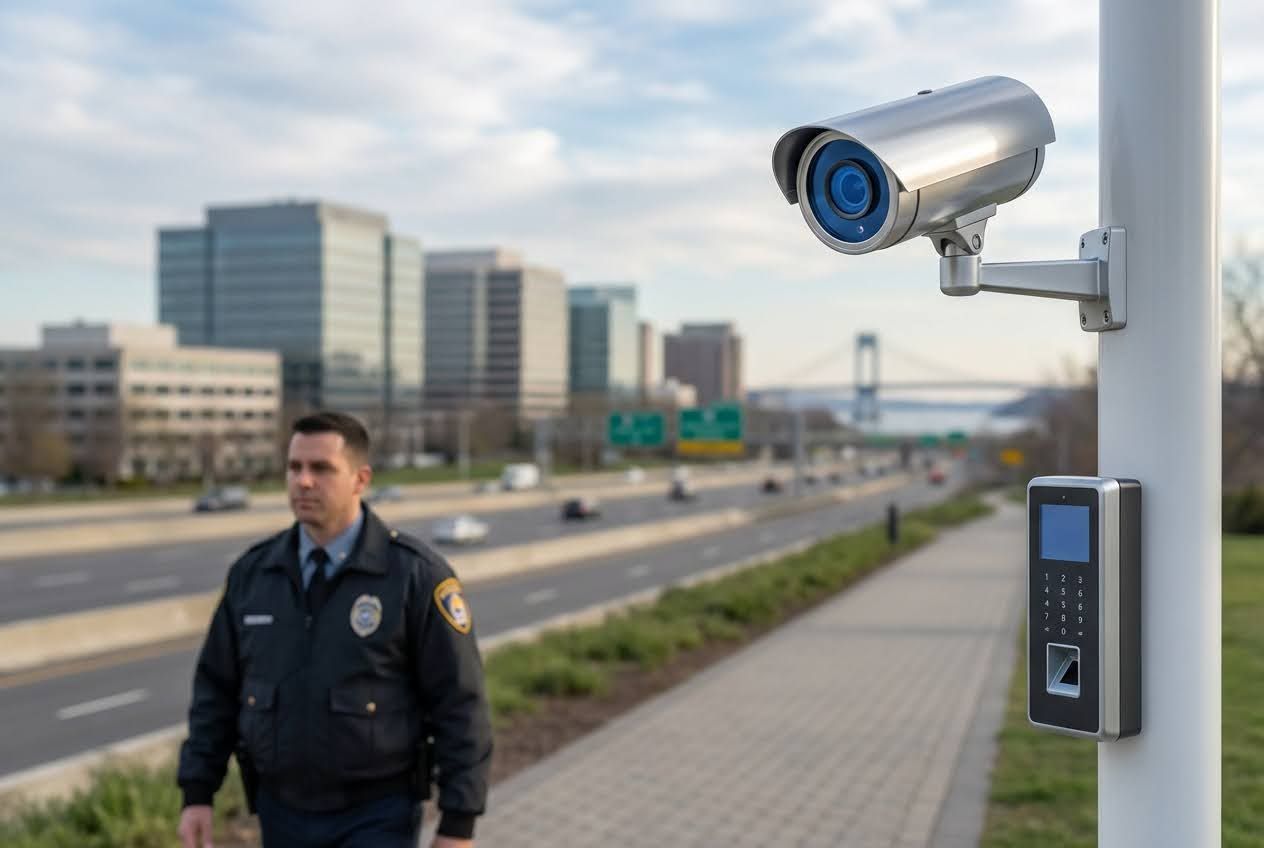
Security camera and biometric keypad on a pole, with a blurred security guard walking by a highway and buildings.

Frequently Asked Questions


What licensing do security guards need in New Jersey?


In New Jersey, all security officers are required to register under the Security Officer Registration Act (SORA), which includes mandatory state training and background checks. While armed guards must also complete additional firearms training and qualification as set by the
New Jersey State Police, a psychological evaluation is not required for this role.


How much does commercial security cost in New Jersey?


Rates vary by service type, required hours, and whether armed or unarmed personnel are needed. Most commercial guard services range from $23 to $ 45 per hour, with armed guards and specialized services commanding premium rates.


Can security guards make arrests in New Jersey?


Security officers have the same authority to make a citizen's arrest as any private citizen. They cannot exercise police powers, but may detain individuals for serious crimes until law enforcement arrives.


What's the difference between security guards and off-duty police?


Off-duty law enforcement officers retain their arrest powers and authority while working private security assignments. This provides enhanced legal standing and often superior tactical training for high-risk applications.


How quickly can security services be deployed for emergencies?


Reputable providers maintain rapid-response capabilities for emergency coverage, often deploying personnel within 12–24 hours for urgent situations such as construction site theft or temporary event security.


Finding Your Security Solution


The right security partner understands that protection isn't one-size-fits-all. Whether you need a single guard for weekend coverage or a comprehensive security program spanning multiple New Jersey locations, the foundation remains the same: trained personnel, clear protocols, and responsive management.

For businesses seeking a veteran-owned security firm with proven expertise across the Garden State, Cascadia Global Security offers professional guard services and off-duty law enforcement personnel tailored to your specific requirements. Contact their team to discuss how their locally managed approach can address your security challenges.

By Josh Harris March 10, 2026
Defining the Role of Rapid Response Security A standard security guard monitors cameras and checks badges. A rapid response security team operates differently: they deploy within minutes when situations escalate beyond normal protocols. Understanding when to call a rapid response security team can mean the difference between a contained incident and a full-scale crisis. These specialized units exist for one purpose: immediate intervention when standard security measures prove insufficient. They're trained for high-pressure scenarios, equipped for physical confrontation, and authorized to take decisive action. Most organizations never need them. But those who do often discover the need comes without warning. The critical question isn't whether your facility might face a serious threat. The question is whether you've established clear protocols for recognizing when that threshold has been crossed, and who to contact when it has. Differences Between Standard Guarding and Rapid Response Standard security guards excel at deterring, observing, and enforcing routine. They manage access points, document incidents, and maintain a visible presence that discourages opportunistic crime. Their training emphasizes de-escalation and communication. Rapid response teams train for scenarios where de-escalation has failed or isn't possible. They carry different equipment, operate under different rules of engagement, and possess specialized training in threat neutralization. Where a guard's job is to prevent problems, a response team's job is to end them. Capabilities of High-Threat Intervention Teams Rapid Response Security Teams are typically composed of personnel with backgrounds in the military or law enforcement. For instance, Cascadia Global Security utilizes teams that include former and off-duty law enforcement officers. This composition offers greater tactical expertise; however, it's important to note that when off duty, their legal authority is limited to that of a licensed private security officer. Response teams can establish perimeter control, conduct coordinated building sweeps, provide armed escort for evacuations, and interface directly with arriving law enforcement. Their training covers active shooter response, hostage situations, and coordinated threat suppression. Immediate Physical Threats and Security Breaches Some situations demand immediate professional intervention. Recognizing these scenarios in advance allows a faster response when seconds matter. Unauthorized Intrusion and Perimeter Violations Not every trespasser requires armed response. A confused delivery driver at the wrong entrance is a standard security matter. But certain intrusion patterns signal serious intent. Call for a rapid response when intruders: Bypass multiple security layers deliberately Ignore verbal commands and continue advancing Display weapons or make explicit threats Arrive in coordinated groups targeting specific areas Demonstrate knowledge of facility layout or security gaps The distinction matters. Professional intruders conduct reconnaissance. They know where the cameras point and when shifts change. When someone breaches your perimeter with evident preparation, standard guards are outmatched. Active Workplace Violence or Hostile Confrontations Workplace violence incidents escalate in seconds. The moment a verbal confrontation involves weapons, physical assault, or credible death threats, rapid response protocols should activate. Warning signs that warrant immediate escalation include an individual barricading themselves with hostages, multiple aggressors acting in coordination, any firearm or edged weapon display, and situations where standard security personnel are injured or pinned down. Don't wait to confirm the severity. False alarms cost money. Delayed responses cost lives. High-Value Asset Protection During Emergencies Emergencies create opportunities for theft. Power outages disable alarm systems. Natural disasters overwhelm first responders. Civil unrest diverts police attention. Criminals exploit these windows. Responding to Large-Scale Theft or Looting Risks The civil unrest of 2020 resulted in substantial financial damage nationwide, with retail losses exceeding $1.5 billion, according to the Insurance Information Institute. A key finding is that while the majority of affected businesses had conventional security measures, very few had an established rapid response plan. Triggers for immediate deployment include confirmed looting at nearby businesses, loss of primary alarm or surveillance systems, credible intelligence of organized theft targeting your location, and any announcement by local law enforcement of delayed response times. Rapid response teams can establish a visible armed presence, secure high-value inventory for emergency relocation, and maintain perimeter integrity until normal operations resume. Securing Critical Infrastructure After System Failures Data centers, manufacturing facilities, and utility installations face unique vulnerabilities during system failures. When backup power fails or security systems go offline, these facilities become attractive targets. Cascadia Global Security provides emergency and short-term security coverage specifically for these scenarios, deploying trained personnel to maintain physical security while technical teams restore systems. Civil Unrest and Crowd Control Scenarios Protests and demonstrations present complex security challenges. Most remain peaceful. Some don't. The transition often happens rapidly. Managing Escalating Protests and Demonstrations Calling a rapid response for a peaceful protest is both unnecessary and counterproductive. Visible armed security can escalate tensions. The key is recognizing genuine escalation patterns. Indicators that warrant response team deployment: Protesters begin targeting your specific facility Property destruction begins at your location or in your immediate vicinity The crowd attempts to breach the facility entrances Standard security personnel report being overwhelmed Local law enforcement indicates they cannot respond Response teams trained in crowd management understand the balance between protecting assets and avoiding provocation. They establish defensive positions, secure entry points, and provide evacuation support without aggressive posturing that might worsen the situation. Executive and Personnel Safety During Travel Business travel exposes personnel to risks that office-based security cannot address. International operations in unstable regions require specialized protection protocols. Extraction Protocols in Unstable Environments Political instability, natural disasters, and regional conflicts can strand personnel in dangerous locations. Standard corporate travel policies assume functioning infrastructure and responsive emergency services. Rapid response becomes necessary when local conditions deteriorate suddenly, transportation infrastructure fails, personnel face targeted threats, or embassy or consular services become unavailable. Professional extraction teams coordinate with local contacts, arrange secure transportation, and maintain communication with corporate headquarters throughout the operation. They operate where local security services cannot or will not respond. Integrating Rapid Response into Your Emergency Plan Having access to rapid response services means nothing without clear activation protocols. Too many organizations establish contracts but never define when they take effect. Establishing Clear Triggers for Deployment Vague guidelines like "call when necessary" guarantee hesitation during actual emergencies. Specific triggers eliminate decision paralysis. Effective trigger definitions specify exact scenarios requiring response, authorize specific personnel to make the call, establish backup authorization chains, and include time-based escalation protocols. Example: "If facility alarm indicates breach in Zones A-C after hours and on-site guard cannot verify cause within 3 minutes, Security Director or designated backup authorizes rapid response deployment." This specificity ensures a consistent response regardless of which personnel are on duty at the time of an incident. Communication Channels with Response Units Response teams need accurate information to deploy effectively. Establish dedicated communication channels that remain functional during emergencies. Primary channels should include direct phone lines to response coordinators, backup satellite or radio communication, pre-shared facility maps and access codes, and designated meeting points for team arrival. Test these channels quarterly. Systems that work during normal operations sometimes fail under crisis conditions. Cascadia Global Security maintains centralized oversight to ensure reliable communication during emergency deployments.
By Josh Harris March 10, 2026
Security guards don't always need to carry firearms to protect your property effectively. For many businesses, unarmed security personnel provide the ideal balance of visible deterrence, customer service, and cost efficiency. Understanding when unarmed security companies are the right fit for your specific situation can save thousands in unnecessary expenses while still maintaining a safe environment. The decision between armed and unarmed protection isn't about choosing less security. It's about matching your security posture to your actual risk profile. A retail store in a suburban shopping center faces fundamentally different threats than a jewelry exchange in a high-crime district. Hiring armed guards for the former is a waste of money and can create an uncomfortable atmosphere for customers. The wrong choice in either direction leaves you either over-protected and over-budget, or dangerously exposed. Data from the Bureau of Labor Statistics show that approximately 70% of security guard positions in the United States are unarmed. This isn't because businesses are cutting corners. It reflects a practical reality: most security situations require observation, communication, and presence rather than the threat of lethal force. When you understand the specific strengths of unarmed security and where these professionals excel, you can make informed decisions that protect both your assets and your bottom line. Defining the Role of Unarmed Security Personnel Unarmed security officers serve as the first line of defense for properties where the primary threats involve trespassing, theft, vandalism, or unauthorized access rather than violent confrontation. Their effectiveness comes from visibility, training, and the ability to respond appropriately to developing situations before they escalate. Core Responsibilities and Training Standards Professional unarmed guards undergo comprehensive training that covers access control procedures, emergency response protocols, conflict resolution, and detailed reporting. State licensing requirements vary, but reputable companies go beyond minimum standards by providing ongoing education in areas such as fire safety, first aid, and customer service. The typical responsibilities include monitoring surveillance systems, conducting regular patrols, verifying credentials at entry points, and documenting incidents. Guards also serve as the primary contact for emergency services, ensuring that police, fire, or medical responders receive accurate information upon arrival. Cascadia Global Security trains personnel in these core competencies while emphasizing the communication skills that distinguish professional security from simple watchman services. The Psychological Advantage of a Non-Threatening Presence A uniformed guard creates what security professionals call "natural surveillance," the awareness among potential wrongdoers that their actions are being observed. This deterrent effect works regardless of whether the guard carries a weapon. Research in environmental criminology consistently demonstrates that visible security presence reduces opportunistic crime. The key insight is that most property crimes are crimes of opportunity. Shoplifters, vandals, and trespassers typically avoid locations with obvious security. An unarmed guard in a professional uniform achieves this deterrent effect while maintaining an approachable demeanor that doesn't alienate legitimate visitors or customers. Key Environments Where Unarmed Security Excels Certain settings benefit specifically from unarmed security due to their operational requirements, customer demographics, or risk profiles. Matching security type to environment maximizes both protection and return on investment. Retail and Commercial Customer Service Roles Retail environments present a unique challenge: security must deter theft while creating a welcoming atmosphere for paying customers. Armed guards can intimidate shoppers and create an uncomfortable environment, hurting sales. Unarmed officers trained in loss prevention techniques observe customer behavior, monitor fitting rooms and high-theft areas, and intervene appropriately when they spot suspicious activity. They greet customers, answer questions, and assist with directions, blending security functions with customer service. This dual role makes them valuable assets rather than pure overhead costs. Residential Communities and Gated Access Control Homeowners' associations and apartment complexes require security that balances protection with community relations. Residents want to feel safe, not surveilled. Armed guards at a residential gate create an atmosphere more appropriate for a military installation than a family neighborhood. Unarmed officers handle visitor verification, package acceptance, patrol common areas, and respond to noise complaints or minor disputes. They become familiar faces who know the residents, creating a sense of community while maintaining security protocols. Corporate Offices and Low-Risk Event Management Office buildings and corporate campuses need security for access control, visitor management, and after-hours protection. The primary threats involve unauthorized entry, workplace violence prevention through early intervention, and protection of sensitive information rather than armed robbery. Conference security, trade shows, and corporate events similarly benefit from unarmed personnel who can manage crowds, check credentials, and respond to medical emergencies without the liability concerns that accompany armed guards at gatherings. Evaluating the Benefits: Cost-Effectiveness and Liability Financial considerations often drive security decisions, and unarmed services offer significant advantages in both direct costs and risk management. Reduced Insurance Premiums and Legal Risks Armed security introduces substantial liability exposure. Any incident involving a firearm, whether a discharge, threat, or even improper display, can result in lawsuits naming both the security company and the client's business. Insurance premiums for armed guard services typically run 20–35% higher than unarmed equivalents. The legal standard for armed response is also more stringent. Courts scrutinize armed interventions more carefully, and the consequences of mistakes are severe. Unarmed guards face lower liability thresholds because their response options don't include lethal force. Budget-Friendly Security Scalability Unarmed officers cost less per hour, allowing businesses to deploy more coverage with the same budget. A company that can afford one armed guard for eight hours might instead employ two unarmed officers for overlapping shifts, providing 16 hours of coverage. This scalability matters particularly for businesses with variable security needs. Cascadia Global Security works with clients to develop flexible staffing models that increase coverage during high-risk periods without the premium costs associated with armed personnel. When to Choose Unarmed Over Armed Guards The decision requires an honest assessment of your actual security environment rather than assumptions about what "real" security looks like. Assessing Threat Levels and Crime Statistics Start with data. What crimes occur in your area and at similar businesses? Local police departments provide crime statistics by neighborhood. If your primary concerns involve shoplifting, trespassing, or vandalism rather than armed robbery or violent crime, unarmed security addresses your actual risks. Industry matters too. Banks, jewelry stores, and cannabis dispensaries face different threat profiles than office buildings or apartment complexes. The presence of cash, high-value portable merchandise, or controlled substances changes the calculus. De-escalation vs. Force: Prioritizing Communication Most security incidents are resolved through communication rather than force. A skilled guard who can talk down an agitated person, calmly redirect a trespasser, or defuse a customer dispute provides more practical value than one whose primary qualification is weapons proficiency. Training in verbal de-escalation, crisis intervention, and conflict resolution equips unarmed officers to handle the situations they'll actually encounter. These skills prevent incidents from escalating to the point where armed response would even be considered. Selecting the Right Unarmed Security Partner Not all security companies deliver equivalent service. Due diligence in vendor selection protects your investment and ensures you receive professional protection. Verifying Licensing and Professional Certifications Every state requires security companies and individual guards to hold valid licenses. Request proof of current licensing and verify it independently through your state's regulatory agency. Ask about insurance coverage, including general liability and workers' compensation. Professional certifications from organizations such as ASIS International indicate a commitment to industry standards. Companies that invest in certification demonstrate a serious commitment to their profession. Tailoring Security Plans to Specific Facility Needs Generic security approaches waste money and leave gaps. A qualified provider conducts a thorough assessment of your property, identifies vulnerabilities, and develops customized protocols. Cascadia Global Security emphasizes site-specific planning that addresses your unique operational requirements rather than applying one-size-fits-all solutions. Ask potential providers about their supervision structure, response times for filling shifts, and incident-handling procedures. The answers reveal whether you're dealing with professionals or a company that simply places warm bodies at your door.