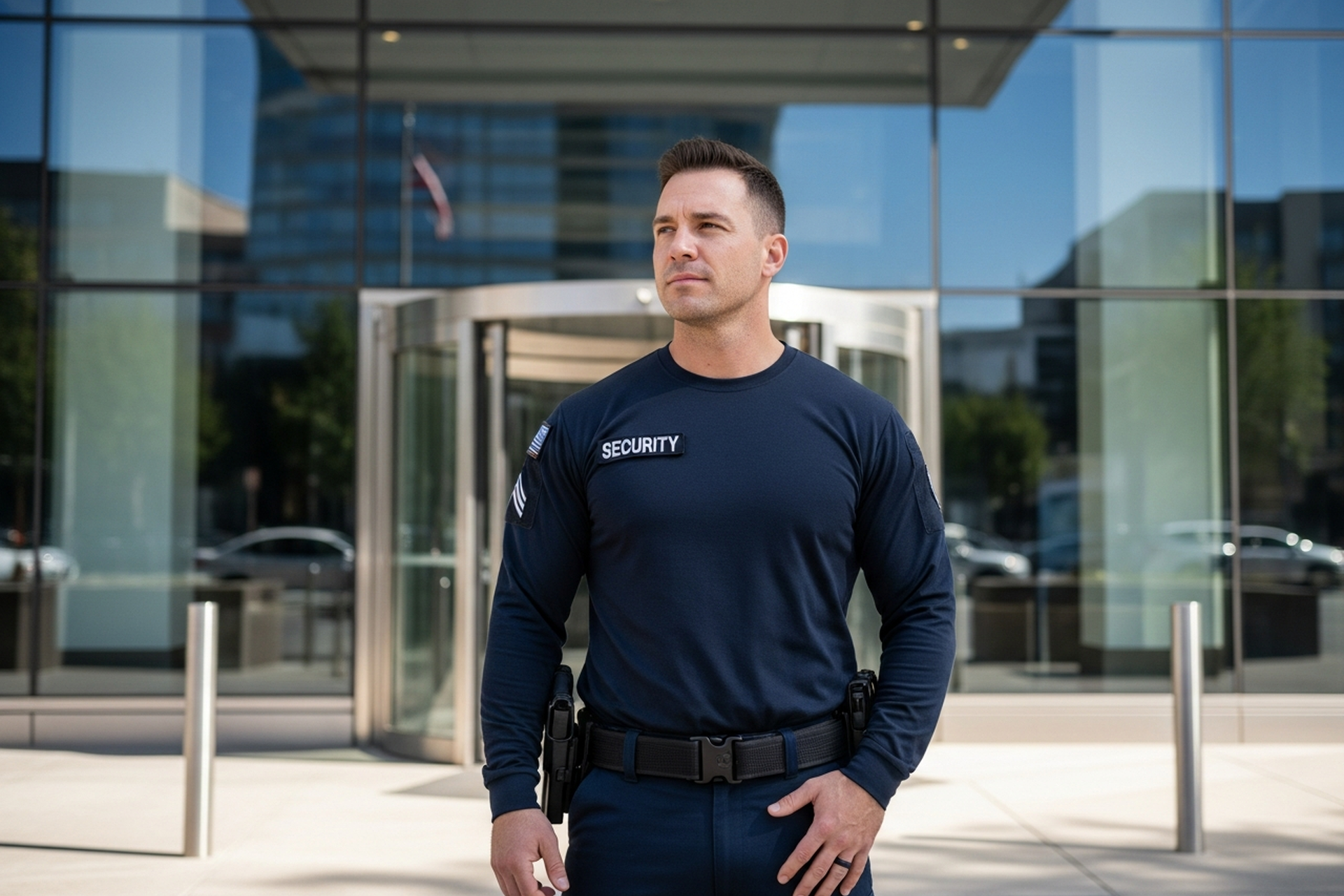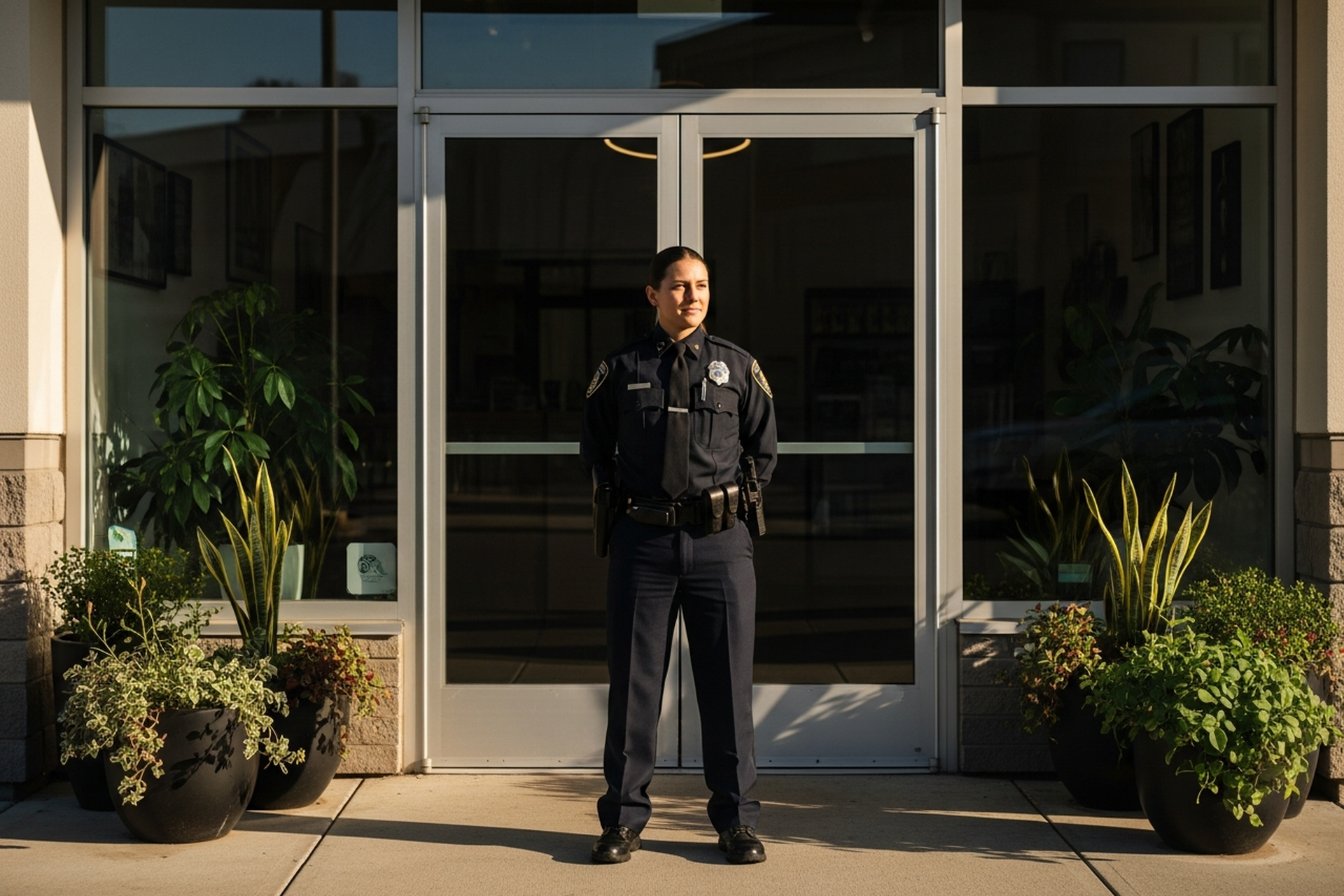
Armed vs Unarmed Guards for Chicago Businesses: How to Choose
Josh Harris | June 27, 2026
The armed vs unarmed guards question is one of the first decisions a Chicago business owner or facility manager faces when starting a security program. The wrong choice in either direction costs you: too little coverage leaves gaps, too much creates unnecessary liability and overhead. This framework covers what security professionals use to make that call based on your property's actual risk profile.
The Default Position: Unarmed Works for Most Chicago Properties
Before mapping out the exceptions, it helps to understand the baseline. The majority of commercial properties in the Chicago market are served effectively by trained, unarmed security officers. This is not a cost-cutting compromise. It is the professionally correct standard for most site types.
Trained unarmed guards handle the work that constitutes 90 percent of what security officers do on any given shift: access control, visitor screening, patrol, incident documentation, emergency response coordination, and de-escalation of everyday conflicts. For properties where the officer's primary value is presence, professionalism, and observation, armed status adds cost and liability without proportionate benefit.
Armed coverage is the exception, not the baseline. The businesses that genuinely need it have specific characteristics that justify it.
Six Questions for Choosing Armed vs Unarmed Guards in Chicago
Running through these questions in order gives you a structured way to assess your site. No single answer determines the outcome. The pattern across all six tells you where you land.
1. What Is the Threat Profile?
Cash-intensive operations, high-value portable inventory, and businesses that handle controlled substances present fundamentally different threat profiles from those of office buildings or residential properties. A jewelry store with six-figure inventory on display, a cannabis dispensary managing daily cash deposits, or a check-cashing business operating through the evening are attractive targets for robberies that are planned in advance. Those threat profiles support armed coverage.
General commercial properties, including most office buildings, mid-market retail, and multifamily residential, face opportunistic property crime rather than targeted robbery attempts. That threat profile responds well to unarmed deterrence and mobile patrol.
2. What Is the Property Type?
Certain property categories have established norms for guard type that reflect decades of incident patterns:
Properties typically served by unarmed guards:
- Corporate and commercial office lobbies
- Multifamily residential concierge posts
- Hotel front desks and lobby areas
- Healthcare facilities (most public-area coverage)
- Mid-market retail floor coverage
- Warehouse and distribution centers
- Parking lot and construction site patrol
Properties where armed coverage is commonly warranted:
- Licensed cannabis dispensaries
- Banks, credit unions, and check-cashing locations
- Jewelry stores and high-value luxury retail
- Pharmaceutical distribution with controlled substances
- Executive floors and cash rooms at high-volume operations
- Facilities with specific active threat histories
3. What Is the Historical Incident Pattern?
Your own incident log is the most direct evidence. If your property has documented robberies, aggravated assaults, or firearm incidents in the past three years, that record argues for escalating from unarmed to armed or adding off-duty law enforcement support. Properties with no history of targeted violent crime, even those in higher-crime neighborhoods, frequently find that a visible, professional unarmed presence provides adequate deterrence.
Ask any credible security provider what their site assessment process looks like. If they quote you an armed program without reviewing your incident history, ask why.
4. What Does Your Insurance Carrier Require?
Some commercial insurers impose specific requirements on businesses that hold high-value inventory, operate in certain industries, or carry specific types of coverage. A pharmaceutical facility with a controlled-substance endorsement may include carrier language specifying armed coverage at certain access points. A cannabis dispensary's policy may require documented armed officer presence as a condition of coverage.
Insurance Information Institute data on commercial property and liability insurance consistently shows that risk classification drives coverage terms. Before finalizing any security program, confirm with your broker or risk manager whether your policy includes security specifications. Discovering a carrier requirement after you have deployed an unarmed-only program creates an insurance gap that may not surface until a claim.
5. What Is Local PD Response Time at Your Site?
This is a practical factor that security consultants consider, but business owners often overlook. In dense urban areas like the Loop or River North, CPD response times to business alarms are generally shorter than in more dispersed suburban or industrial areas. In locations where law enforcement response takes ten or more minutes, the calculus for on-site security coverage shifts. A property in a more remote industrial corridor with a documented theft pattern and slow police response has stronger grounds for armed presence than a downtown Loop office with a two-minute average CPD response.
6. What Is the Visitor and Customer Profile?
A lobby or environment that is primarily public-facing, with high foot traffic and a hospitality component (e.g., a hotel, medical office, or corporate campus), calls for officers who project approachability and professionalism. Armed status at those posts frequently creates friction that outweighs any deterrence benefit. Controlled-access environments, restricted facilities, and after-hours-only operations have a different dynamic where armed presence may be appropriate.
When Armed Coverage Is the Right Call
Certain site conditions consistently support the decision to deploy armed security. These are not hypothetical edge cases. They represent a real category of Chicagoland properties for which trained, licensed armed officers are the professionally appropriate response.
Cannabis dispensaries in Illinois operate under state license conditions that create cash-heavy environments by necessity. Banking restrictions mean many dispensaries hold large cash reserves on-site. Combined with high-value portable inventory, this creates a target profile that armed coverage directly addresses.
Banks, credit unions, and high-volume ATM operations (financial institutions) have longstanding armed coverage norms that reflect both deterrence research and carrier requirements. The presence of an armed officer at a cash-handling window is a visible commitment that changes the risk calculus for potential offenders.
Facilities in the pharmaceutical sector with active Schedule II-IV controlled substance distribution require armed coverage at primary access points when volume and diversion risk justify it. This is a regulatory and risk-management decision, not a preference.
Executive environments with documented credible threats, whether directed at a specific person or a facility, support escalating from standard unarmed coverage to armed or sworn-officer protection. Deploying off-duty law enforcement officers is often the best fit here, bringing both weapons training and sworn authority.
Facilities with documented violent incident histories, including prior armed robberies, aggravated assaults, or weapon-related incidents, present a clear evidentiary basis for armed coverage. The incident record is the most defensible basis for the decision.
When Unarmed Is the Professionally Correct Choice
NIOSH workplace violence risk data shows that most workplace violence incidents resolve through communication, de-escalation, and environmental design rather than force. This reinforces that most commercial environments do not require armed personnel to achieve effective incident outcomes, and that de-escalation training matters regardless of armed status.
For corporate and commercial office buildings, residential concierge operations, hotel lobbies, healthcare public areas, and most retail security environments, unarmed officers with strong de-escalation training deliver the day-to-day security outcomes those sites require. Armed deployment adds cost (typically 20 to 40 percent more per hour), creates additional liability exposure, and frequently does not match the tone the client wants to project to tenants, guests, or patients.
Parking lot patrol, mobile patrol of multi-property portfolios, and construction site coverage are further examples where visible presence, not armed status, provides the primary security value.
The Blended Model for Larger Facilities
Many larger Chicagoland properties do not fit neatly into one category. A multi-building corporate and commercial campus with both executive offices and a ground-floor retail corridor, or a mixed-use development with residential floors above a pharmacy, often benefits from a deployment that concentrates armed coverage only at the specific post where the risk profile supports it.
A common blended structure looks like this: one armed officer stationed at the cash room, pharmacy counter, or executive access point with the highest demonstrated risk; unarmed officers handling lobby, residential floor, and general access control; mobile patrol providing perimeter and parking coverage overnight. This structure concentrates armed coverage where evidence supports it and keeps the overall program cost proportionate.
A Brief Note on Illinois Licensing
Both armed and unarmed officers in Illinois must hold a Permanent Employee Registration Card (PERC), issued by the Illinois Department of Financial and Professional Regulation. Armed officers also require a Firearm Control Card (FCC), which includes a 48-hour training course and live-fire qualification, as well as a valid FOID card. The FCC credential is what distinguishes a licensed armed officer in Illinois from an unarmed peer. For a detailed walkthrough of the credential process, the prior post on armed security services in Chicago covers the full licensing structure.
When evaluating any provider, ask for both the agency license number and individual officer credential numbers before the first shift. Any legitimate provider produces this documentation without hesitation.
How to Make the Decision
The best outcomes come from a structured process, not a vendor's default recommendation.
Start with a site assessment. A credible provider does not quote armed or unarmed until after they have reviewed your incident history, walked the property, and understood your operational hours and visitor profile.
Consult your insurance broker before finalizing the program. Confirm whether your policy has security specifications and ask whether your coverage terms change based on guard type.
If you are genuinely uncertain, launch with an unarmed program, document incidents for ninety days, and revisit the question with real data. If your threat profile escalates or a carrier requirement emerges, you have the evidence base to justify the change.
Working with Cascadia Global Security in Chicago
Cascadia Global Security deploys both armed guard programs and unarmed guard programs across the Chicagoland market. Our approach to this question starts with a site assessment and an honest review of your risk profile. We do not default to the higher-cost option, and we do not recommend armed coverage where the evidence does not support it.
If your site falls into a category where the decision is genuinely unclear, we will walk you through the framework above, review your incident data, and provide a written recommendation you can share with your carrier and legal counsel.
To start the conversation, request a quote or call us at (800) 939-1549.
Frequently Asked Questions
Can I start with unarmed and add armed coverage later?
Yes, and this is often the right approach for properties without a clear armed coverage case. A phased deployment lets you gather site-specific incident data before committing to the additional cost and liability of armed posts. Most security providers can adjust your deployment structure mid-contract if your threat profile changes.
Does having armed guards on-site affect my business insurance?
It can, in either direction. Some carriers view armed coverage as a risk-mitigation factor for specific industries. Others impose additional notification requirements or coverage conditions when armed personnel are present. Consult your broker before finalizing any armed program. The interaction between your security deployment and your policy terms is a legitimate factor in the decision.
What is the typical cost difference between armed and unarmed guards in Chicago?
Armed posts typically run 20 to 40 percent more per hour than comparable unarmed posts. The premium reflects higher licensing requirements, ongoing firearms qualification, and elevated insurance costs on the provider's side. The differential is appropriate when the risk profile supports armed coverage. When it does not, that premium buys you no additional safety outcome.
Does de-escalation training matter for armed officers, or only unarmed?
It matters for both, and arguably more for armed officers. An officer who defaults to command presence rather than communication is a liability at any post. The most effective armed security programs invest significantly in verbal de-escalation training because force is always a last resort. When evaluating any provider, ask specifically about the de-escalation curriculum for both armed and unarmed staff.
What site types genuinely require armed guards in Chicago?
The clearest cases are cannabis dispensaries, banks and credit unions, jewelry stores, pharmaceutical distribution with controlled substances, and facilities with documented violent incident histories. Executive protection situations with credible threats also fall into this category. For everything else, a qualified site assessment is the right starting point before making the call.