Data Center & Tech Hub Security in Chicagoland
Josh Harris | June 24, 2026
The physical security programs that protect data centers and technology facilities operate differently from other components of the commercial real estate stack. The assets are not merchandise or equipment in the conventional sense. They are computing infrastructure that may anchor financial systems, healthcare records, federal cloud workloads, or the digital operations of hundreds of businesses simultaneously. The consequences of a physical intrusion, a tailgating event at a mantrap, or an inadequately vetted contractor can extend well beyond the facility itself.
Chicagoland is one of the major data center markets in North America, and the concentration of facilities here creates a genuine demand for security programs that understand the operational and compliance environment specific to this industry. Data center tech hub security in Chicago is not a variation on standard commercial building security. It is a distinct discipline with its own protocols, staffing requirements, and audit obligations.
Why Chicago Is a Major Data Center Market
The density of data center infrastructure in the Chicagoland region traces back to geography, connectivity, and decades of investment. The 350 East Cermak building, known as the Lakeside Technology Center, sits in the South Loop and is recognized as one of the largest carrier hotels in the United States. Equinix operates multiple facilities in the Chicago market, clustered in the Cermak corridor alongside Digital Realty, CoreSite, NTT Global, QTS, Iron Mountain, and CyrusOne. This concentration creates a corridor where high-density computing infrastructure operates in close proximity, connected by a fiber network that serves financial trading firms, healthcare systems, and enterprise cloud customers that depend on low-latency connectivity in Chicago.
Suburban locations extend the market outward. Data center parks in Elk Grove Village, Aurora, Hoffman Estates, and Mount Prospect serve operators who require large footprints, utility-grade power infrastructure, and the land area that downtown Cermak corridor sites cannot offer. The suburban parks are different physical environments from the urban carrier hotel: lower building density, larger parcels, more vehicle access points, and proximity to freight corridors that change the perimeter security calculus considerably.
Tech company offices add a third category. Loop and Fulton Market headquarters for major technology firms, along with North Shore office campuses in Northbrook and Glenview, house research, engineering, and executive functions where intellectual property protection is a core security objective. These facilities are not data centers in the colocation sense, but they share some of the same threat vectors and require security programs that understand sensitive environments.
Threats Specific to Data Centers and Tech Facilities
The threat profile here differs from a standard commercial building in ways that drive specific security requirements.
Insider threat. Individuals with authorized access, whether employees, contractors, or tenant personnel, pose the most significant physical security risk. Badge cloning, shared credentials, and access accumulation that exceeds role requirements are recurring vulnerabilities. Security programs support accurate visitor and vendor logging, making access audits meaningful.
Targeted physical intrusion. Rare but consequential. A motivated actor with advanced knowledge of a facility's layout can attempt entry by impersonating a vendor, tailgating a badge, or exploiting shift-change routines. The physical intrusion problem is fundamentally a human problem, which is why the officer layer cannot be replaced by technology alone.
Vendor and contractor access abuse. Each vendor visit, from hardware replacement to cabling and cooling maintenance, is an opportunity for unauthorized observation or removal of hardware. Escorts, time-limited access windows, and pre-registration requirements are standard controls in well-run programs.
Tailgating at mantraps. The mantrap's effectiveness depends entirely on the officer or system monitoring it. A mantrap unattended during a busy maintenance window is a friction point, not a control.
Hardware theft and IP exposure. Servers, drives, and components have significant value. In a colocation environment, hundreds of organizations' hardware occupies the floor simultaneously. In a tech HQ, whiteboards, lab environments, and development systems contain IP that competitors or foreign intelligence services may target through physical means.
The Layered Security Model for Data Centers
Effective data center physical security operates across multiple concentric layers, each designed to slow, detect, and stop unauthorized access before it reaches sensitive infrastructure.
Perimeter. Anti-climb fencing, controlled vehicle access with barriers where warranted, and continuous CCTV coverage establish the outer boundary. Mobile patrol coverage for suburban campus perimeters, where a single building entry may be hundreds of feet from the nearest occupied interior point, supplements fixed camera coverage with physical presence.
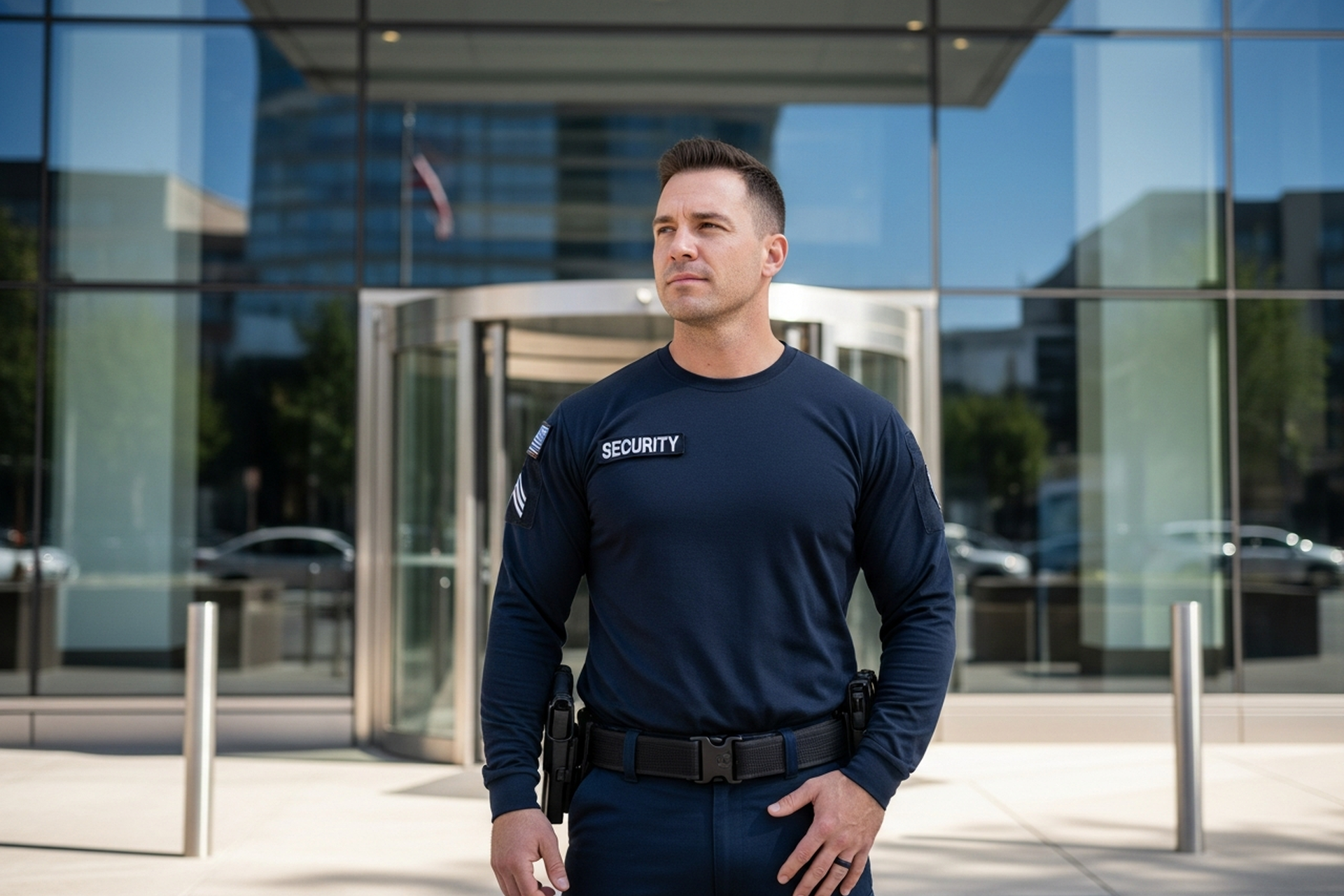
Lobby and single-point-of-entry. The lobby officer is the most important human element in the data center security model. Every visitor, every vendor, every contractor enters through a single controlled point. The unarmed security officer at that entry controls the pre-registration verification workflow, manages photo ID check, issues time-limited visitor credentials, and serves as the escort coordinator for any vendor requiring access to the floor. This is not a passive role. It is the primary control point for the entire facility.
Mantrap and interlocked door control. Beyond the lobby, access to the raised floor, cage areas, and server rooms typically passes through a mantrap sequence. Biometric verification, whether palm vein readers, iris scanners, or fingerprint systems, layered with a proximity badge and a PIN, creates a multi-factor access requirement that is far harder to circumvent than any single control. The Uptime Institute publishes the Tier Classification System for data center design and operational standards, and multi-factor access control is a baseline expectation in certified facilities.
Cage and tenant-specific access. In a colocation model, individual tenants lease cage space within the broader facility. The tenant's authorized personnel may have access to the shared lobby and raised floor, but not to other tenants' cage areas. Managing that layer-within-a-layer requires access lists maintained per tenant, audited regularly, and coordinated between the facility security program and each tenant's IT security team.
Escorted vendor access. Every contractor who enters the raised floor area in a well-run data center is escorted. The escort accompanies the vendor from entry to exit, documents what was done, and ensures no unauthorized hardware leaves the premises. Facilities that skip this step because escort workflows slow down maintenance windows are accepting a risk that audit frameworks do not permit.
Visitor logging and continuous audit trail. Pre-registration is standard in data centers that hold compliance certifications. Visitors are registered in advance, photographed at entry, issued a badge with floor authorization and an expiration timestamp, and logged out on departure. The audit trail is not just a security measure. It is a compliance deliverable.
NOC integration. Most large data centers operate a Network Operations Center or joint NOC/SOC that monitors infrastructure health and security events simultaneously. Physical security programs integrate with the NOC so that door-held-open conditions, alarm events, and CCTV alerts are handled by a coordinated team rather than in organizational silos.
Colocation, Hyperscale, and Tech Offices: Different Models
The security program appropriate for a facility depends on which model it operates under.
In a colocation facility like those in the Cermak corridor, multiple tenants share the building. The facility operator controls perimeter and common area security, while individual tenant cage areas require tenant-specific access controls layered on top of the facility baseline. The security program must account for tenant diversity: a financial services firm caged next to a healthcare SaaS company and a federal contractor all have different compliance obligations.
A hyperscale facility operates as a single-tenant campus. The perimeter is typically more extensive, and guard programs in these environments often include more specialized staffing and background screening requirements that go beyond those of a standard commercial building contract.
Technology headquarters in the Loop, Fulton Market, and suburban campuses occupy open-plan office environments where sensitive IP work happens alongside routine business operations. The corporate commercial security program for a tech HQ must balance the accessibility expectations of a collaborative office environment with the IP protection requirements of the sensitive functions occurring within it.
Compliance Frameworks and the Officer's Role
Data centers holding certifications under major frameworks carry specific physical security obligations that the guard program directly supports.
SOC 2 Type II (CC6 series) requires documented logical and physical access controls. The officer program's visitor logs, escort documentation, and access control audit trails are part of the evidence package reviewed during a SOC 2 audit.
ISO 27001 (A.7 / A.11) addresses physical security across facilities, visitor management processes, and restrictions on secure area access. The A.11 controls map directly to the mantrap, escort, and visitor badging workflows that the guard program operates.
PCI-DSS Requirement 9 mandates physical access controls for cardholder data environments, visitor logs, and badge usage records. Any data center or tech facility that hosts payment-processing infrastructure is subject to these requirements, and the security guard program's documentation is reviewed during assessments.
HIPAA Physical Safeguards apply where healthcare cloud customers are hosted. The facility operator's guard program and access logs are included in the business associate documentation chain. FedRAMP physical security controls govern facilities that serve federal agency cloud workloads, with requirements that are more prescriptive than those of standard commercial frameworks.
AFCOM , the primary professional association for data center infrastructure professionals, publishes guidance on the intersection of operational and security requirements in mission-critical facilities, and these frameworks serve as standard reference material for any Chicagoland facility operator pursuing or maintaining certification.
Vendor Vetting and Officer Qualifications
Officers assigned to data center lobbies and escort functions benefit from familiarity with the physical environment: understanding that a cage door held open longer than expected is an anomaly, recognizing when a contractor's explanation doesn't match the work order documentation, and knowing which vendors are scheduled versus which arrived unannounced. That contextual awareness is built through facility orientation, not assumed on arrival.
Background screening for data center assignments typically goes beyond a standard criminal history check. Depending on the tenant profile and compliance framework, it may include credit history, verification of previous employment, and federal suitability determinations for facilities that host government workloads. Non-disclosure agreements covering what officers observe during tenant tours are common.
In south-suburban data center parks, where facilities sit within broader industrial security environments, the guard program may also address perimeter vehicle access controls and freight dock security alongside the technology-specific interior protocols.
Illinois Licensing
Security officers working in Illinois data centers and tech facilities must hold a valid PERC card issued by the Illinois Department of Financial and Professional Regulation. Armed officers carrying firearms require both a PERC and a Firearm Control Card. The employing agency must hold licenses for Illinois Private Detective, Private Alarm, Private Security, Fingerprint Vendor, and Locksmith Act. These are baseline requirements; facilities operating under FedRAMP or other federal frameworks may layer additional vetting requirements on top of state minimums.
Frequently Asked Questions
What is the difference between a data center lobby officer and a standard commercial building guard?
The data center lobby officer manages pre-registration verification, vendor credentialing, escort coordination, and NOC integration. The role requires a higher degree of protocol discipline than a standard commercial building desk position, and the consequences of a process gap are more significant.
Do data center security programs require armed officers?
Most colocation and enterprise data center programs do not use armed officers for routine lobby and escort functions. Armed security may be appropriate for government-classified environments or specific high-risk scenarios, but the baseline data center model relies on layered physical controls and trained unarmed officers.
How are contractors and vendors managed in a secure data center environment?
Vendors are pre-registered, credentialed at the lobby, issued time-limited access, and escorted throughout their time on the raised floor. Unescorted vendor access in a certified facility is an audit finding.
What compliance frameworks most commonly affect Chicagoland data center security programs?
SOC 2 Type II is the most widely required framework for commercial colocation tenants. ISO 27001 is common for enterprise and international operators. PCI-DSS applies to payment processing environments. HIPAA applies where healthcare customers are hosted. FedRAMP governs federal cloud workloads. Many Chicagoland facilities operate under two or more simultaneously.
How does security differ for a tech company headquarters versus a data center?
A tech HQ operates in an open-plan environment where accessibility is a design priority. The security program manages visitor access, development lab controls, and executive protection in a far less restrictive setting than a raised-floor data center. Corporate espionage, competitive intelligence gathering, and social engineering of employees are more prominent threat vectors in the tech office context.
Working with Cascadia Global Security
Cascadia Global Security provides licensed security guard programs for data centers, technology facilities, and tech company offices across the Chicagoland area, including the Cermak corridor, suburban data center parks, and North Shore tech campuses. Guard staffing for data center assignments is selected and oriented to the facility's specific compliance environment, and programs can be structured to support SOC 2, ISO 27001, PCI DSS, HIPAA, and FedRAMP audit requirements.
To discuss a security program for your facility, get a quote or call (800) 939-1549.