Loop & River North Office Building Security in Chicago
Josh Harris | May 31, 2026
The Loop and River North together hold the densest concentration of office inventory in the Midwest. Glass towers along Wacker Drive, converted loft buildings in River North, and creative campuses across both neighborhoods serve as a home base for law firms, financial services companies, technology firms, marketing agencies, and thousands of small and mid-size businesses. The security demands across that range of tenants and building types are significant, and they are not all the same.
Loop and River North office security is a layered program built around the specific vulnerabilities of downtown office environments: lobby access, elevator banks, loading docks, parking structures, after-hours operations, and the coordination challenges that come with multi-tenant buildings where dozens of companies share a single address. The sections below cover the threat landscape, the layered security model, staffing structures, and technology integrations that make a guard program measurably more effective.
The Threat Landscape in Downtown Chicago Office Buildings
Office buildings in Chicago face a set of recurring threats common to dense urban commercial environments, but these take on specific characteristics in the Loop and River North.
Unauthorized access and tailgating are the most frequent daily challenges. High-traffic lobbies with turnstile systems still create opportunities for individuals to slip through behind an authorized badge holder. After-hours periods are particularly vulnerable: when the lobby desk is unstaffed or reduced to a single officer, badge-only access becomes the primary control, and tailgating incidents go unobserved more often. In multi-tenant towers, a visitor with legitimate access to one floor can move freely through the elevator system to floors they are not authorized to enter.
Theft of equipment and packages is a persistent problem in office environments. Laptop theft from open workstations, package interception in lobbies and mail rooms, and the removal of shared equipment from common areas are low-complexity crimes that cause real financial and operational damage. High-density buildings with shared reception areas and unsupervised package staging create easy opportunities.
Vagrancy and lobby intrusion are ongoing operational issues in both the Loop and River North. Ground-floor lobbies in high-traffic corridors attract individuals seeking shelter, particularly during cold months. Loading docks and service entrances at grade level are frequent entry points. Without a consistent ground-level presence, building teams spend significant time on non-security issues that escalate when unaddressed.
Vendor and delivery management create security gaps that are easy to overlook. A building with dozens of tenants experiences a steady stream of deliveries, maintenance vendors, cleaning crews, and contractors. Without a structured visitor and vendor management process, the lobby becomes a point of uncontrolled access for anyone who states they have an appointment.
Workplace violence and active threat scenarios require advance planning that goes beyond the individual tenant. For a full treatment of workplace violence prevention frameworks applicable to Loop and River North employers, see Chicago workplace violence prevention, which covers the OSHA typology, threat assessment protocols, and the physical security controls that complement an organizational WVP program.
The civil unrest. The Central Business District is the gathering point for large demonstrations, and building security programs need pre-established protocols for storefront and lobby protection, tenant communications, and coordination with CPD's 1st District during elevated-risk periods. Contingency is particularly relevant to Loop buildings
The Layered Security Model for Office Buildings
Effective corporate and commercial security in a Class A office building is not a single officer at a desk. It is a combination of staffed positions, technology systems, and operational protocols that work together.
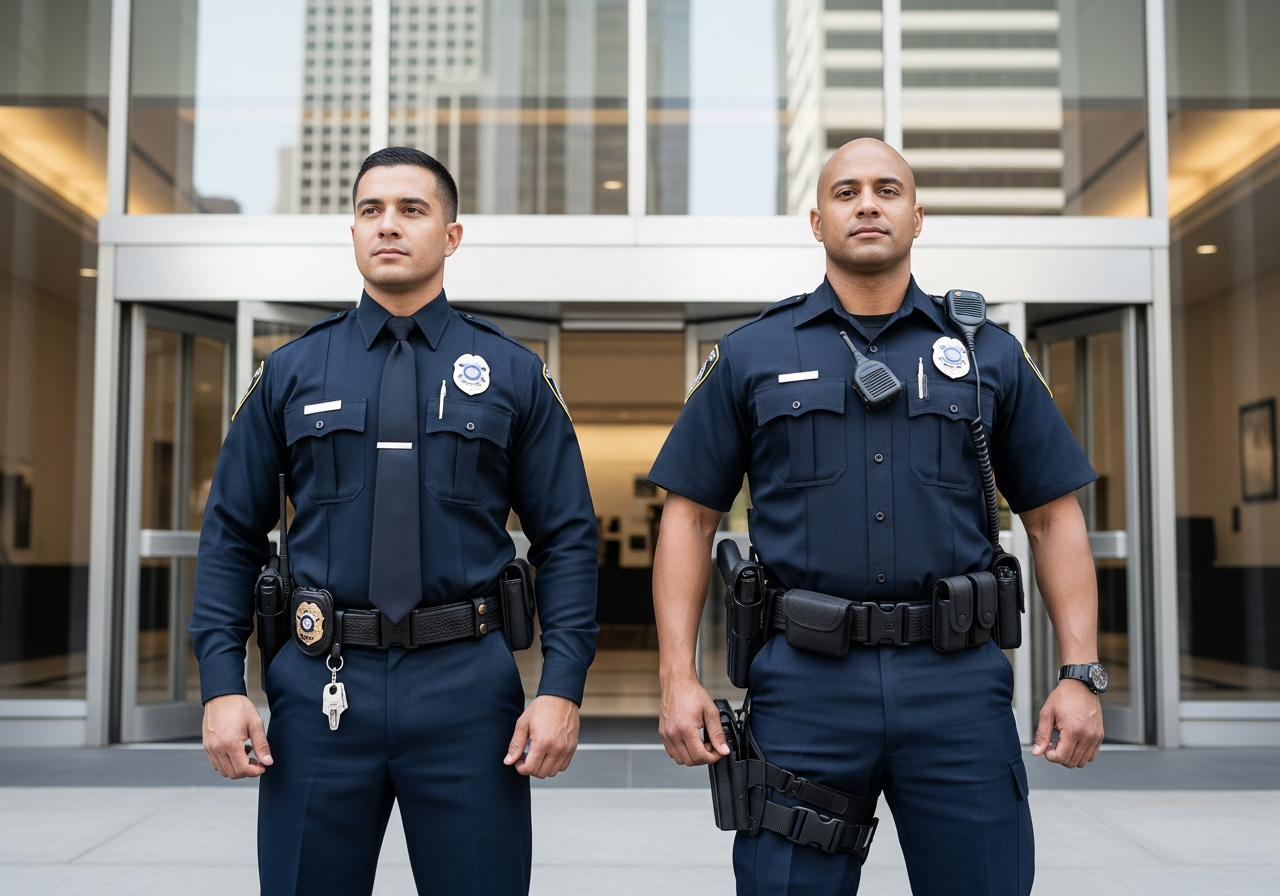
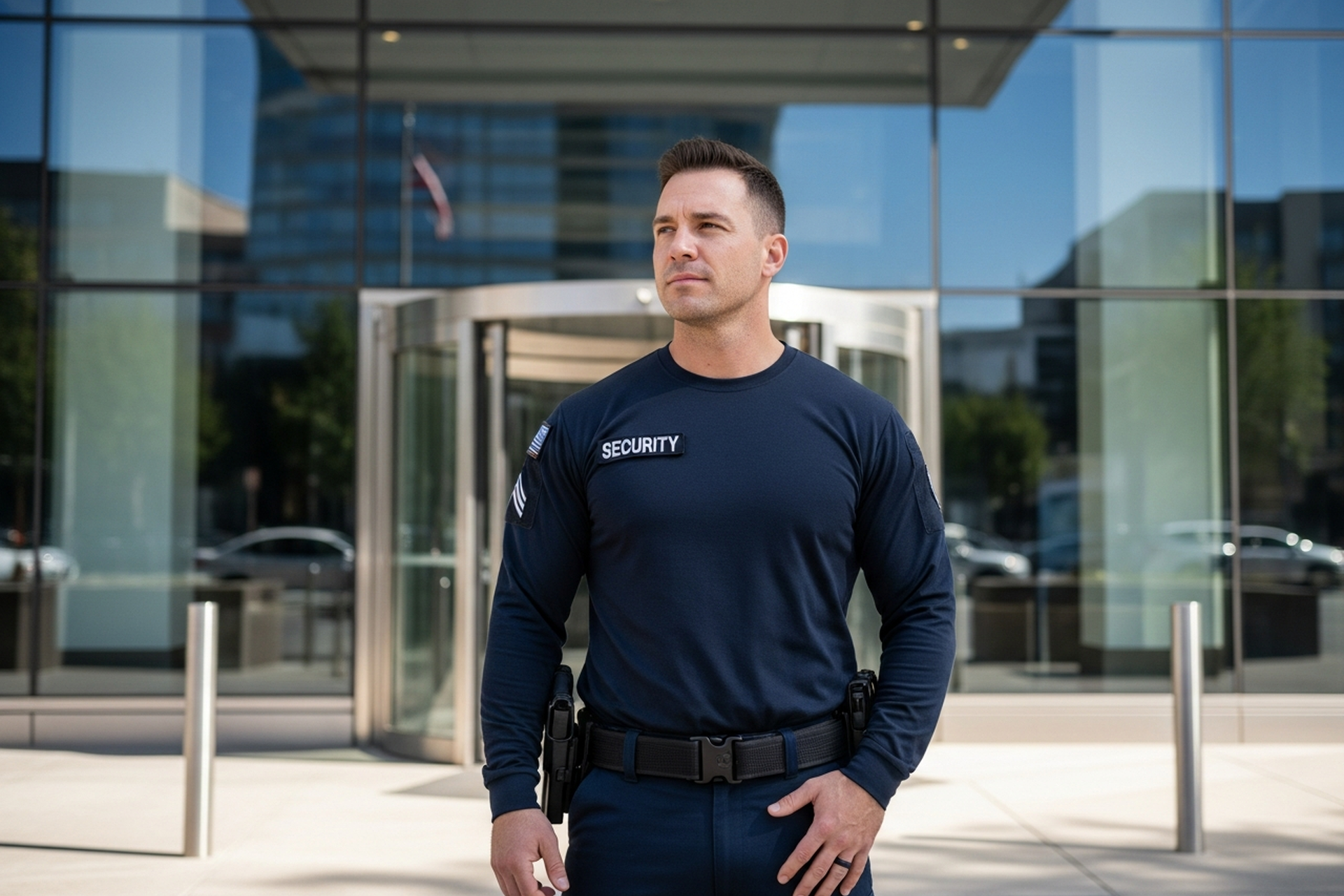
Concierge and front-desk security officer. The lobby is the first and most visible layer. A trained officer at the front desk manages visitor check-in, issues temporary badges, monitors the turnstile area for tailgating, handles package receipt and notification, and provides a customer-facing presence that reflects the building's standard of professionalism. For Class A properties in the Loop and River North, the concierge officer is often in business attire rather than a traditional guard uniform, matching the building's aesthetic while maintaining the role's deterrence and access-control functions. Unarmed guards working concierge positions handle the vast majority of day-to-day access control and visitor management in office environments.
Patrol officer. For buildings larger than a certain size or with complex footprints, a separate patrol officer conducts scheduled and random rounds through the building's interior and exterior spaces. This includes the elevator lobbies on upper floors, stairwells, mechanical rooms, restrooms, and the loading dock. Documented rounds with checkpoint scanning provide a verifiable record of coverage and deter theft and unauthorized access in areas the lobby officer cannot monitor.
Loading dock control. The loading dock is the back door of the building, and it is frequently the path of least resistance for unauthorized entry. A staffed or camera-monitored dock entry with a defined vendor sign-in process closes this gap. For buildings with high delivery volume, a dedicated dock position during peak hours is standard.
Garage security integration. Parking structures attached to Loop and River North office towers require coordination with the building's overall security program. After-hours badge-only access for garage entry, camera coverage of the garage levels, and defined escalation paths between the parking operator and the building security team close the gap between the two programs that otherwise operate in silos. For a detailed treatment of parking-specific security strategies in Chicago, see the "Parking lot security in Chicago" guide, which covers vehicle theft, after-hours coverage models, and the patrol options available to parking operators.
Access control infrastructure. The physical layer of turnstiles, tenant key card systems, and visitor badge issuance is what makes the lobby officer's work enforceable. Modern systems allow tenant-level programming: a specific badge authorizes access to specific floors and specific times of day, and every access event is logged. Visitor badging systems with photo capture and pre-registration workflows reduce the friction of the check-in process while maintaining a documented record. Technology upgrades, including mobile credentials and biometric verification, are increasingly common in newer Class A products and in major tenant renovations.
CCTV and video analytics. Camera coverage of lobbies, elevator banks, stairwells, loading docks, and parking access points serves as both a deterrent and a post-incident investigative tool. AI-powered video analytics layers are being adopted in newer building installations: they can flag loitering in monitored areas, track dwell-time anomalies near secured doors, and generate alerts for specific access events without requiring continuous human monitoring of every feed.
After-hours protocols. When the building transitions to after-hours operation, the security program must adapt accordingly. Badge-only access replaces walk-in lobby access. A single overnight officer or a mobile patrol service that makes documented visits along a multi-property route maintains coverage without the cost of a full daytime staff. Escort protocols for late-working staff round out the after-hours framework.
IFMA, the International Facility Management Association, publishes guidance for facility managers on security integration, emergency planning, and vendor coordination. Resources directly applicable to Loop and River North building managers align security with broader facilities operations.
VIP and executive arrival protocols. Buildings housing financial services firms, law firms, and corporate tenants frequently require defined procedures for executive arrivals: pre-cleared parking, elevator reservations, advance lobby clearance, and coordination with the tenant's own security program. Off-duty law enforcement officers provide CPD-level credentialing and arrest authority for situations that exceed the scope of a contracted guard.
Staffing Models for Office Buildings of Different Scales
There is no single staffing structure that works for every office building in the Loop or River North. The right model depends on building size, tenant mix, operating hours, and budget structure.
24/7 in-house officer with relief coverage is the standard for large Class A towers. A dedicated team works assigned shifts (typically three overlapping shifts with weekend coverage), and the building's security director manages the program directly. For a 40-story multi-tenant tower with 3,000 daily occupants, a staffed lobby desk, a patrol position, and a dock officer represent a minimum coverage baseline.
Day officer plus overnight mobile patrol is the cost-effective model for mid-size buildings and smaller River North creative office properties. A full-time concierge officer handles daytime operations; after hours, a mobile patrol unit makes documented visits to the building as part of a multi-property route. This model captures most of the deterrence benefit of overnight coverage at a fraction of the cost of a posted overnight position.
Tenant-funded versus landlord-funded programs. Security is often partially funded through common area maintenance (CAM) charges, with tenants contributing to a building-wide program. Financial services or legal firms with elevated requirements sometimes fund additional floor-level coverage in addition to the building's base program. These positions work in coordination with the overall building program rather than independently of it.
For high-profile tenants or specific threat profiles, off-duty CPD officers provide enforcement authority that contracted guards cannot match. Most Loop and River North office programs are unarmed; the deterrence and customer-service orientation of the work does not require an armed posture.
CISA's physical security resources provide frameworks for assessing building-level vulnerabilities, from access control gaps to active threat preparedness, that security directors and property managers can use as a program evaluation baseline.
Illinois Licensing and CPD Coordination
All officers working compensated security functions in Illinois must hold a valid PERC (Permanent Employee Registration Card) issued by the Illinois Department of Financial and Professional Regulation. Armed personnel require an additional Firearm Control Card (FCC). Most Loop and River North office programs operate entirely unarmed, with PERC-licensed officers filling concierge, patrol, and dock positions.
Coordination with CPD's 1st District, which covers the Loop and River North, is an important component of emergency planning. Buildings should have defined relationships with the district for incident reporting, active threat response, and the special events coordination that affects downtown traffic and access patterns throughout the year.
Frequently Asked Questions
What is the standard security staffing level for a mid-size Loop office building?
A mid-size multi-tenant building of 10 to 25 floors typically runs one lobby officer during business hours, with after-hours coverage handled by a mobile patrol program or a reduced overnight desk position. Buildings with a high-volume loading dock or a parking structure often add a third position during peak delivery hours. The exact staffing level depends on building occupancy, tenant mix, and the access control technology in place.
How does visitor management work in a multi-tenant office building?
Most Class A buildings use a centralized visitor management system at the lobby desk. Visitors register on arrival, are issued a temporary badge with floor authorization, and are logged in and out of the system. Pre-registration by tenants (where staff notifies the desk in advance of expected visitors) reduces wait times and allows the lobby officer to focus on the turnstile area rather than on manual check-in processing.
What is the difference between a concierge security officer and a traditional guard?
The role is functionally the same, but the presentation differs. A concierge officer is typically in business attire at the reception desk, oriented toward access control, visitor management, and customer service. A uniformed guard in the same position performs identical security functions. The choice of presentation is driven by the building's brand standards rather than by the scope of the role.
When should a building consider off-duty CPD over contracted security?
Off-duty CPD officers are appropriate when arrest authority is needed, when a tenant has a documented elevated threat profile, or for executive arrival details. Most Loop and River North buildings use contracted unarmed guards for standard operations and bring in off-duty CPD for specific events or civil unrest contingencies.
Does the security program need to coordinate with building cleaning crews?
Yes. After-hours janitorial crews are a significant access control consideration. A documented sign-in and sign-out process for cleaning staff, floor-level access restrictions, and check-in protocols with the overnight officer are standard components of a complete after-hours program.
Working with a Professional Security Partner
Property managers, building owners, and facility directors working to maintain Class A security standards in the Loop and River North need a partner with direct experience in downtown Chicago office environments: tenant expectations, PERC licensing requirements, CPD coordination protocols, and staffing flexibility across shifts and budgets.
Cascadia Global Security provides corporate and commercial security programs for office buildings across the Chicago market, from concierge and patrol staffing to after-hours mobile patrol coverage. Contact us at (800) 939-1549 or Get a Quote to discuss the right program for your building.