Manufacturing Facility Security in Puget Sound Industrial Belt
Josh Harris | June 13, 2026
Manufacturing facility security in Puget Sound has to handle a profile that few other regions in the country share at the same density: aerospace supply chains, marine fabrication, food and beverage production, and a growing cluster of advanced manufacturing all operating within the same industrial corridor. A security program designed for a generic warehouse will not cover the risk landscape these plants actually face, and a program that ignores the operational rhythms of round-the-clock production will create friction that managers eventually work around.
The Puget Sound industrial belt stretches from Everett south through Seattle, Kent, Auburn, and into Tacoma, with significant concentrations in the Kent Valley, the Duwamish corridor, and along Interstate 5 toward Pierce County. Plants in this corridor produce aircraft components and assemblies, marine vessels and parts, processed foods, beverages, biotech products, and the equipment that supports all of it. That diversity is a strength for the regional economy and a planning challenge for any security director responsible for keeping a facility running, compliant, and protected.
What makes Puget Sound manufacturing security distinct
Plants in this region operate inside one of the densest aerospace supply ecosystems in North America. Tier-one and tier-two suppliers, machine shops, composites fabricators, and assembly contractors all feed into a network that has strict customer expectations around chain of custody, controlled access, and traceability. A breach at a small tier-two supplier can ripple into customer audits and contract review at facilities much larger than the one where the incident occurred.
Marine manufacturing adds another layer. Shipyards, boatbuilders, and component fabricators along the waterfront work with heavy machinery, hazardous materials, and high-value parts that move on flatbed and oversize loads. The combination of waterside exposure, after-hours yard activity, and specialized inventory makes marine plants distinct from inland industrial facilities, and the risk profile overlaps in places with the chain-of-custody concerns covered in Port of Seattle warehouse security operations.
Food and beverage production is the third pillar, with processors, breweries, roasters, cold storage and fulfillment operators, and packaging facilities distributed across the corridor. These plants live under FDA and Washington Department of Agriculture oversight, and access control around production zones is not just a security concern, it is a food safety control. The National Association of Manufacturers has documented that manufacturers across sectors increasingly treat physical security and process safety as integrated programs, not separate silos, and that shift is particularly visible in food-grade facilities.
Advanced manufacturing, biotech, and clean-tech round out the picture. These facilities often hold proprietary equipment, prototypes, and process intellectual property that have value well beyond the resale price of the hardware itself. Protecting that material is a different exercise than protecting raw materials or finished consumer goods.
Access control and employee badging
The first operational decision in a manufacturing security program is how people get in and out. Most plants in the corridor run multi-shift operations, which means access control has to function at shift change without creating a bottleneck that delays production starts.
A modern badging program for a manufacturing facility should establish zones rather than treating the building as one access category. Production floors, finished-goods storage, IT and server rooms, R&D or prototype areas, hazardous materials storage, and shipping and receiving each carry different risk profiles. Employees and contractors should hold credentials that match their job function, not a universal badge that opens every door.
Visitor and contractor protocols are where many programs break down. A facility that issues paper sign-in sheets at a front desk and assumes the receptionist will catch problems is running on a 1990s playbook. Pre-registered visitor lists, photo verification, escorted access in production zones, and digital logs that integrate with the access control system are the baseline expectation for any plant doing business with aerospace, defense, or pharmaceutical customers.
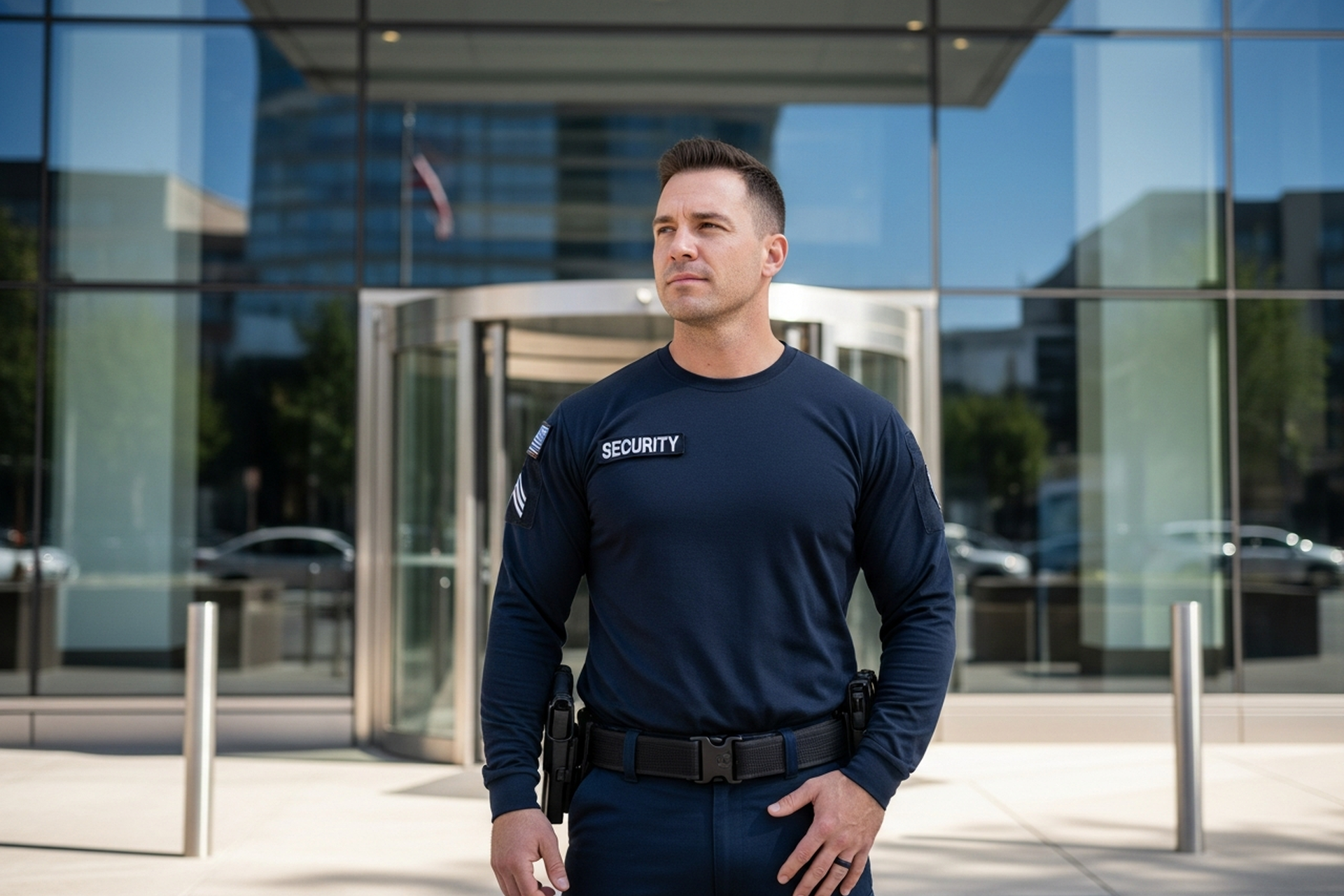
An unarmed security officer posted at the main entrance can run that program efficiently. The officer verifies appointments against the visitor manifest, issues temporary credentials, confirms PPE requirements before granting floor access, and escorts visitors or coordinates with the responsible employee. That single position handles compliance documentation, deters tailgating, and creates an audit trail that satisfies customer security questionnaires.
Shift-change procedures deserve their own design pass. Plants that move five hundred workers through a single entry point in fifteen minutes need a flow that handles the volume without abandoning verification. Some facilities solve this with badge-only entry during shift change and dedicated officer coverage during the surrounding windows when visitors and contractors are more likely to arrive.
Loading dock supervision
Loading docks are where the most high-value movement happens, and they are also where the most security gaps appear. Drivers arrive on tight windows, dock crews work fast, and supervisors are often pulled in multiple directions at once. A camera-only program cannot keep up with the pace of a busy dock.
Dock supervision protocols should cover three checkpoints: gate-in, dock assignment, and load verification. At gate-in, a security officer verifies the driver against an appointment, confirms the bill of lading or pickup authorization, and issues a yard pass with a specific dock assignment. Drivers self-navigating the yard create gaps that are difficult to close after the fact.
At the dock, an officer or supervisor confirms the load matches the manifest before doors close and seals are applied. For plants shipping high-value or controlled goods, photographing seals and recording trailer numbers at gate-out closes the chain of custody in a way that supports both internal investigations and customer audits.
The Kent Valley sees enough freight volume that cargo theft patterns documented across the warehouse and distribution sector show up in manufacturing yards as well, particularly for plants that ship finished goods directly from production. Officers trained in dock supervision are the most reliable defense against staged pickups, fraudulent dispatch documents, and trailer substitution schemes. The same dock-discipline principles that reduce employee theft at distribution centers apply at production yards, where staff and driver access overlap during peak shipping windows.
Intellectual property protection
For aerospace, biotech, and advanced manufacturing plants, the most valuable asset on site is often not the inventory, it is the process, the prototype, the tooling, and the data. Protecting intellectual property in a manufacturing setting requires a coordinated approach that combines physical access control, escort protocols, device management, and clear policies on photography and removable media.
Production areas where proprietary processes happen should be designated controlled zones with badge access limited to employees whose job function requires presence. Contractor and vendor access to these zones should require escort, signed nondisclosure documentation on file, and a clear sign-in record. Visitor photography policies need to be enforced, not just posted.
Removable media and personal devices on the production floor are an underappreciated risk. A facility that allows employees to plug personal USB drives into production controls or carry phones with active cameras into prototype areas has effectively waived its IP protection at the perimeter. The security program should reinforce the IT and operations policy on devices, including bag checks where appropriate and clear escalation when a violation is observed.
ASTM International develops standards used widely across industrial manufacturing for materials, processes, and quality control, and many customer audit frameworks reference ASTM standards as part of the supplier qualification process. Security programs that document access to controlled-process areas and maintain credential records support those qualification efforts even when the security team itself does not write the technical procedures.
OSHA and L&I safety overlap
Manufacturing security in Washington intersects directly with workplace safety regulation in ways that do not apply to retail or office settings. Washington Labor & Industries (L&I) enforces state workplace safety standards through the Division of Occupational Safety and Health, and the citations issued in industrial settings frequently touch on areas where security officers are positioned to help.
Hazard communication, restricted-area access, lockout-tagout enforcement, and emergency exit clearance are all areas where a trained security officer can observe and report conditions that supervisors might miss during a production push. Officers walking the perimeter who note a blocked emergency exit or an unsecured chemical storage door are providing value that an audit team cannot replicate.
OSHA recordkeeping and L&I claim documentation also benefit from a security presence at the scene of any incident. Officers trained in first-response observation, with body cameras or incident reporting tools, create a contemporaneous record that supports both the injured worker's claim and the facility's documentation of conditions and response. This is not a substitute for a safety program, it is a reinforcement layer that catches gaps before they become citations or claims.
Emergency response coordination
Manufacturing facilities present emergency scenarios that other commercial settings do not. Chemical releases, machinery entrapment, fire in production areas with concentrated fuel loads, and active-threat events all require coordinated response. The security team is often the first line of communication with first responders, and the quality of that initial contact shapes the outcome.
Officers should have current emergency action plans on hand, know the location and content of hazardous materials storage, and be trained in the facility's evacuation routes and assembly points. Drills run quarterly or semi-annually keep the program live and surface gaps before a real event does.
For larger facilities or multi-building campuses, mobile patrol coverage during off-shifts provides a roving response capability that a single fixed post cannot. Patrols can reach a distant building, verify a fire alarm activation, and report conditions to dispatch before responders arrive, which is particularly valuable for facilities outside immediate municipal response zones.
Coordination with local fire marshals, police, and L&I in advance of incidents is the other half of the equation. Pre-incident plans on file with responding agencies, regular site walks, and clear contact rosters mean the response in the first ten minutes of an emergency is not improvised. Cascadia Global Security works with corporate and commercial clients across the Puget Sound region to build those coordination plans before they are needed.
Frequently Asked Questions
What is the difference between manufacturing security and warehouse security?
Manufacturing security covers production operations, intellectual property, controlled processes, and safety overlap with L&I and OSHA regulation. Warehouse security focuses on inventory, dock operations, and loss prevention. The two programs share core elements like perimeter and access control, but a manufacturing program adds escort protocols for proprietary areas, integration with safety programs, and stricter visitor and contractor management.
How does aerospace supply chain status affect security requirements?
Aerospace suppliers in the Puget Sound corridor typically operate under customer security expectations that flow down through the supply chain. Tier-one and tier-two suppliers face documented access control, controlled-area protocols, and audit-ready credential records as part of their customer qualification. A plant that wants to bid on or retain aerospace contracts has to maintain a security program that satisfies those audit frameworks.
Do food and beverage manufacturers need different security than other plants?
Food and beverage facilities carry FDA and Washington Department of Agriculture oversight in addition to standard security concerns. Access control around production and packaging zones serves both security and food safety. Officers managing dock access also verify carriers in a way that supports sanitary transportation requirements, and contractor escort protocols help maintain the documented chain of custody that food safety audits require.
What role does Washington L&I play in manufacturing security planning?
L&I enforces workplace safety standards through the Division of Occupational Safety and Health, and manufacturing facilities are regularly inspected against those standards. Security officers who observe and report conditions like blocked exits, unsecured hazardous materials, or unsafe equipment use reinforce the facility's safety program. Officers are not safety professionals, but they are positioned to catch and escalate gaps that supervisors miss during production.
How does a plant balance security with shift-change throughput?
Shift change is the most operationally sensitive moment for any access control program. Facilities typically solve the throughput problem with badge-only credential entry during peak shift-change windows and dedicated officer presence during the surrounding hours when visitors, vendors, and contractors are more likely to arrive. The goal is to keep the verification standard consistent while letting the workforce flow through without delays that affect production starts.
Working with a security partner that knows the corridor
Industrial manufacturing in Puget Sound has operational requirements that a generic commercial security program does not address. A vendor that has worked across aerospace suppliers, food processors, and marine fabrication understands the rhythms of multi-shift production, the audit pressures from customer security questionnaires, and the L&I overlap that affects how officers document what they see.
Cascadia Global Security supports manufacturing clients across the Puget Sound corridor with industrial manufacturing programs built around the specific risk profile of each facility, from aerospace tier suppliers in Kent and Auburn to food processors in the Duwamish corridor to marine fabricators along the waterfront. Programs are designed to satisfy customer audit frameworks, integrate with L&I safety expectations, and operate through shift changes and after-hours coverage without creating bottlenecks.
To discuss a security program for your manufacturing facility, request a security quote or call (800) 939-1549.