Mobile Patrol vs. Standing Guards in Seattle: How to Choose
Josh Harris | May 15, 2026
Choosing between mobile patrol vs standing guards in Seattle is not a question with one right answer. It depends on what your property looks like, what threats you face, and what you actually need a security officer to do. Make the wrong call and you either overpay for coverage your site does not need, or you end up with gaps that a more appropriate model would have closed.
Seattle businesses operate across a wide range of property types: dense downtown office towers, sprawling industrial parks in SoDo and Georgetown, retail strips in Bellevue and Renton, multifamily portfolios spread across King County, and construction sites active throughout the region. Each of these environments calls for a different security posture. What works for a high-traffic corporate lobby will not work for a 40-acre industrial campus with a dozen access points. This guide breaks down both models so you can match the right one to your actual situation.
What each security model actually means
Before comparing them, it helps to be clear on what each deployment looks like in practice.
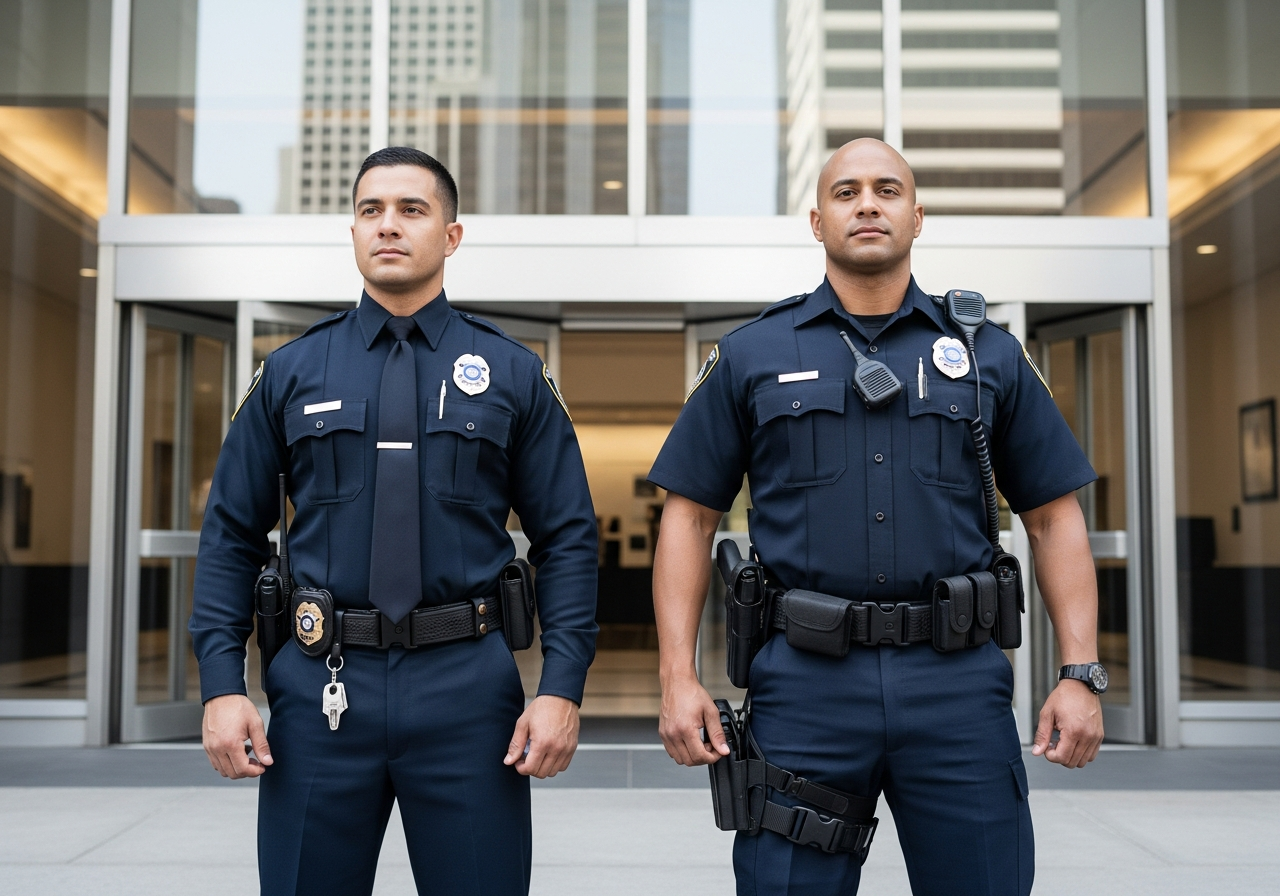
A standing guard, also called a static guard or fixed post, is stationed at one assigned location throughout the shift. That location might be a lobby desk, a gate entrance, a parking attendant booth, or an access control checkpoint. The officer is present continuously, which makes them immediately available to respond to anything that happens at that post. They are also visible to everyone who enters the building or approaches the gate, which creates a persistent deterrent at that specific point.
A mobile patrol officer works differently. Rather than staying in one place, the officer moves through a property or across multiple properties in a marked vehicle, conducting checks at designated areas on a randomized schedule. The Bureau of Labor Statistics identifies patrol officers as one of the largest segments of the security workforce precisely because the model scales across property types and geographic coverage areas where fixed posts would require multiple officers to achieve the same footprint.
Both roles require Washington state licensing through the Department of Licensing, including a background check and completion of required pre-assignment training. The difference is in how each officer spends their shift and what operational problems they are designed to solve.
When mobile patrol is the stronger choice
Mobile patrol delivers its best value in situations where the threat is distributed rather than concentrated at a single point, and where the goal is broad deterrence and periodic verification rather than continuous staffed presence.
Large properties with multiple zones
Warehouses, distribution facilities, manufacturing plants, and industrial parks common to Kent, Auburn, and the Green River Valley often have perimeters that stretch hundreds of feet, multiple vehicle access points, and large outdoor areas with limited natural visibility. Stationing a single guard at the front entrance leaves everything else uncovered. A patrol vehicle can cover the full perimeter, check dock doors, sweep parking areas, and verify lot access across the entire site in one pass.
Multi-property portfolios
Property management companies that hold several commercial or residential properties within a region often benefit from a single patrol circuit rather than a dedicated guard at each location. One officer can rotate across multiple sites during a shift, checking each property multiple times at intervals that change nightly. This extends professional coverage to properties where the volume does not justify a full-time static post.
After-hours and overnight coverage
For properties that are unoccupied overnight, mobile patrol creates visible deterrence without requiring a guard to sit at an empty building for eight hours. Retail centers, construction sites, parking structures, and light commercial buildings all fit this profile. The randomized timing is the core of the deterrence value: an opportunistic offender who cannot predict when the patrol vehicle will appear is less likely to act than one who has observed a predictable pattern.
Lower-risk sites with broad exposure
Not every commercial property in the Puget Sound region faces elevated specific threats. Many need a general security presence to deter opportunistic property crime without the cost structure of a full-time static officer. Mobile patrol provides that presence at a coverage efficiency that fixed posts cannot match when measured against the square footage protected.
When standing guards are the stronger choice
Static guards work best when the security function centers on a specific physical point and when the work at that point requires continuous, immediate capability.
High-traffic entry points and lobbies
A building where dozens or hundreds of people enter and exit throughout the day needs someone who can observe who is coming in, verify credentials, manage sign-in procedures, and respond immediately if something goes wrong at the door. A patrol officer who visits every 90 minutes cannot perform that function. The lobby of a corporate office tower in downtown Seattle, the reception area of a medical clinic, or the gate of a secure facility all require someone who is always there.
Access control
When the security function is to physically control who enters a space, a standing guard is the right tool. Verifying IDs, managing a visitor log, operating access gates, or enforcing a restricted area requires someone stationed at the control point at all times. This is a core function that patrol cannot replicate. SHRM identifies access management and controlled entry as foundational to workplace violence prevention programs, and effective access control requires a continuous human presence at the relevant threshold.
Immediate response requirements
If your property needs someone who can respond within seconds rather than minutes to an incident at a specific location, a static guard stationed at or near that location is the right choice. This is especially relevant for retail environments where shoplifting or confrontations happen at the floor level, for properties that handle cash or high-value goods, or for facilities where incidents tend to cluster at predictable points.
High-value or high-sensitivity environments
Financial institutions, pharmaceutical facilities, data center lobbies, and other locations where a breach at the wrong point carries serious consequences benefit from continuous staffed presence at the critical threshold. The deterrence value of a visible guard who is always there is different from the deterrence value of a patrol that visits periodically. For high-stakes access points, the former is the appropriate tool.
The blended model: when you need both
For many Seattle-area properties, the right answer is a combination of the two. A static officer at the primary access control point handles entry verification and immediate response at the front of house. A mobile patrol vehicle covers the perimeter, parking areas, secondary access points, and any other areas that the static officer cannot monitor from their post.
This layered approach is common in commercial real estate, multifamily housing complexes, and corporate campuses with multiple buildings or off-street parking. It extends coverage without requiring a static post at every vulnerability point, and it lets each model do the work it does best. Your static officer is not spending their shift walking a parking garage. Your patrol officer is not sitting at a desk. Both are contributing to a more complete security posture than either could provide alone.
Cascadia Global Security deploys mobile patrol programs alongside unarmed guard placements across the greater Seattle market, and builds programs that match the model to the actual risk profile of each site.
How to choose: questions to work through
If you are trying to decide which model fits your property, these questions help clarify the decision.
What is the primary security function you need covered? If the answer is access control or immediate response at a fixed point, the static model is the starting point. If the answer is broad perimeter coverage or deterrence across a large area, patrol is the starting point.
Is the property occupied continuously during the coverage period? If the building is active with employees or customers, a static presence at entry points supports the occupants. If the property is vacant or minimally staffed overnight, patrol provides more efficient coverage.
Are there multiple distinct vulnerability points or one concentrated risk area? Multiple distributed points favor patrol. A single high-risk point favors a static post.
What does your incident history tell you? Properties with prior break-ins at a specific location, repeated trespassing at a particular access point, or documented theft at a predictable zone benefit from targeted static coverage there. Properties with general property crime exposure across a broad area benefit more from patrol.
What is the footprint of your property? Single-building, single-entrance locations are well served by a standing guard. Large multi-building campuses or properties with sprawling outdoor areas benefit from patrol coverage as part of the program.
What a security assessment covers
A professional site assessment reviews your physical layout, access points, lighting conditions, prior incident history, and operational patterns to recommend a deployment model that fits the actual exposure. This is different from a one-size-fits-all package. A commercial building security checklist offers a starting point for evaluating which physical factors matter most for your property type.
Neither model is universally superior. The right choice depends on what your site actually needs, and the answer sometimes changes as your business evolves. A construction site midway through development has different needs than the same property once it becomes an occupied commercial building.
Cascadia Global Security works with property owners and facility managers across Seattle, Bellevue, Tacoma, and the broader Puget Sound region to structure security programs around actual risk rather than convenience. If you are ready to evaluate the right model for your property, get a quote or call (800) 939-1549 to speak with a security specialist.
Frequently Asked Questions
What is the main difference between mobile patrol and a standing guard?
A standing guard is stationed at one fixed location throughout their shift, providing continuous presence and immediate response at that point. A mobile patrol officer moves through a property or across multiple properties in a marked vehicle on a randomized schedule, covering a larger area but visiting each location periodically rather than staying in one place.
Which option costs less for Seattle businesses?
Neither model is cheaper in absolute terms because the cost depends on the scope of coverage. Mobile patrol typically delivers a lower cost per square foot protected because one officer can cover a much larger area during a shift. Standing guards provide higher value at specific high-traffic points where continuous presence is required. Many properties use both, sizing each element to what their site actually needs.
Can one security provider supply both mobile patrol and standing guards?
Yes. A full-service security company can structure a program that combines a static officer at a primary access point with patrol coverage across the broader perimeter and secondary areas. This blended model is common for commercial campuses, multifamily properties, and retail centers in the Seattle area.
How does Washington state licensing apply to both types of officers?
All security officers in Washington, whether assigned to static posts or patrol routes, must hold a valid individual license issued by the Washington State Department of Licensing. Both armed and unarmed officers have specific licensing requirements, and the security company itself must hold a state business license. The licensing requirements are the same regardless of the deployment model.
What property types in Seattle most commonly use each model?
Standing guards are most common at corporate lobbies, medical facilities, financial institutions, retail locations with high customer volume, and any site where access control at a specific point is the primary security function. Mobile patrol is most common at industrial properties, warehouses, construction sites, parking structures, multifamily complexes, and commercial properties that are unoccupied or low-staffed overnight.