Seattle Workplace Violence Prevention for Local Businesses
Josh Harris | May 28, 2026
Workplace violence is one of the leading causes of occupational injury in the United States, and no industry or market is immune. For businesses in Seattle, the combination of dense commercial corridors, high-traffic public-facing operations, and a competitive labor market makes a written, practiced workplace violence prevention plan more than a best practice. It is a baseline expectation for responsible operations.
This guide walks through the framework that underlies effective prevention planning, what Washington employers are expected to do under state occupational safety rules, and how professional security personnel support the people and protocols that make a workplace safer.
Understanding the four types of workplace violence
OSHA organizes workplace violence into four categories, and each one calls for a different response strategy.
Type 1 involves criminal intent. The perpetrator has no legitimate relationship with the business and enters the premises to commit a crime, such as robbery. Retail locations, banks, and late-night service operations face the highest exposure here.
Type 2 involves a customer, client, patient, or visitor directing violence at an employee. Healthcare facilities carry significant Type 2 risk, but this category also applies to corporate and commercial settings where high-stress client interactions occur.
Type 3 is worker-on-worker violence, whether between current employees or involving a former employee. Warning signs in this category often appear before any incident, making early identification and reporting essential.
Type 4 involves someone with a personal relationship to an employee, such as a domestic partner, bringing that conflict into the workplace. Employers have a legal and ethical responsibility to address this category when it creates a workplace hazard.
Understanding which types of violence your specific operation is most exposed to is the starting point for any meaningful prevention plan.
What Washington employers are required to do
Washington's occupational safety framework, enforced by the Department of Labor and Industries (L&I) under the Washington Industrial Safety and Health Act (WISHA), requires employers to maintain a written Accident Prevention Program (APP) tailored to the actual hazards their workers face. Workplace violence qualifies as a covered hazard, meaning that if your work environment creates exposure to violence, your APP must address it.
L&I's own guidance publication on workplace violence awareness and prevention outlines what Washington employers should include in a workplace violence component: a written policy, hazard identification and assessment, control measures, employee training, and incident recordkeeping. For general industry employers, these expectations exist under the existing safety and health core rules (WAC 296-800-140).
Healthcare employers face a more specific and emerging regulatory framework. L&I has been developing a dedicated chapter (WAC 296-830) for workplace violence prevention in health care settings, including requirements for annual training, formal incident records, and violence prevention programs covering contracted security personnel. That rulemaking is ongoing, but healthcare employers in the Seattle area should track it closely.
For all other industries, the baseline is clear: if employees face exposure to violence, the employer needs a documented plan and training to match.
The five components of an effective prevention plan
Whether you are building a plan from scratch or reviewing an existing one, effective workplace violence prevention programs consistently include five core elements.
Management commitment establishes the tone. A prevention program without leadership buy-in rarely gets funded, staffed, or enforced. Senior leadership needs to sign off on the policy, assign responsibility for implementation, and make it clear that reports of threatening behavior will be taken seriously without retaliation.
Worksite analysis identifies where your vulnerabilities actually are. This means looking at your physical layout, your hours of operation, your client or visitor flow, your cash handling procedures, and your history of prior incidents or near-misses. A downtown Seattle office tower has different exposure than a Southend warehouse or a Bellevue medical clinic.
Hazard prevention and control translates that analysis into action. Physical controls include access control systems, lighting in parking areas, and visitor screening protocols. Administrative controls include policies around working alone, escalation procedures, and a clear chain of reporting. Engineering controls might include secured reception areas or panic alert systems.
Safety and health training ensures every employee knows what the plan says, how to recognize warning signs, and what steps to take if they witness or experience threatening behavior. Training should be specific to your workplace, not generic.
Recordkeeping and program evaluation closes the loop. Every incident and near-miss should be documented, reviewed, and used to update the plan. A workplace violence prevention program that never changes is one that isn't being used.
Warning signs and risk factors
Most workplace violence incidents are preceded by observable warning signs. Escalating verbal aggression, direct or indirect threats, sudden changes in behavior, preoccupation with grievances, and references to weapons or past incidents of violence are among the behavioral indicators that security professionals and HR teams are trained to notice and document.
Risk factors that increase a workplace's overall exposure include working with the public, handling cash or high-value assets, operating late-night or overnight shifts, working in isolated or low-visibility areas, and serving clients or customers who may be in distress. Businesses along Seattle's Aurora Avenue corridor, in South Lake Union, or operating near transit hubs may face elevated exposure from Type 1 incidents given the density and nature of activity in those areas.
None of these risk factors means a violent incident is inevitable. What they tell you is where to focus your controls, your training, and your staffing.
The role of professional security in a prevention plan
Security personnel are not a substitute for a workplace violence prevention plan, but they are one of the most effective tools for executing it. A professional security officer working under a defined scope of duties supports prevention in four practical ways.
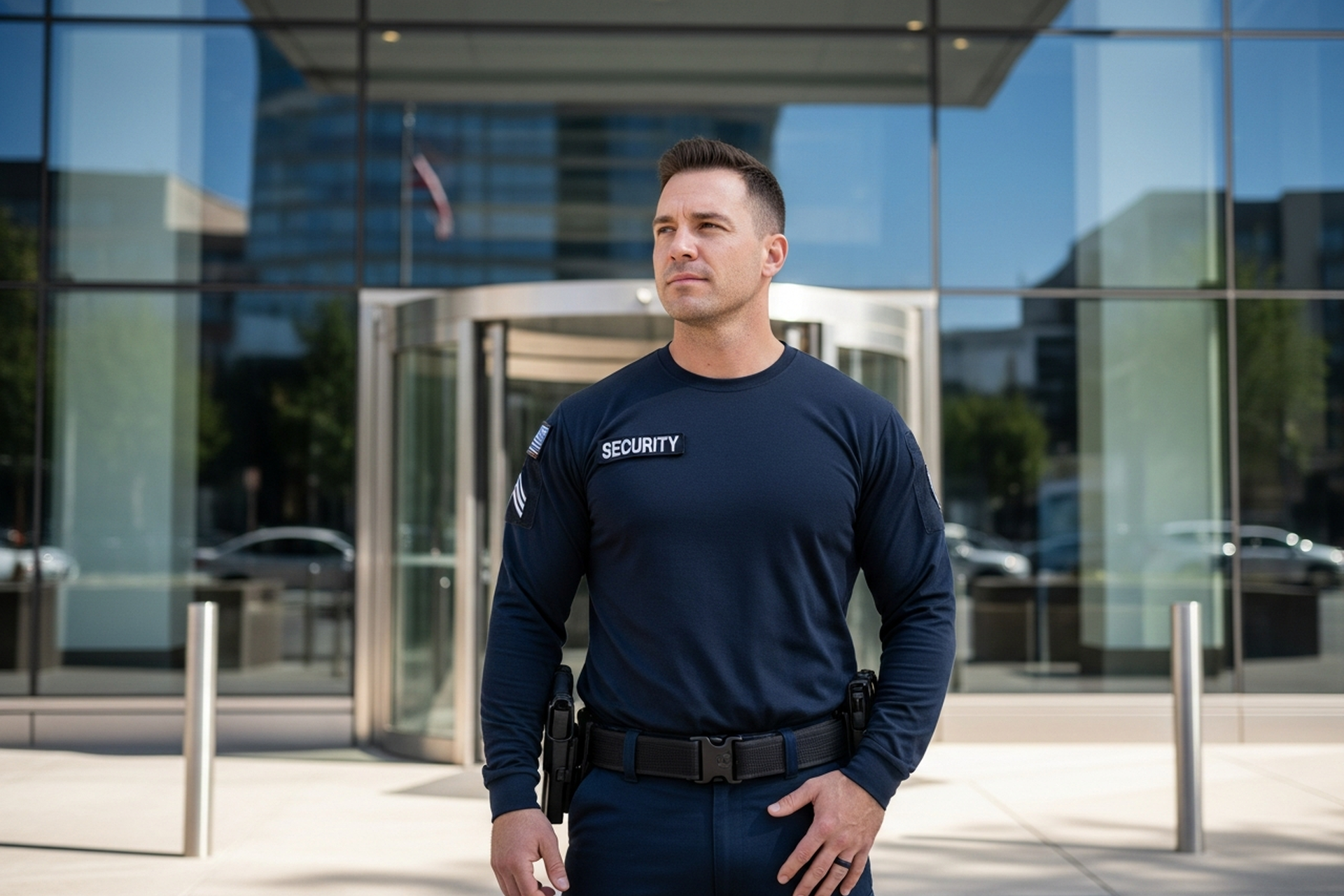
Deterrence through presence. A uniformed officer at the entry point or in high-traffic areas reduces the likelihood that someone with criminal intent will choose your location. The deterrent effect of visible security is well documented.
Access control and visitor screening. Officers verify credentials, manage visitor logs, control who enters secured areas, and recognize when someone's behavior warrants additional attention before they proceed further into the building. Unarmed security personnel are commonly deployed in office lobbies, reception areas, and building entrances for this exact purpose.
Incident observation and documentation. When a situation escalates, the officer's role is to observe carefully, document what occurred, and escalate to law enforcement when warranted. Cascadia officers are trained to deter, document, and escalate; they do not perform threat intervention beyond their training. Clear documentation supports HR investigations, legal proceedings, and future prevention planning.
Post-incident support. After an incident, continuity matters. Officers can secure a scene, support employee welfare, and provide management with a factual account of what occurred for the purpose of reporting and plan updates.
For businesses facing elevated threat scenarios, such as executives navigating sensitive personnel decisions or organizations managing significant public-facing conflict, executive protection resources may be appropriate for specific periods.
Building a threat assessment team
Larger organizations and those with complex risk profiles benefit from a formal Threat Assessment Team (TAT). This is a cross-functional group typically involving HR, security, legal, and sometimes a mental health resource, whose job is to receive, evaluate, and respond to reports of threatening or concerning behavior before a situation escalates.
The team defines how reports get made, who reviews them, what investigation looks like, what interventions are available (from a performance conversation to a restraining order to immediate law enforcement contact), and how outcomes are tracked. Security vendors supporting the organization should have a defined role in this process, including who to call and when.
If a formal TAT is not practical for your organization's size, a simpler version, a designated HR contact paired with a security point of contact and clear reporting procedures, accomplishes most of the same goals.
Practical next steps for Seattle businesses
If your business does not yet have a workplace violence component in its Accident Prevention Program, the first step is a worksite assessment. Review your physical environment, your operational hours, your incident history, and your current reporting channels. Identify which of the four OSHA violence types represent the highest exposure for your operation.
From there, build or update your written policy, schedule training for all employees (including management), and establish your incident documentation process. If you work with security guard companies in Seattle, confirm that they understand your prevention plan and that your officers know how it applies to their scope of work.
Property managers and facility directors coordinating security across multiple tenants or buildings can reference the Seattle commercial building security checklist for a broader view of access control and site-level controls that support violence prevention alongside other security objectives.
Frequently Asked Questions
What are the four types of workplace violence recognized by OSHA?
OSHA categorizes workplace violence into four types. Type 1 is criminal intent by someone with no legitimate connection to the workplace. Type 2 involves violence from a customer, client, or visitor directed at an employee. Type 3 is worker-on-worker violence between current or former employees. Type 4 involves someone in a personal relationship with an employee bringing that conflict into the workplace. Each type has different risk factors and calls for different preventive controls.
Are Washington employers legally required to have a workplace violence prevention plan?
Washington employers are not required to have a standalone workplace violence prevention document, but L&I expects employers to address workplace violence within their required Accident Prevention Program (APP) when exposure to violence is a recognized hazard. Healthcare employers face additional and more specific rulemaking under WAC 296-830, which is currently in development. For guidance specific to your industry, consult with HR counsel or contact L&I directly.
What should a workplace violence prevention plan include for a Seattle business?
An effective plan covers five core areas: a written policy with management commitment, a worksite hazard analysis, hazard controls (physical, administrative, and engineering), employee training, and a process for incident recordkeeping and program review. The specifics vary based on your industry, facility layout, hours of operation, and workforce. A security assessment by a qualified provider can help identify your highest-priority control gaps.
How do security officers support workplace violence prevention without overstepping?
Professional security officers in a workplace violence prevention context are trained to deter through visible presence, manage access and visitor screening, observe and document concerning behavior, and escalate to law enforcement when a situation warrants it. Cascadia officers operate under a clearly defined scope: observe, document, deter, and escalate. They do not conduct threat interventions beyond their training. This distinction is important for both liability and effective response.
When should a Seattle business consider bringing in professional security support?
Any business with public-facing operations, late-night hours, high-value inventory, or a history of workplace incidents should evaluate whether a security presence is appropriate. Organizations navigating significant personnel actions, executive departures, or situations that have generated credible threats should speak with a security professional and their HR or legal team before the situation escalates. For specific guidance on your situation, call a qualified security provider rather than relying on a general checklist.
Workplace violence prevention is not about assuming the worst of your employees or customers. It is about taking seriously the responsibility you have to everyone who works in or enters your facility, and building the systems that protect them before a situation demands it.
If you want help building a workplace violence prevention plan that includes professional security support, Cascadia Global Security works with businesses across the Seattle area and the broader Puget Sound region to assess risk, define security scope, and deploy officers trained for commercial environments. Reach out at Get a Quote or call (800) 939-1549 to start the conversation.