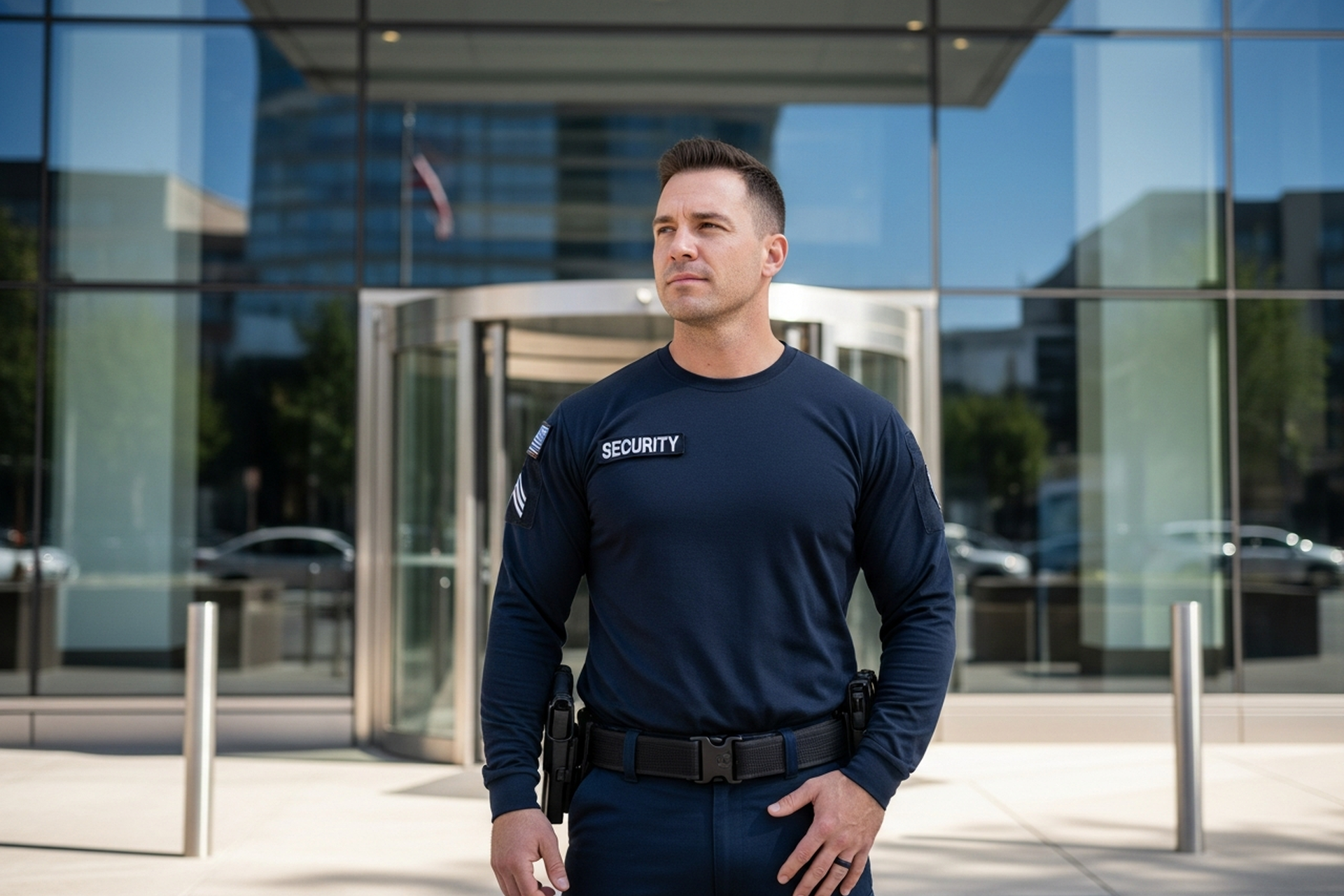
Security Services for Naperville & Schaumburg Businesses
Josh Harris | June 22, 2026
The two most economically significant suburbs in Chicagoland sit on opposite ends of the I-90/I-88 arc. Naperville anchors the western corridor through DuPage County, home to a deep corporate research park running along I-88, top-rated schools, and one of the most productive retail and multifamily markets in the region. Schaumburg, in Cook County, clusters around the intersection of I-90 and I-290, with a mix of major corporate headquarters, the largest enclosed mall in Illinois, and a convention center that draws national meetings year-round. Both markets operate at a scale that demands professional Naperville and Schaumburg security services: not a guard from a national dispatch center three counties away, but a locally managed program with supervisors who know the corridors, the tenants, and the local law enforcement partners.
This post covers the threat landscape and property types driving security demand in each suburb, the service models that fit the different site categories, how private security coordinates with Naperville PD, Schaumburg PD, and the county sheriffs, and what to look for when evaluating a provider for either market.
Why Suburban Chicagoland Businesses Need Professional Security
The suburbs are not immune to the security challenges that draw attention in the city. The concentration of corporate assets, retail inventory, and transient commercial traffic across Naperville and Schaumburg creates a distinct set of operational risks.
Corporate campuses along the I-88 Research and Technology Park in Naperville, with tenants including major energy, pharmaceutical, and technology firms, require structured access control programs. Multi-tenant campuses often have shared parking structures, public campus roads, and multiple building entries that are difficult to secure without a staffed program. Vehicle crime in surface lots, tailgating at badge-controlled entries, and after-hours intrusion are all recurring concerns for facilities teams managing large footprints.
Schaumburg's retail concentration at Woodfield Mall and the surrounding commercial corridors generates organized retail crime (ORC) exposure comparable to urban retail corridors. High-value merchandise, dense foot traffic, and proximity to major highway interchanges make this corridor attractive to ORC groups that move quickly through a region. Retail security in this environment requires visible deterrence, coordination with mall management, and loss prevention protocols that extend beyond a single store's floor.
Distribution and warehouse facilities along the I-88 and I-90 corridors are a third category. These operations carry cargo theft exposure, particularly for loads staged overnight. The volume of freight movement through DuPage and Cook County has made both corridors active areas for cargo-related crime, and facilities with inadequate perimeter security and overnight guard programs are disproportionately targeted.
Healthcare campuses, including Edward-Elmhurst Health's Naperville facilities, present a separate set of demands: patient confidentiality, after-hours emergency department access management, behavioral health incidents, and compliance with Joint Commission security standards. Healthcare security in a suburban hospital setting requires officers trained in de-escalation and healthcare-specific incident protocols, not just general commercial guard work.
The I-88 Corridor: Naperville's Corporate and Commercial Landscape
Choose DuPage, DuPage County's economic development organization, consistently identifies the I-88 corridor as one of the most commercially productive technology and professional services corridors in the Midwest. The corporate base in Naperville extends beyond research and technology into financial services, insurance, and healthcare administration, with several major headquarters and regional offices operating large campus footprints.
For corporate and commercial properties in this corridor, the security program typically centers on a few core components. Lobby and access control management is the primary function for Class A office buildings and corporate campuses: a trained unarmed guard or concierge officer manages visitor check-in, enforces badge protocols, monitors loading-dock access, and coordinates with the building's technology access systems. For larger campuses with multiple buildings and a connected parking structure, a separate patrol function conducts documented rounds along the perimeter and in interior common areas.
Parking lot security is an active concern across Naperville's commercial corridors. Surface lots serving large office parks and retail centers are high-exposure areas for vehicle break-ins, catalytic converter theft, and after-hours trespass. A mobile patrol program running multiple documented passes per night through a commercial park is the cost-effective model for this type of exposure, providing GPS-verified coverage across a large area at a fraction of the cost of stationary overnight guards at every entry point.
Retail properties, including Naperville Crossings and the town's downtown district, face the standard mix of commercial retail threats, with organized retail crime groups posing the highest-value risk. On-site retail security officers, often in plain clothes to deter without a uniformed presence, reduce shrinkage while keeping the retail experience customer-facing.
The I-90 Corridor: Schaumburg's Corporate and Convention Cluster
Schaumburg operates as a true corporate hub within Cook County. Major headquarters in the market include leading financial and technology firms whose campus security requirements involve executive protection, controlled access to sensitive office areas, and coordination with corporate security departments that have their own protocols.
The Schaumburg convention and conference circuit, anchored by the Renaissance Schaumburg Convention Center and a strong base of full-service hotels, drives demand for event security year-round. Conference security differs from standard commercial guard work: it requires perimeter management for event-specific access, credential checking, crowd flow management in pre-function spaces, and a staff capable of handling both the high-visibility, public-facing portions of an event and the back-of-house service and loading dock areas simultaneously. Hotels and hospitality properties in the Schaumburg market need guard programs that understand the dual demands of guest experience and physical security.
The Schaumburg Business Association serves more than 870 member businesses in and around the village, a number that reflects just how dense the commercial base is for a municipality of 75,000 residents. That density creates both a strong demand for professional security services and a marketplace where business operators are increasingly sophisticated about what they expect from a provider.
Woodfield Mall is a category unto itself. At more than 2 million square feet of leasable area, it is the largest enclosed mall in Illinois and one of the largest in the country. Retail security at this scale involves coordination between individual tenant loss-prevention programs and a centralized mall-management security operation. Private security providers serving individual tenants within the mall need to integrate with the broader mall program while maintaining their clients' specific loss-prevention objectives. Retail security at Woodfield-adjacent locations also extends to the strip and power centers surrounding the mall, which experience spillover traffic and share similar ORC exposure.
Multifamily, Construction, and Other Suburban Property Types
Both Naperville and Schaumburg have seen continued multifamily development as part of broader Chicagoland residential growth. Garden-style apartment communities and newer mid-rise buildings in both markets follow the same security model as the broader Chicago suburbs: mobile patrol programs covering exterior perimeters, parking areas, and amenity spaces provide cost-effective overnight coverage for distributed residential footprints. Specifically for multifamily properties, the patrol model, documentation requirements, and HOA community approaches that define Chicago multifamily mobile patrol programs apply equally in Naperville and Schaumburg.
Active construction sites across both markets create their own security exposure. DuPage and Cook County both have high volumes of active residential and commercial development, and unprotected construction sites experience equipment and copper theft, as well as vandalism, at rates that make overnight security a cost-effective operational decision rather than a discretionary expense. Construction site security in suburban markets is handled primarily through mobile patrol programs for smaller sites and stationary overnight posts for larger projects with expensive staged equipment.
Private schools in both communities, with their combination of student safety requirements, after-hours facility access, and event security needs, represent another recurring client category. Suburban private school security programs balance visible deterrence with the approachable, service-oriented posture that fits an educational environment.
Licensing, Coordination, and What to Ask a Provider
Any security provider operating in Naperville or Schaumburg must comply with Illinois statewide licensing requirements. The state framework requires the agency to hold a Private Security Contractor license from the Illinois Department of Financial and Professional Regulation. Every officer must hold a valid Permanent Employee Registration Card (PERC), which requires 20 hours of basic security training and a fingerprint-based background check. Officers carrying a firearm require an additional Firearm Control Card (FCC) from IDFPR.
The suburban context also matters for law enforcement coordination. Naperville PD is a well-resourced department with established protocols for working with private security at major commercial facilities. Schaumburg PD runs a similar framework for the village's dense commercial base. DuPage County Sheriff covers unincorporated DuPage County areas and county-owned facilities; Cook County Sheriff extends coverage through unincorporated Cook and provides backup resources for high-demand commercial areas in Schaumburg. A professional security provider operating in either market should have direct working relationships with the relevant departments and documented incident-escalation protocols that include dispatch-notification timelines.
Off-duty law enforcement officers from Naperville PD, Schaumburg PD, or the respective county sheriff's offices are an option for clients who need sworn officer presence, arrest authority, or a higher visible deterrence profile than a contracted guard provides. This model is most commonly used at high-volume retail properties, events at Schaumburg convention venues, and corporate clients with specific threat profiles.
The practical advantage of a Chicagoland-based provider over a national firm for Naperville and Schaumburg accounts is response time and local management. A local supervisor who can be on-site within 30 minutes, who has a working relationship with the facility manager, and who understands the specific layout of the I-88 Research Park or the Woodfield Mall commercial zone provides materially better service than a program managed from a regional operations center with no local presence.
Frequently Asked Questions
What types of businesses in Naperville and Schaumburg most commonly use security services?
The most active categories are corporate campuses and multi-tenant office parks along the I-88 and I-90 corridors, retail properties at Woodfield Mall and Naperville Crossings, hotel and conference venues, including the Renaissance Schaumburg, healthcare campuses, multifamily communities, and active construction sites. Distribution and warehouse facilities off both interstates also represent a significant category due to cargo theft exposure.
Is armed security commonly used at suburban office and retail properties?
Armed security is less common at standard office and retail properties in the suburbs than in higher-risk urban environments. Most corporate and commercial sites in Naperville and Schaumburg operate with PERC-licensed unarmed officers. Armed programs are used selectively for financial institutions, high-value cargo facilities, executive protection details, and specific retail or event situations where threat assessments support a higher deterrence posture.
How does private security coordinate with Naperville PD and Schaumburg PD?
Professional providers establish documented escalation protocols that specify when and how officers contact local police. For most commercial sites, this means calling Naperville PD (dispatch via DuPage County) or Schaumburg PD for active incidents, trespass enforcement, and medical emergencies, with the private officer remaining on-scene to assist and document. For large planned events at conference venues, advance coordination with Schaumburg PD is standard practice. Facilities in unincorporated DuPage or Cook County areas coordinate with the respective county sheriff.
What is the difference between mobile patrol and a posted guard for a suburban commercial property?
A posted unarmed guard provides a continuous visible presence at a single location, most appropriate for a controlled entry point, a lobby, or a loading dock with high transaction volume. Mobile patrol covers large or distributed footprints through multiple documented visits per shift, making it the better model for parking lots, multi-building campuses, and garden-style multifamily properties where coverage area exceeds what a single posted officer can monitor. Many suburban commercial properties use both: a posted concierge or lobby officer during business hours and mobile patrol for the overnight perimeter.
What should a Naperville or Schaumburg business look for when evaluating a security provider?
The key evaluation factors are Illinois IDFPR licensing for both the agency and every officer, GPS-verified patrol documentation, a local supervisor with direct access to the property and the client contact, documented relationships with local law enforcement, and a response-time commitment for the supervisor's on-site arrival. References from comparable property types in DuPage or Cook County are more relevant than general testimonials from unrelated markets.
Naperville and Schaumburg Security Services from Cascadia
Cascadia Global Security provides security services in Naperville and Schaumburg for corporate campuses, retail properties, healthcare facilities, multifamily communities, and industrial sites across the western and northwestern Chicagoland suburbs. Officers hold current IDFPR credentials; programs are built around documented GPS-tracked patrols and professionally staffed lobby positions; and local supervisors maintain the on-the-ground presence that suburban commercial clients need. Contact us at (800) 939-1549 or Get a Quote to discuss the right security program for your Naperville or Schaumburg property.