Warehouse Security Officers and Facility Protection
Josh Harris | March 20, 2026
A single warehouse fire, theft incident, or security breach can erase months of profit and damage supply chain relationships that took years to build. Distribution centers and storage facilities represent concentrated risk: valuable inventory, constant foot traffic, multiple access points, and round-the-clock operations create vulnerabilities that opportunistic criminals actively exploit. Warehouse security officers serve as the critical human element in facility protection, bridging the gap between passive security systems and active threat response. Their presence deters theft, their training enables rapid emergency response, and their vigilance catches what cameras and sensors miss. For operations managers and facility directors, understanding how professional security personnel protect assets, maintain compliance, and preserve supply chain integrity has become essential to competitive operations. The difference between adequate and excellent warehouse security often determines whether a business absorbs preventable losses or maintains the margins that sustain growth.
The Evolving Role of Security Officers in Modern Warehousing
The job description for warehouse security has expanded dramatically over the past decade. Officers now function as integrated members of operations teams rather than isolated sentinels at entry points.
Beyond Gatekeeping: Asset Protection and Loss Prevention
Modern security officers contribute directly to loss prevention through active observation, pattern recognition, and behavioral analysis. They identify suspicious activity before it escalates, whether that means noticing an employee lingering near high-value inventory or spotting a delivery driver deviating from established protocols. Effective officers understand inventory flow well enough to recognize anomalies that automated systems might miss. This human intelligence layer catches the subtle warning signs that precede major incidents.
Mitigating Risks in High-Traffic Distribution Centers
High-volume facilities face compounding risks as throughput increases. More shipments mean more opportunities for diversion, more personnel to monitor, and more vehicles requiring verification. Security officers manage this complexity by maintaining situational awareness across multiple activity zones simultaneously. They coordinate with receiving teams, verify credentials, and ensure that the controlled chaos of busy shipping days doesn't create exploitable gaps in oversight.
Core Responsibilities for Comprehensive Facility Protection
Effective warehouse security encompasses overlapping duties that create multiple layers of protection. Each responsibility reinforces the others, building redundancy into the overall security posture.
Access Control and Perimeter Monitoring
Controlling who enters and exits a facility remains foundational to warehouse protection. Security officers verify identification, log visitors, and ensure that only authorized personnel access restricted areas. Perimeter monitoring extends this control beyond the building itself, watching fence lines, parking areas, and approach routes for unusual activity.
Cascadia Global Security provides trained officers who understand that access control isn't just about checking badges: it's about maintaining awareness of who belongs where and why.
Inventory Audits and Internal Theft Deterrence
Employee theft accounts for a substantial portion of warehouse shrinkage, though recent U.S. retail and logistics data from 2025 show that external theft and organized retail crime now contribute comparably or even more significantly to total losses. Security officers deter internal theft through visible presence, random inspections, and participation in inventory verification processes. Their involvement signals to staff that accountability exists at every level. When officers conduct spot checks of outgoing vehicles or verify that inventory counts match shipping manifests, they create friction that makes theft considerably more difficult to execute undetected.
Emergency Response and Fire Safety Oversight
Warehouses present unique emergency challenges: large footprints, combustible materials, heavy equipment, and limited egress points. Security officers assist with emergency response for medical incidents, fire alarms, and evacuation coordination, but are not classified as certified first responders under federal or state law unless they hold specific emergency medical or firefighting credentials. They know facility layouts intimately, maintain communication with emergency services, and ensure that safety equipment remains accessible and functional. This preparedness transforms potential disasters into manageable incidents.
Integrating Human Intelligence with Security Technology
Technology amplifies officer effectiveness, but only when humans and systems work together intelligently. The goal isn't replacing officers with cameras: it's creating synergy between observation and automation.
Maximizing CCTV and Remote Surveillance Systems
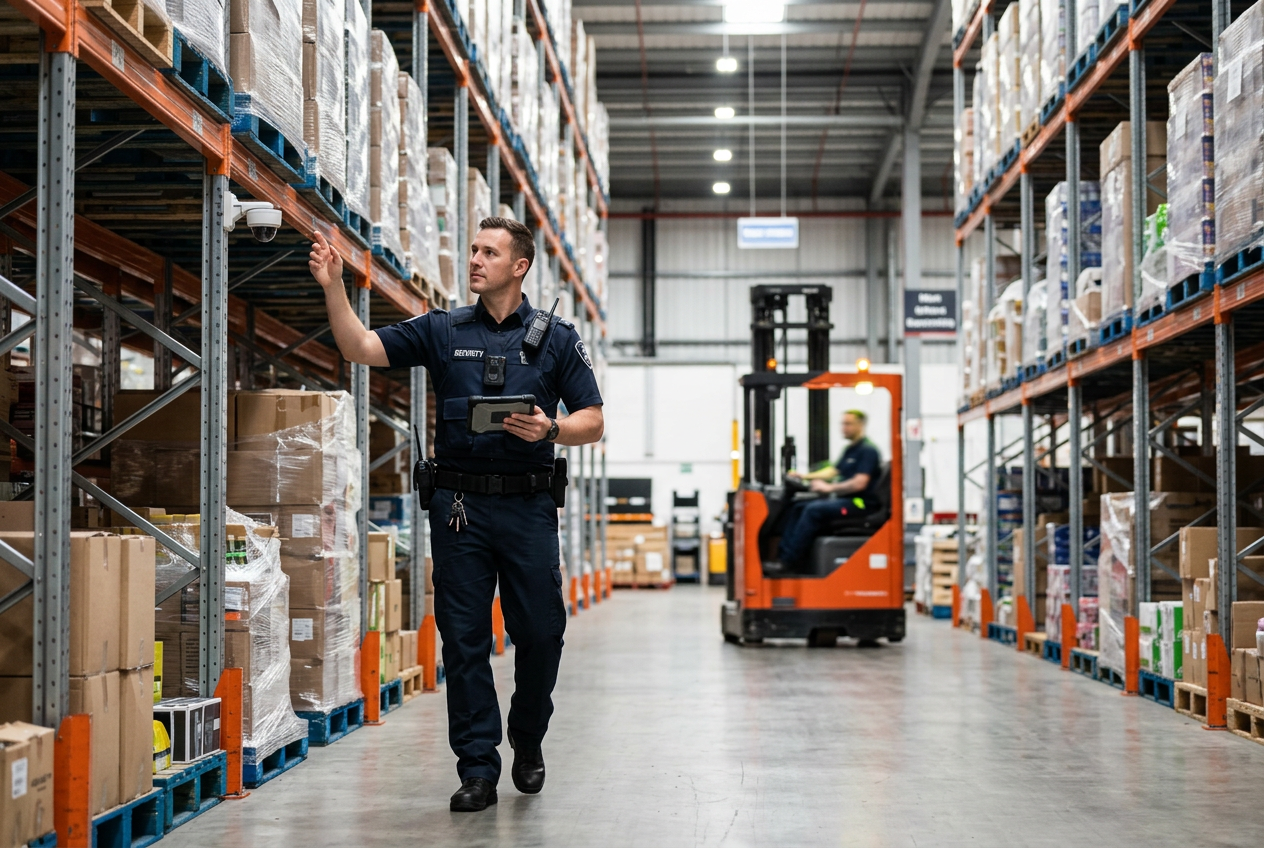
Modern camera systems generate vast volumes of data that require both automated analytics and human interpretation to be effective. Security officers monitor live feeds, respond to motion alerts, and review recorded footage to investigate incidents. They understand camera blind spots and compensate through physical presence. Effective officers don't just watch screens: they interpret what they see, recognizing behavioral patterns that algorithms might classify as normal activity.
Utilizing Warehouse Management Systems (WMS) for Security
Warehouse management systems track inventory movement with precision, creating opportunities for security. Officers trained to interpret WMS data can identify discrepancies between recorded and actual inventory locations, flag suspicious transaction patterns, and verify that physical counts match system records. This integration transforms security from reactive incident response to proactive anomaly detection.
Strategic Patrol Routes and Vulnerability Assessments
Random patrols provide some deterrent value, but strategic patrol planning multiplies officers' effectiveness by focusing attention where risks are concentrated.
Identifying Blind Spots in Large-Scale Facilities
Every warehouse contains areas where visibility diminishes, and supervision becomes difficult. Racking configurations, storage mezzanines, and equipment staging areas create natural blind spots that require deliberate patrol coverage. Experienced officers identify these vulnerabilities and incorporate them into patrol routes.
Cascadia Global Security trains personnel to conduct systematic vulnerability assessments that map facility risks and develop coverage strategies accordingly.
Securing Loading Docks and Shipping Bays
Loading docks represent the highest-risk zones in most warehouses. Products leave the facility here, trucks arrive and depart, and the pressure to maintain throughput can compromise verification procedures. Security officers stationed at loading areas verify seal numbers, check driver credentials, and ensure that only authorized shipments leave the premises. Their presence at these critical chokepoints prevents the most common theft scenarios.
Training Standards for Specialized Warehouse Security
Generic security training doesn't prepare officers for warehouse-specific challenges. Effective programs address industry-specific risks, regulatory requirements, and operational integration. Officers need to understand OSHA compliance, forklift safety protocols, hazardous materials handling, and the logistics processes that govern facility operations. They must recognize the difference between normal operational variations and genuine security concerns. This specialized knowledge allows officers to function as security professionals who understand warehousing rather than generic guards who happen to work in a warehouse.
Building a Culture of Safety and Supply Chain Integrity
Security officers influence facility culture through their daily interactions with staff. When officers demonstrate professionalism, consistency, and genuine concern for safety, they model the behaviors that protect everyone. They become trusted resources for reporting concerns, asking questions, and addressing potential hazards. This cultural impact extends beyond theft prevention to encompass workplace safety, regulatory compliance, and operational discipline. Facilities where security is integrated into operations rather than imposed upon them experience fewer incidents and faster response when problems occur.
Frequently Asked Questions
What qualifications should warehouse security officers have?
Effective warehouse security officers should possess state-required licensing, background clearance, and specialized training in loss prevention, emergency response, and access control procedures. Experience in logistics or distribution environments provides valuable operational context.
How many security officers does a typical warehouse need?
Staffing depends on facility size, inventory value, operating hours, and risk profile. A 100,000-square-foot distribution center operating 24/7 generally requires two to four officers per shift to ensure proper coverage of access points, patrol zones, and emergency response needs, according to 2025 industry staffing benchmarks.
Can security officers help reduce insurance premiums?
Yes. Many insurance carriers offer reduced premiums for facilities with professional security programs. Documented patrol logs, incident reports, and loss prevention statistics demonstrate risk mitigation that insurers reward with favorable rates.
What's the difference between armed and unarmed warehouse security?
Most warehouse environments in the U.S. employ unarmed officers who focus on observation, deterrence, and incident documentation. Armed security is typically reserved for facilities handling high-value commodities, controlled substances, or federally regulated materials, where higher threat levels justify additional authorization and licensing requirements.
How do security officers coordinate with local law enforcement?
Professional security officers maintain relationships with local police departments, understand reporting procedures, and properly preserve evidence for law enforcement investigations. They serve as the facility's liaison during incidents that require a police response.
Protecting Your Facility Investment
Warehouse security officers represent an investment in operational continuity, asset protection, and supply chain reliability. The right security partner provides trained personnel who understand your industry, integrate with your operations, and deliver measurable protection for your inventory and facilities. For businesses seeking professional warehouse security officers and facility protection services,
Cascadia Global Security offers veteran-owned, locally managed security solutions tailored to distribution and logistics operations. Contact their team to discuss how dedicated security personnel can strengthen your facility's protection posture.