Church Security Planning in Texas: Protecting Congregations
Josh Harris | May 22, 2026
Church security planning in Texas has matured into its own operational discipline, shaped by a specific state legal framework. Texas churches range from rural sanctuaries with thirty regulars to suburban multi-campus ministries running thousands through their doors each weekend, and the planning question is the same: how does this congregation protect its people without turning Sunday morning into a hardened perimeter? This is a practical overview of how a Texas church security plan is built, what state law allows, and where licensed officers fit alongside volunteer safety teams.
Why Texas Churches Plan Differently
Three factors give Texas houses of worship a planning environment of their own.
The first is state law. Texas explicitly permits licensed handgun carry inside places of worship unless the church prohibits it through specific statutory signage, which means most Texas congregations operate as armed-permissive environments by default. That fact alone reshapes how a safety plan is written and how volunteer teams are organized.
The second is congregation diversity. A Texas church plan has to account for very different attendance profiles: small rural churches that know every regular, mid-size suburban congregations with seasonal visitor spikes, large multi-service campuses with childcare wings, and Spanish-language services on different timing than English services in the same building.
The third is the urban and rural split. A church in central Houston or central Dallas plans for different incident profiles than a small congregation in West Texas. Both deserve a working plan; the emphasis shifts.
The Texas Legal Framework: SB 535 and Posted Signage
Senate Bill 535, passed during the 86th Legislature and effective September 1, 2019, amended Chapter 46 of the Texas Penal Code to clarify that places of worship are treated the same as other private property for License to Carry purposes. The bill removed prior ambiguity about whether churches were a default-prohibited location.
The practical effect: a Texas church is, by default, a place where licensed handgun carry is permitted. A congregation that wants to prohibit carry must post the statutory notice that controls private property generally.
- Section 30.06 signage prohibits concealed handgun carry by License to Carry holders.
- Section 30.07 signage prohibits open carry by License to Carry holders.
- Verbal notice is also legally recognized, though signage is the cleaner mechanism for a public-facing space.
This is a leadership decision, not a security-vendor decision. Some congregations post both signs and run a fully unarmed environment with a trained safety team; others leave the premises unposted and build the plan around lawful carry. Both are defensible; the plan has to match the choice. Consult counsel before posting or removing notices.
The Three Layers of a Church Security Plan
A working church security plan is built in three layers, and the layers do different work.
Prevention
Prevention is everything the congregation does to lower the probability of an incident in the first place. It is the longest layer and the one most often skipped because it does not look like security.
- Greeter and usher awareness, with eyes on the parking lot, foyer, and sanctuary entrance during arrival and departure
- Access control during midweek hours: locked exterior doors, monitored entry, sign-in protocols for visitors
- Lighting, sightlines, and trimmed landscaping around the building exterior, parking, and youth entrances
- Background checks for staff and volunteers who work with children, with documented renewal cycles
- Pastoral awareness of escalating personal conflicts (family disputes, custody issues, terminated employees) that can carry into Sunday services
Response
Response is what happens in the first ninety seconds of an event. The biggest determinant of outcome is whether a response framework exists at all and whether the team has rehearsed it.
- Clear roles: who calls 911, who directs evacuation, who controls access to childcare, who runs medical
- Internal alert mechanism that does not depend on phones (radios, panic buttons, a coded announcement)
- A safety team or licensed officer with the training and authority to act before law enforcement arrives
- Pre-coordinated relationships with local police or the sheriff's office
Recovery
Recovery is the part churches think about least and need most when an incident occurs.
- Family notification and reunification protocols, especially when children are involved
- Pastoral care for affected members, staff, and the safety team
- Coordination with law enforcement on scene preservation and witness statements
- Insurance, legal follow-through, and a plan for the next service
Volunteer Safety Teams vs Licensed Security Officers
A common question from Texas church leadership is whether a trained volunteer safety team is sufficient or whether the congregation needs licensed officers. The answer is rarely binary; most working plans combine both.
A volunteer safety team is the right backbone for a small to mid-size congregation with members from relevant backgrounds (law enforcement, military, EMS, medical) and a leader willing to organize training and rotations.
Licensed officers belong in the plan when the congregation hits a scale or risk profile that exceeds what a volunteer team can cover. Common triggers:
- Weekly attendance above roughly one thousand, where foot traffic outpaces a small volunteer rotation
- Multiple simultaneous services or campus locations that split the volunteer team thin
- A profile or programming choice that raises the baseline threat above what volunteers should be asked to absorb
- High-attendance services such as Christmas Eve, Easter, or community events
- Childcare wings or youth events that warrant a dedicated post
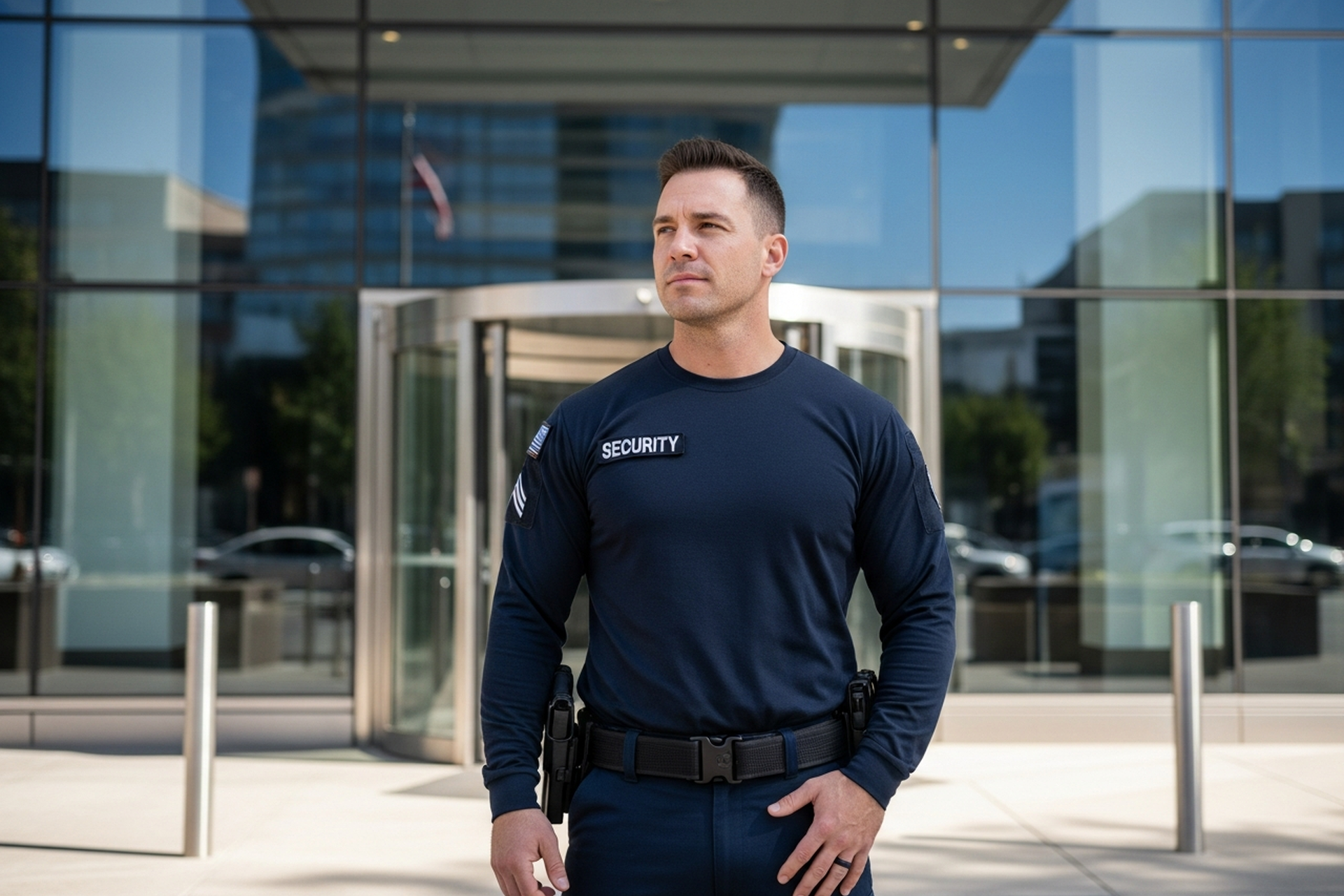
When licensed officers are deployed, unarmed guards cover access control, parking, and visitor management; armed guards cover the elevated-protection roles. Many Texas churches also bring in off-duty law enforcement for the largest weekend services because the radio link back to the agency and the sworn authority simplify the response chain.
Texas DPS Licensing Baseline for Paid Security
Any paid security officer working on a Texas church property must be licensed by the Texas Department of Public Safety Private Security Bureau. The baseline is well-defined.
- An unarmed Level II officer completes a Department-approved Level II course, currently six hours, plus the application and background process.
- An armed Level III officer completes the Level III course, currently forty-five hours, plus firearms qualification and renewal requirements.
Licensing is the floor, not the differentiator. The differentiators are post-order quality, supervisor coverage, training above the state minimum (de-escalation, medical, scenario-specific), and the team's integration with church leadership and the volunteer safety team.
Coordinating With Local Law Enforcement
A working church plan is never built in isolation from local police or the sheriff's office. Across the Dallas-Fort Worth metroplex, where Cascadia Global Security runs day-to-day operations, the coordination pattern looks similar to that in Houston, San Antonio, Austin, and rural Texas counties.
- A walk-through with the responding agency so officers know the floor plan, the youth wing, and secondary egress points
- A radio or phone protocol for quick contact during a service
- Off-duty officer assignments for high-attendance services or events that bring outside crowds onto the property
- A documented plan for who law enforcement reports to on arrival
For larger congregations and special events, temporary emergency staffing is also useful: high-attendance holidays, conferences, or weddings may warrant short-term, elevated coverage during the event window.
Communication, Access Control, and Event-Day Mechanics
The operational mechanics of a Sunday morning are not glamorous, and that is the point. A church safety program runs on small repeatable behaviors.
- Radio discipline with channel assignments and call-sign protocols
- A defined safety-team check-in before doors open
- Exterior posts during arrival and departure, with eyes on the parking lot rather than the sanctuary
- A controlled-access protocol for the childcare wing, including check-in and pickup credentials
- Scheduled sweeps of restrooms, classrooms, and side hallways during service
- A clean post-service stand-down that accounts for late-stay activity
Larger campuses add layers, including dedicated parking officers, intersection control at service changeover, and overnight coverage between Sunday and midweek programming.
What This Means for Your Texas Congregation
Most Texas churches do not need a hardened facility. They need a calm, documented, and rehearsed plan that matches the congregation's size, location, and risk profile. The legal framework is settled, the licensing baseline is clear, and the operational components are well understood. National frameworks such as the CISA Protecting Houses of Worship resources provide a useful reference point for congregations building or updating a plan.
A congregation that walks through prevention, response, and recovery with intention, builds a volunteer safety team where appropriate, and brings in licensed officers when the scale justifies it has done the substantive work.
Frequently Asked Questions
Is it legal to carry a handgun in a Texas church?
Yes, by default. Under SB 535, places of worship in Texas are treated like other private property, which means a License to Carry holder may lawfully carry a handgun on the premises unless the church has posted 30.06 or 30.07 signage or given verbal notice prohibiting it.
Do Texas churches have to hire licensed security?
No. Texas does not require churches to retain paid licensed security officers. Many congregations rely on trained volunteer safety teams. When a paid officer is on the property, that officer must hold the appropriate Texas DPS license.
What is the difference between a volunteer safety team and licensed security?
A volunteer safety team is made up of vetted church members serving in a security and response role. They operate within the legal framework that applies to any private citizen. Licensed security officers are paid professionals regulated by Texas DPS, with documented training and accountability through their licensed employer.
Should our church post 30.06 and 30.07 signs?
That is a leadership decision, not a security-vendor decision. Some congregations post both signs and run an unarmed environment supported by a trained team; others leave the property unposted and allow lawful carry. Both can support a defensible plan as long as the plan matches the choice. Consult legal counsel before posting or removing notices.
How much security coverage is appropriate for a Texas church?
The answer depends on weekly attendance, campus layout, programming, and risk profile. A small rural congregation may run on a volunteer team alone. A mid-size suburban church often pairs a volunteer team with a single unarmed or armed officer during services. Large multi-service campuses typically run a layered plan with multiple licensed officers and off-duty law enforcement for high-attendance services.
Plan Your Church Security Program With Cascadia
Cascadia Global Security supports Texas congregations across the state with licensed officers, volunteer team coordination, and event-day coverage tailored to the congregation's scale and risk profile. Our teams are Texas DPS licensed and trained to integrate cleanly with church leadership, existing safety teams, and local law enforcement. To talk through a plan, request a quote, or call (800) 939-1549.