Commercial Building Security in Dallas: A Practical Guide
Josh Harris | May 22, 2026
Commercial building security in Dallas is not a line item you review at contract renewal. It is an operational program that directly affects tenant retention, liability exposure, and the long-term value of your asset. Property managers and building owners running Class A and B office space in downtown Dallas, Uptown, Las Colinas, Legacy West, and the Plano corridor are navigating a threat environment that has grown more complex alongside the DFW market. This guide covers the components of a commercial building security program and what separates buildings that hold tenants from those that don't.
Why Dallas Commercial Building Security Demands a Different Approach
A mid-size retail strip and a Class A office tower share the same basic security categories: access control, surveillance, and personnel. But the stakes and the complexity diverge significantly at the commercial building level.
DFW office buildings, particularly in dense corridors like Uptown and Legacy West, host multiple tenants with different access needs, visitor volumes, vendor streams, and hours of operation. A single 20-story tower may house fifteen companies, each with its own after-hours badge policy and contractor schedule. Coordinating security across that mix requires a program, not just a guard and a camera.
Research from BOMA International, the leading trade association for commercial real estate professionals, consistently identifies security program quality as a top factor in tenant satisfaction benchmarks. In a city where corporate relocation continues at pace, the security experience a prospective tenant observes during a building tour carries real weight in leasing decisions. Buildings with professional, visible, well-managed security programs reduce friction in lease negotiations and shorten vacancy cycles.
The DFW threat environment has local specifics: persistent auto burglary and catalytic converter theft in parking structures, transient foot traffic from active construction corridors, and longer law enforcement response times in outer submarkets like Frisco and Irving, which make on-site deterrence more operationally critical.
Lobby and Visitor Management
The front door is the security program. Every access control system, every floor camera, every after-hours patrol runs on the assumption that the lobby is the primary filter for who enters the building. When that filter is weak, everything downstream is harder.
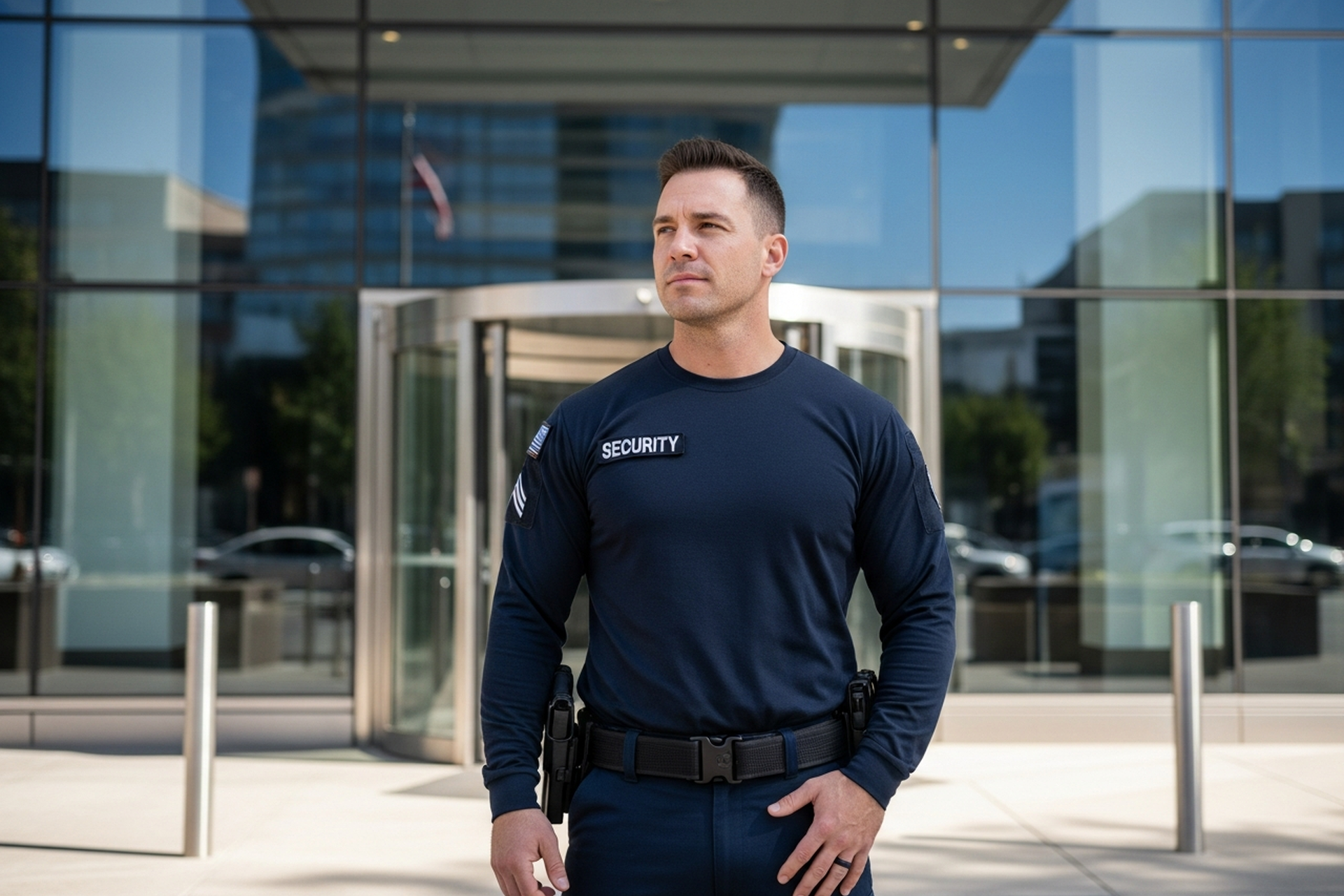
An effective lobby posture starts with a staffed reception point during all occupied hours. The officer at that post is performing continuous risk assessment: distinguishing tenants from visitors, vendors from unauthorized personnel, and normal behavior from behavior that warrants attention. Visitor management in a multi-tenant building requires a process. Credentialed tenants pre-register expected guests, unannounced visitors are held at the lobby, and delivery vendors use a designated check-in point separate from the main entrance.
The lobby is also where tenant relations and security intersect most visibly. Tenants notice when a guard is engaged and attentive. A distracted or unprofessional lobby presence signals to every tenant that the property management team is not serious, and that signal is difficult to walk back.
Access Control Integration with Security Personnel
Access control systems define who can be where and when. But access control without human oversight creates audit trails, not security. The value of the system is realized when a trained officer is actively using the data it generates.
An integrated officer knows which floors are occupied at any given time, which doors were last accessed, and how to lock down specific areas on short notice. Contractor and vendor access is where failures most commonly occur: deactivated credentials missed after a vendor change, subcontractors using tenant badges to reach mechanical floors, maintenance technicians arriving without pre-authorized work orders. Officers running weekly credential audits close those gaps before they become incidents.
Office buildings, mixed-use towers, and retail centers are classified as part of national critical infrastructure under CISA 's Commercial Facilities Sector guidance, with specific resources on physical security, access control, and threat awareness that office portfolios increasingly use as a baseline. Cascadia builds corporate and commercial security programs around those principles, layered with the local risk reality of the specific DFW submarket the building sits in.
After-Hours Coverage Models for DFW Office Buildings
Office buildings are not empty after hours. Cleaning crews, HVAC technicians, and late-working tenants all create legitimate after-hours presence. The security challenge is distinguishing that legitimate presence from unauthorized access and ensuring that incidents are caught on shift rather than discovered the next morning.
The two primary coverage models are stationed overnight officers and mobile patrol. A stationed officer is appropriate for buildings with significant after-hours foot traffic, high-value assets on specific floors, or a documented incident history that requires continuous presence. Buildings with lower overnight activity but still needing verified coverage and alarm response are a natural fit for mobile patrols , increasingly common for suburban office parks in Plano, Frisco, and Irving. Many DFW buildings use a hybrid: a stationed officer through the evening hours when cleaning crews are still present, transitioning to mobile patrol for the low-activity overnight window.
Parking Garage and Surface Lot Security
Parking facilities are the most consistently problematic security zone in commercial office buildings. They are high-traffic, low-visibility environments where auto burglary, assault, and vehicle theft concentrate. Tenants form strong opinions about parking safety, and those opinions surface in lease renewal conversations.
Effective garage security requires layered coverage: camera systems covering driving lanes, elevator lobbies, and stairwells; lighting meeting IES standards for parking structures; and access control on garage entrances. On-site personnel add what cameras cannot: visible deterrence and immediate response. A guard stationed in the garage during morning arrival and evening departure windows significantly reduces the conditions that attract opportunistic crime. For portfolios with surface lots that don't justify a dedicated post, mobile patrol creates a verifiable deterrent presence without the full-time staffing cost.
Layering: Cameras, Access Systems, Guards, Mobile Patrol
No single component works adequately on its own. Cameras document and deter, but they don't physically stop anyone and are only as useful as the attention they receive. Access control is the most operationally efficient tool in a commercial building when configured correctly, but it depends on credential integrity, which requires human oversight. On-site personnel are the connective tissue: a trained officer watching monitored feeds, enforcing access protocols, and responding to incidents before they escalate.
Mobile patrol extends coverage across time and footprint without the cost of a second full-time stationed post. All of this sits within the DFW security services framework, and the broader context for selecting a provider is covered in security guard companies in Dallas.
What This Means for Your DFW Building
A commercial building security program is an asset management decision, not just a facilities expense. The buildings that hold Class A tenants in Uptown Dallas and Legacy West are the ones where security is visible, professional, and consistently managed. Tenants do not need to think about security in a well-run building. When they do start thinking about it, lease renewal conversations become harder.
The components covered here - lobby management, access control integration, after-hours coverage, parking security, and layered systems - are not independent decisions. They are a program that requires a provider with the training depth, local infrastructure, and management accountability to execute it across every shift, every floor, and every tenant interaction. Getting the baseline right protects your asset. Getting it right consistently retains tenants.
Frequently Asked Questions
How much does commercial building security cost in Dallas?
Costs vary based on building size, number of staffed posts, coverage hours, and armed versus unarmed requirements. Unarmed officer programs for a single-building DFW office property typically range from $18 to $26 per hour per officer, depending on post requirements. A full program covering lobby staffing, after-hours coverage, and mobile patrol integration is priced per site. Contact Cascadia at (800) 939-1549 or request a quote for a site-specific estimate.
What does a typical commercial building security program include?
A complete DFW program typically includes lobby staffing during occupied hours, visitor management protocols, access control integration and credential auditing, after-hours coverage via a stationed officer or mobile patrol, parking garage oversight, camera system monitoring, and documented incident reporting. The configuration depends on building size, tenant mix, hours of operation, and incident history.
Are armed or unarmed officers right for a DFW office building?
Most Class A and B commercial office buildings in DFW use unarmed officers for lobby and interior posts. The professional, client-facing presence of a trained unarmed officer fits the tenant experience most building owners want to project. Deploying armed officers is appropriate when the building hosts high-value assets, executive-level personnel with elevated threat profiles, or is located in an area with documented elevated crime. The right configuration should come out of a formal site assessment with your provider.
How do security guards work with access control systems?
Effective integration means the officer has real-time visibility into access events, can lock or unlock zones remotely, is trained on the specific system installed in the building, and runs regular credential audits as part of their post responsibilities. Officers receive notifications about access anomalies, door-held-open alarms, and credential rejections, allowing them to investigate in real time rather than reviewing logs after an incident.
Can one provider cover multiple buildings in a DFW portfolio?
Yes, and consolidating to a single provider is typically more effective than managing separate contracts per property. A single provider creates consistent reporting standards, a unified management contact, coordinated mobile patrol routes across multiple buildings, and a shared understanding of your portfolio's risk profile. Cascadia manages multi-building DFW portfolios under a single account structure with unified digital reporting across sites.
Secure Your DFW Commercial Building
Cascadia Global Security is a veteran-owned security company providing commercial building security programs for office, retail, and mixed-use properties across Dallas-Fort Worth. We staff and manage lobby programs, after-hours coverage, parking security, and mobile patrol services for Class A and B buildings throughout downtown Dallas, Uptown, Las Colinas, Legacy West, and the Plano and Frisco corporate corridors.
Every client receives a dedicated account manager, digital reporting on every shift, and a program designed around their building's specific risk profile and tenant mix. Call Cascadia at (800) 939-1549 or visit Get a Quote to schedule a site assessment.