Professional Security Services Across the Dallas Metro Area
Josh Harris | May 26, 2026
The security services Dallas property managers actually need rarely fit a single category. A corporate campus in Las Colinas has a different risk profile than a fuel depot off I-20 or a mixed-use tower in Uptown, and getting the service type wrong costs money, creates liability, or leaves gaps that matter at 2 a.m.
This walkthrough covers every major service category available across the DFW Metroplex, what each looks like in a North Texas context, and which property types each one serves best.
Why Service Mix Matters in DFW
The Dallas-Fort Worth Metroplex spans roughly 9,000 square miles, with properties ranging from Class A office towers and luxury multifamily communities to construction corridors along SH-121, warehouse campuses in Grand Prairie, and open-air retail centers in the northern suburbs. Each environment carries a distinct threat profile and requires a different operational response. Most mid-to-large DFW properties end up using two or more service types in combination.
The Texas Department of Public Safety Private Security Bureau licenses and regulates security companies and individual officers in the state. Any provider you work with should be able to produce their PSB company registration number immediately.
For context on how Cascadia structures coverage across the region, visit our DFW security hub.
Armed and Unarmed Guard Services in Dallas
Static guard posts are the foundation of most security programs. The core decision is whether those guards should be armed.
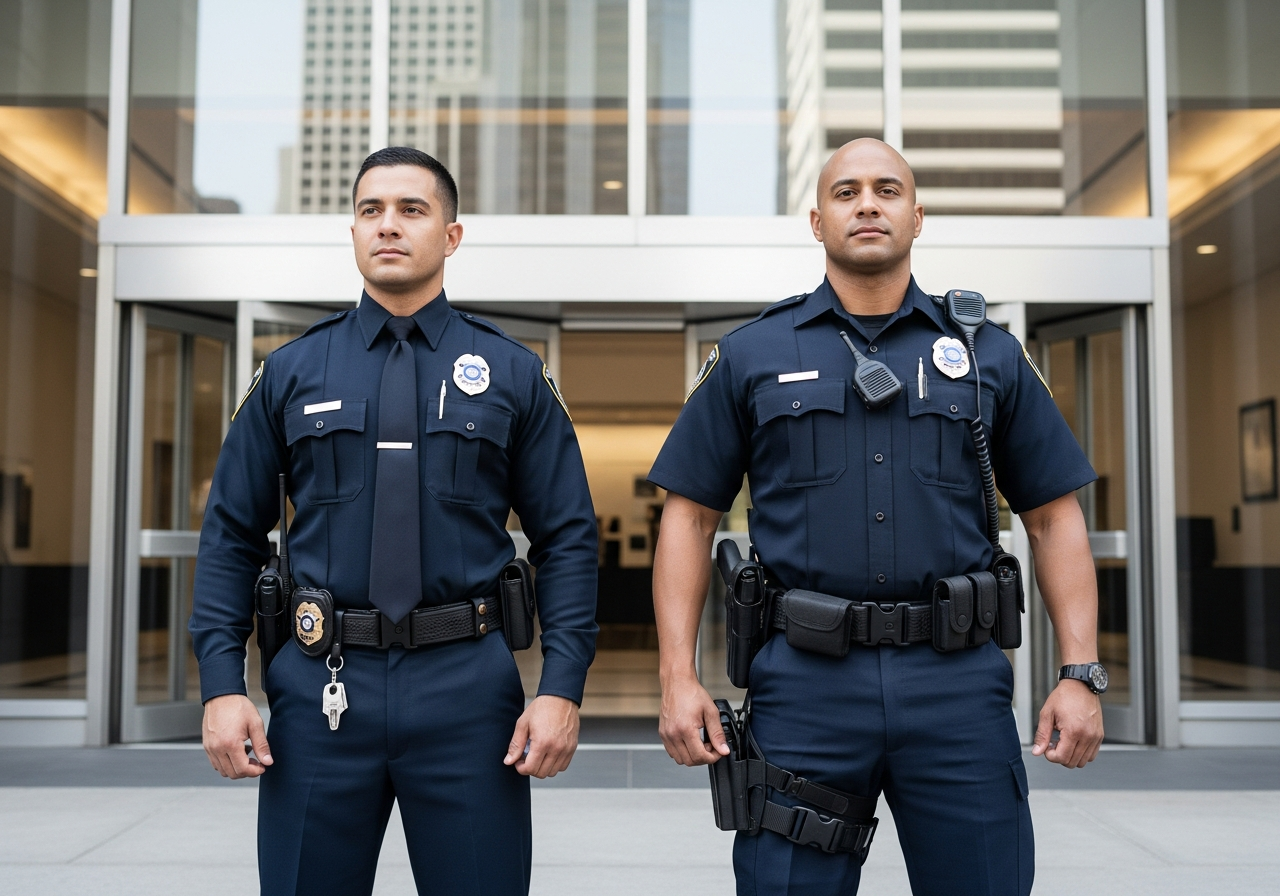
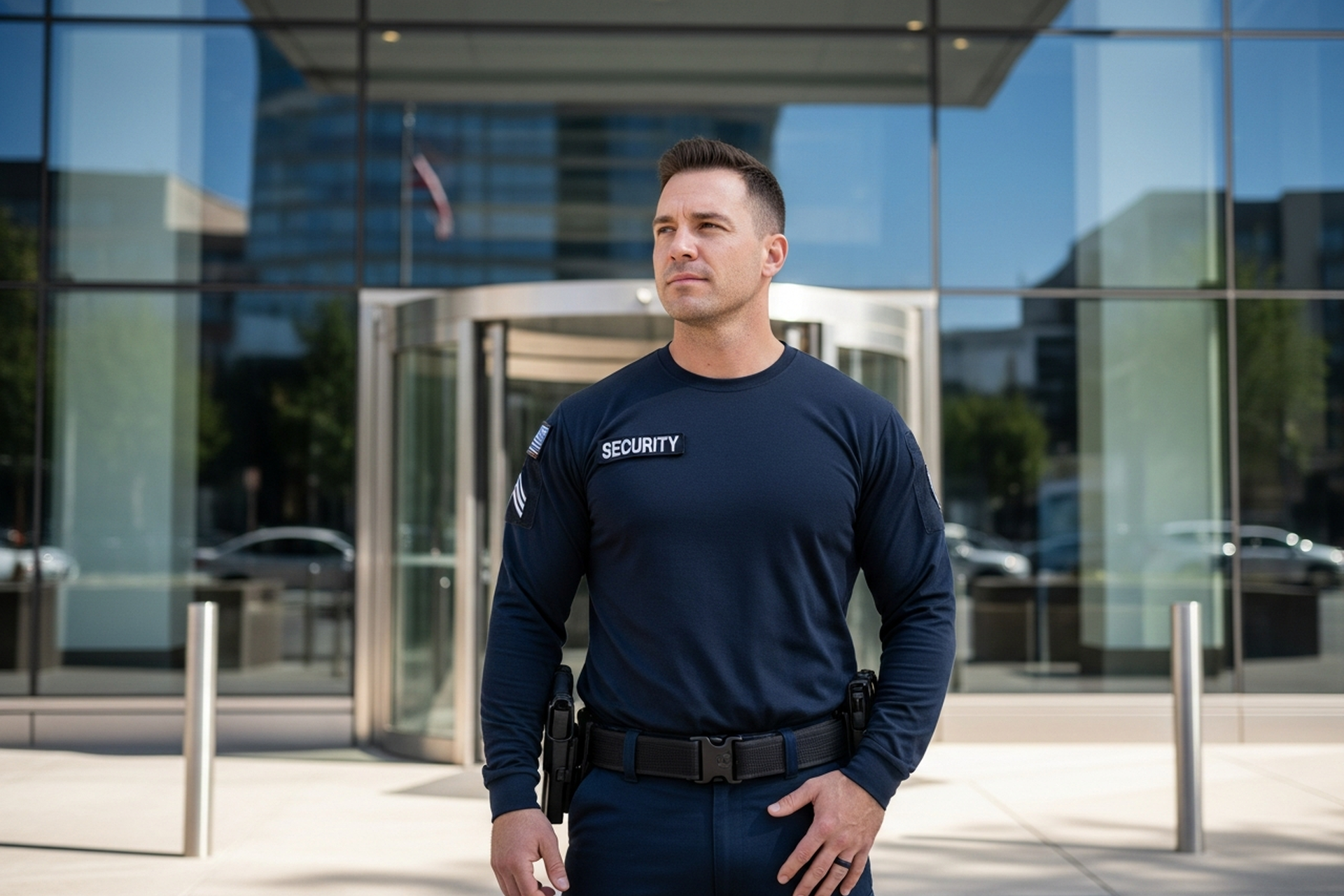
For most commercial environments, unarmed guards are the right fit where deterrence and professional presence are the primary goals. Office buildings, multifamily communities, healthcare campuses, and retail centers typically fall here. They handle access control, visitor management, incident documentation, and emergency response coordination at a lower per-hour cost than armed coverage.
Facilities where the threat profile justifies the added layer call for armed guards: jewelry retail, pharmaceutical storage, cash-handling facilities, and high-value logistics operations. In Texas, armed officers must hold a Level III Commissioned Security Officer license with a firearm endorsement issued through the DPS. Verify those credentials before deployment.
BOMA International, the trade association for commercial real estate, publishes security and emergency preparedness resources for property managers and recognizes security and emergency planning as core operational disciplines in its industry standards. In DFW, a provider with genuine regional infrastructure covers your Irving office and your Mesquite warehouse differently than one operating from a single dispatch center. The company you choose needs local staffing depth to fill posts consistently.
Mobile Patrol Services Across the Metro Area
Mobile patrols trade static post coverage for range and unpredictability. A patrol vehicle moving between multiple stops on a rotating, randomized schedule creates visible deterrence across a much larger footprint than a single officer can cover on foot.
In Dallas, mobile patrol is heavily used by multi-property retail owners, HOAs, and multifamily communities in suburban submarkets like Frisco and McKinney, industrial parks requiring after-hours coverage across large acreage, and construction sites where a 24/7 static post is not in the budget.
Patrol officers conduct exterior checks, document conditions, respond to alarms, and report incidents in real time. GPS tracking on patrol vehicles gives property managers verifiable records of every stop, making mobile patrol services in Dallas one of the most auditable coverage options available for commercial properties.
Off-Duty Law Enforcement Deployment
Off-duty law enforcement officers hold active commissions, giving them arrest authority that private security officers cannot replicate. In Texas, they can be hired through a licensed security provider for assignments that require certified law enforcement presence: high-profile events where crowd management may involve enforcement action, nightlife venues where altercation risk demands commissioned authority, and sensitive sites where private security authority is insufficient by regulation.
Off-duty deployments require more lead time than standard guard placements and carry higher billing rates. For most commercial properties, standard armed guards are the right solution. Cascadia's off-duty law enforcement program is reserved for situations where commission authority is genuinely required, with scheduling managed through our DFW operations team.
Fire Watch and Emergency Security
Fire watch is a regulatory requirement, not an optional service. When a suppression system goes offline for inspection, repair, or failure, the property must post a trained fire watch officer to patrol the affected area and document any fire risk until the system is restored.
In DFW, fire watch is most commonly needed at high-rise construction and renovation projects, hotels and multifamily properties undergoing sprinkler replacements, and commercial facilities facing unexpected suppression system failures. Fire watch officers follow a specific patrol protocol, maintain written logs, and initiate evacuation procedures when required. This is not a post you fill with a general-purpose guard.
Emergency security covers rapid-deployment scenarios: an incumbent provider exits overnight, a sudden incident requires reinforcement, or a weather event creates unplanned access control needs. A provider with the staffing depth to respond within hours is the difference between a gap and a managed situation. Our temporary and emergency security page covers both scenarios.
Executive Protection in Dallas
Executive protection is personal security for individuals, not properties. The DFW Metroplex hosts more than 20 Fortune 500 companies and a deep base of private equity, energy, and technology executives who travel frequently and maintain high public profiles. That corporate density makes Dallas one of the more active executive protection markets in the country.
A professional executive protection detail involves advance work at venues and travel routes, threat assessment, secure transportation planning, and real-time communication protocols. In Dallas, assignments commonly include airport transitions through DFW International and Love Field, corporate events requiring discreet coverage, residential security for C-suite principals, and international travel coordination originating from DFW.
Executive protection officers must have specific training beyond standard guard certification. When evaluating providers, ask about their protective detail training methodology and their experience with advance work in the Dallas market.
Drone and Robotic Patrols
Drone patrols and ground-based robotic units are in active deployment across DFW facilities, particularly where coverage area or access limitations make human-only patrols impractical.
Security drones cover aerial surveillance, perimeter monitoring, and visual response to alarm events. They are most useful for large industrial campuses, construction sites, and event venues during open-air setup and breakdown. Ground-based robotic units run programmed patrol routes, capture video, and alert human operators to anomalies. Both work best as a force multiplier alongside human officers, not as standalone solutions.
In Texas, drone operations must comply with FAA regulations, including airspace restrictions around DFW Airport and Love Field. Cascadia's drone patrol and robotic security deployments are operated by Part 107-certified operators with current FAA authorizations for the DFW airspace.
Matching Services to Property Types
- Class A Office / Corporate Campus: Unarmed guards, mobile patrol, executive protection
- Industrial / Warehouse: Unarmed or armed guards, mobile patrol, drone surveillance
- Multifamily / HOA: Unarmed guards, mobile patrol
- Retail Center: Unarmed guards, mobile patrol
- High-Value Retail (Jewelry, Pharma): Armed guards, mobile patrol
- Construction Site: Unarmed guards, mobile patrol, fire watch, drone patrol
- Hotel / Hospitality: Unarmed guards, fire watch
- Corporate Event / Venue: Armed or unarmed guards, off-duty law enforcement
- High-Rise Under Renovation: Fire watch, unarmed guards
- Executive / C-Suite Principal: Executive protection, armed guards
This table is a starting point. A site assessment will surface specifics that change the recommendation for any individual property.
Choosing Dallas Security Services for Your Property
Selecting a security service type is not a checkbox exercise. The right mix reduces your liability exposure, creates visible deterrence, and produces verifiable documentation if something goes wrong. Property managers evaluating security guard companies in Dallas should assess local staffing depth, licensing verification processes, and whether the provider can support a multi-service program rather than a single contract in isolation.
Frequently Asked Questions
What types of security services do Dallas companies offer?
Most full-service providers in DFW offer some combination of armed guards, unarmed guards, mobile patrol, off-duty law enforcement, fire watch, executive protection, and drone or robotic surveillance. Not every company offers all of them with equal depth. Before engaging a provider, confirm that the specific service type you need is staffed locally, not subcontracted.
When should I use armed vs unarmed security in Dallas?
Unarmed security fits most commercial environments where the goal is presence, access control, and documented deterrence. Armed security applies when your facility handles high-value assets, cash, pharmaceuticals, or has documented exposure to violent incidents. In Texas, armed officers must hold a Level III Commissioned Security Officer license. Verify those credentials before deployment.
Do all Dallas security companies offer mobile patrols?
No. Mobile patrol requires dedicated vehicles, GPS infrastructure, and local staff to run routes without depleting static post coverage. Smaller providers may offer it in name but dispatch a single vehicle across too large a territory to deliver meaningful deterrence. Ask how many patrol vehicles a provider operates in DFW and whether GPS records are available to you as the client.
How does off-duty law enforcement security work in Texas?
Off-duty law enforcement officers in Texas retain their arrest authority while working secondary employment through a licensed security company. The provider coordinates scheduling and manages the engagement, but the officer's commission remains active. This is appropriate for events and situations where law enforcement authority is specifically required, not as a general substitute for armed security officers.
Can I combine multiple security services for one Dallas property?
Yes, and most mid-to-large properties do. A common DFW configuration pairs a static guard post at the primary entrance with a mobile patrol covering the perimeter after hours. Construction sites often layer fire watch, mobile patrol, and drone surveillance. A quality provider builds an integrated program rather than selling each service as a separate standalone contract.
Ready to Find the Right Security Mix for Your Property?
Cascadia Global Security is a veteran-owned provider serving commercial, industrial, multifamily, and event clients across DFW. We deploy armed and unarmed guards, mobile patrols, fire watch officers, executive protection details, and drone surveillance, all managed by a local operations team with real accountability infrastructure.
Every engagement starts with a site assessment. We evaluate your property, your risk profile, and your operational requirements before recommending a service mix. No generic proposals.
To connect with a DFW security specialist, request a quote or call us at (800) 939-1549.