Security Guard Companies Serving Dallas, Texas

POST AUTHOR | POST PUBLISH DATE

The Evolving Security Landscape in the Dallas-Fort Worth Metroplex


Dallas ranks among the fastest-growing metropolitan areas in the United States, with population growth outpacing infrastructure and public safety resources. This expansion creates unique challenges for property owners, business operators, and event organizers who need reliable protection beyond what municipal police departments can provide. Security guard companies serving Dallas, Texas, have become essential partners for organizations managing risk across diverse environments, from gleaming downtown high-rises to sprawling industrial parks along the I-35 corridor.

The demand for private security in North Texas has shifted dramatically over the past five years. Where companies once viewed security as an optional expense, most now treat it as operational infrastructure, no different from IT systems or insurance coverage. This change reflects both rising crime concerns and the recognition that professional security personnel deliver measurable returns through loss prevention, liability reduction, and employee peace of mind.


Crime Trends and Public Safety in Dallas Neighborhoods


Property crime rates in Dallas remain elevated compared to national averages, with commercial burglary and theft driving significant business losses across the metroplex. Certain neighborhoods, including parts of South Dallas, Oak Cliff, and sections of Northwest Dallas, experience higher incident rates, making a visible security presence a practical necessity rather than a luxury.

For businesses in the Dallas area, particularly those with extensive parking facilities, vehicle-related crime remains a significant security challenge. Although stricter enforcement and Texas legislation (SB 224) have led to a decline in catalytic converter theft, the overall theft of high-value vehicle components and complete vehicles remains a major concern. Consequently, mobile patrol services are increasingly favored security solutions for commercial properties seeking to address the ongoing problem of vehicle theft in surface lots and parking structures.


Why Local Businesses are Prioritizing Private Security


Response times for non-emergency calls to Dallas Police can stretch beyond 30 minutes during peak periods. Businesses cannot afford to wait when suspicious activity occurs on their premises. Private security officers provide immediate intervention, deterrence, and documentation that protects both people and property.

Insurance carriers have also begun factoring security programs into their underwriting decisions. Properties with professional security oversight often qualify for reduced premiums, creating a financial incentive that offsets a portion of security costs.


Specialized Guard Services for Dallas Industries


Different industries require distinct security approaches. A one-size-fits-all strategy fails to address the specific vulnerabilities and operational requirements that vary across commercial sectors.


Commercial Real Estate and High-Rise Office Protection


Downtown Dallas and Uptown office towers require security personnel who can manage lobby access, monitor building systems, and respond to tenant concerns professionally. These environments demand officers with strong communication skills and professional presentation, as they represent the first point of contact for visitors and clients.

Building security teams typically handle access control, visitor management, and after-hours patrols. Integration with building management systems allows officers to monitor fire alarms, HVAC alerts, and elevator issues alongside traditional security functions.


Retail Loss Prevention and Shopping Center Patrols


Dallas-area businesses lose an estimated $2.1 billion annually to retail theft, according to the
National Retail Federation. Consequently, major shopping venues such as NorthPark Center, Galleria Dallas, and the Shops at Legacy properties depend on a mix of uniformed and plainclothes security personnel to prevent shoplifting and manage security incidents.

Effective retail security combines visible deterrence with trained observation. Officers positioned at entrances and throughout parking areas reduce theft attempts before they occur. When incidents do happen, properly trained personnel document evidence and coordinate with law enforcement.


Industrial and Warehouse Security for Logistics Hubs


The Dallas-Fort Worth area hosts one of the nation's largest concentrations of distribution centers, with major logistics corridors running through Lancaster, Wilmer, and the Alliance area near Fort Worth. These facilities face threats ranging from cargo theft to unauthorized access by individuals seeking to steal equipment or materials.

Cascadia Global Security provides specialized industrial security services that address the unique challenges of warehouse environments, including perimeter monitoring, truck gate access control, and coordination with facility operations teams.


Armed vs. Unarmed Personnel: Choosing the Right Level of Protection


The decision between armed and unarmed security depends on threat assessment, client preferences, and regulatory requirements. Both options serve legitimate purposes in different contexts.


Texas Level III Commissioned Guard Requirements


Armed security officers in Texas must hold a Level III commission from the
Texas Department of Public Safety's Private Security Bureau. This certification requires additional training beyond the basic Level II license, including firearms proficiency, use-of-force protocols, and legal liability education.

Armed personnel are appropriate for high-value asset protection, cash handling operations, and environments where credible threats exist. Financial institutions, jewelry stores, and certain industrial facilities commonly employ commissioned officers. The visible presence of armed security creates a stronger deterrent effect in situations where potential criminals might otherwise test boundaries.


De-escalation Training and Customer Service Roles


Most commercial environments benefit from unarmed security personnel trained in conflict resolution and customer service. These officers handle the vast majority of security functions effectively without introducing the liability considerations that accompany armed response.

Quality security providers invest heavily in de-escalation training. Officers learn to recognize escalating situations, communicate effectively with agitated individuals, and resolve conflicts without physical intervention whenever possible. This approach reduces liability exposure while maintaining safe environments.


Event Security for Dallas Venues and Festivals


Dallas hosts hundreds of major events annually, from concerts at American Airlines Center to festivals in Fair Park and corporate gatherings at the Kay Bailey Hutchison Convention Center.


Crowd Control Management for Large-Scale Gatherings


Large events require security planning that addresses crowd flow, emergency egress, and incident response. Experienced event security teams work with venue management and local authorities to develop comprehensive safety plans before doors open.

Security staffing ratios vary based on event type, expected attendance, and venue configuration. A seated concert requires different coverage than a general admission festival. Professional security companies serving Dallas events bring experience across multiple venue types and event formats.


VIP and Executive Protection Services


Corporate events, celebrity appearances, and high-profile gatherings often require executive protection services beyond standard event security. These assignments demand officers with specialized training in threat assessment, advanced planning, and protective formations.

Cascadia Global Security offers executive protection services staffed by personnel with law enforcement or military backgrounds, providing the experience and discretion that high-profile clients require.


How to Evaluate and Hire a Dallas Security Agency


Selecting the right security provider requires due diligence beyond comparing hourly rates. The cheapest option rarely delivers the best value when considering the total cost of ownership, including liability exposure and service quality.


Verifying Texas DPS Private Security Bureau Licenses


Every security company operating in Texas must hold a valid license from the Private Security Bureau. Individual officers must also maintain current registrations. Request license numbers and verify them through the DPS online database before signing any contract.

For commercial security providers, the Texas Department of Public Safety (DPS) advises carrying general liability insurance with a minimum of $1 million per occurrence and $2 million aggregate. All personnel must also be covered by workers’ compensation or occupational accident insurance. Always ask for certificates of insurance and verify coverage directly with the insurance carrier.


Assessing Technology Integration and Real-Time Reporting


Modern security operations rely on technology for accountability and communication. Look for providers offering electronic tour verification, incident reporting systems, and real-time communication capabilities.

Daily activity reports should document officer observations, incidents, and any maintenance issues identified during patrols. This documentation proves valuable for liability protection and operational improvement.
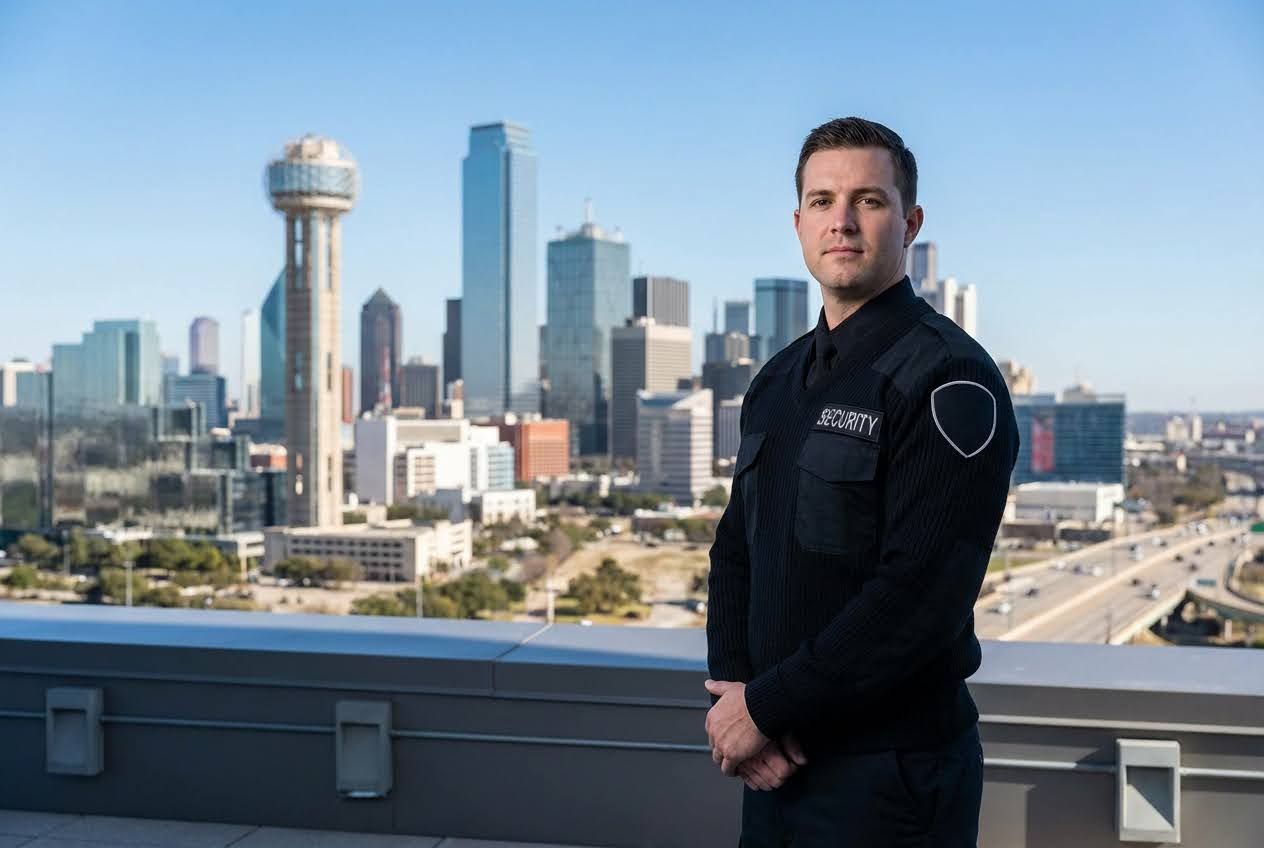

Security guard in black uniform with

Frequently Asked Questions


How much do security guard services cost in Dallas?


Security guard costs are determined by the service provided. Unarmed officers generally cost between $22 and $32 per hour, while armed guards are priced higher, typically ranging from $30 to $45 per hour. These rates reflect factors such as wage inflation and current state training mandates. Discounts are commonly available for clients who enter into volume contracts or long-term agreements.


What's the difference between Level II and Level III security officers in Texas?


Level II officers are non-commissioned and cannot carry firearms while on duty. Level III officers hold a commission that allows them to carry weapons after completing additional training and a background screening.


How quickly can a security company deploy officers to my Dallas location?


Established providers can typically deploy personnel within 24 to 48 hours for standard assignments. Emergency coverage may be available the same day, depending on the provider's staffing capacity.


Do security guards have arrest authority in Texas?


In Texas, security officers possess the same arrest authority as private citizens. Specifically, they are permitted to detain individuals for felonies committed in their presence until law enforcement arrives. However, they are generally prohibited from making arrests for misdemeanors, with the exception of specific scenarios, such as breaches of the peace or when otherwise authorized under the Texas Code of Criminal Procedure Article 14.01.


Should I hire off-duty police officers or private security guards?


Off-duty officers bring law enforcement authority and training, but cost more and have scheduling limitations. Private security offers more flexibility and lower costs for most commercial applications. Many organizations use both depending on the situation.


Securing Your Dallas Property with Professional Oversight


Selecting security guard companies in Dallas requires matching provider capabilities to your specific operational needs. The right partner brings industry experience, properly trained personnel, and management systems that ensure consistent service delivery.

Start by documenting your security requirements: access points, operating hours, specific threats, and any industry-specific regulations that apply. Use this assessment to evaluate potential providers against concrete criteria rather than marketing claims.

For businesses seeking reliable security solutions across the Dallas-Fort Worth area, Cascadia Global Security offers professionally managed guard services backed by local supervision and centralized support. As a veteran-owned firm, Cascadia brings operational discipline and accountability to every client engagement.
By Josh Harris March 10, 2026
Defining the Role of Rapid Response Security A standard security guard monitors cameras and checks badges. A rapid response security team operates differently: they deploy within minutes when situations escalate beyond normal protocols. Understanding when to call a rapid response security team can mean the difference between a contained incident and a full-scale crisis. These specialized units exist for one purpose: immediate intervention when standard security measures prove insufficient. They're trained for high-pressure scenarios, equipped for physical confrontation, and authorized to take decisive action. Most organizations never need them. But those who do often discover the need comes without warning. The critical question isn't whether your facility might face a serious threat. The question is whether you've established clear protocols for recognizing when that threshold has been crossed, and who to contact when it has. Differences Between Standard Guarding and Rapid Response Standard security guards excel at deterring, observing, and enforcing routine. They manage access points, document incidents, and maintain a visible presence that discourages opportunistic crime. Their training emphasizes de-escalation and communication. Rapid response teams train for scenarios where de-escalation has failed or isn't possible. They carry different equipment, operate under different rules of engagement, and possess specialized training in threat neutralization. Where a guard's job is to prevent problems, a response team's job is to end them. Capabilities of High-Threat Intervention Teams Rapid Response Security Teams are typically composed of personnel with backgrounds in the military or law enforcement. For instance, Cascadia Global Security utilizes teams that include former and off-duty law enforcement officers. This composition offers greater tactical expertise; however, it's important to note that when off duty, their legal authority is limited to that of a licensed private security officer. Response teams can establish perimeter control, conduct coordinated building sweeps, provide armed escort for evacuations, and interface directly with arriving law enforcement. Their training covers active shooter response, hostage situations, and coordinated threat suppression. Immediate Physical Threats and Security Breaches Some situations demand immediate professional intervention. Recognizing these scenarios in advance allows a faster response when seconds matter. Unauthorized Intrusion and Perimeter Violations Not every trespasser requires armed response. A confused delivery driver at the wrong entrance is a standard security matter. But certain intrusion patterns signal serious intent. Call for a rapid response when intruders: Bypass multiple security layers deliberately Ignore verbal commands and continue advancing Display weapons or make explicit threats Arrive in coordinated groups targeting specific areas Demonstrate knowledge of facility layout or security gaps The distinction matters. Professional intruders conduct reconnaissance. They know where the cameras point and when shifts change. When someone breaches your perimeter with evident preparation, standard guards are outmatched. Active Workplace Violence or Hostile Confrontations Workplace violence incidents escalate in seconds. The moment a verbal confrontation involves weapons, physical assault, or credible death threats, rapid response protocols should activate. Warning signs that warrant immediate escalation include an individual barricading themselves with hostages, multiple aggressors acting in coordination, any firearm or edged weapon display, and situations where standard security personnel are injured or pinned down. Don't wait to confirm the severity. False alarms cost money. Delayed responses cost lives. High-Value Asset Protection During Emergencies Emergencies create opportunities for theft. Power outages disable alarm systems. Natural disasters overwhelm first responders. Civil unrest diverts police attention. Criminals exploit these windows. Responding to Large-Scale Theft or Looting Risks The civil unrest of 2020 resulted in substantial financial damage nationwide, with retail losses exceeding $1.5 billion, according to the Insurance Information Institute. A key finding is that while the majority of affected businesses had conventional security measures, very few had an established rapid response plan. Triggers for immediate deployment include confirmed looting at nearby businesses, loss of primary alarm or surveillance systems, credible intelligence of organized theft targeting your location, and any announcement by local law enforcement of delayed response times. Rapid response teams can establish a visible armed presence, secure high-value inventory for emergency relocation, and maintain perimeter integrity until normal operations resume. Securing Critical Infrastructure After System Failures Data centers, manufacturing facilities, and utility installations face unique vulnerabilities during system failures. When backup power fails or security systems go offline, these facilities become attractive targets. Cascadia Global Security provides emergency and short-term security coverage specifically for these scenarios, deploying trained personnel to maintain physical security while technical teams restore systems. Civil Unrest and Crowd Control Scenarios Protests and demonstrations present complex security challenges. Most remain peaceful. Some don't. The transition often happens rapidly. Managing Escalating Protests and Demonstrations Calling a rapid response for a peaceful protest is both unnecessary and counterproductive. Visible armed security can escalate tensions. The key is recognizing genuine escalation patterns. Indicators that warrant response team deployment: Protesters begin targeting your specific facility Property destruction begins at your location or in your immediate vicinity The crowd attempts to breach the facility entrances Standard security personnel report being overwhelmed Local law enforcement indicates they cannot respond Response teams trained in crowd management understand the balance between protecting assets and avoiding provocation. They establish defensive positions, secure entry points, and provide evacuation support without aggressive posturing that might worsen the situation. Executive and Personnel Safety During Travel Business travel exposes personnel to risks that office-based security cannot address. International operations in unstable regions require specialized protection protocols. Extraction Protocols in Unstable Environments Political instability, natural disasters, and regional conflicts can strand personnel in dangerous locations. Standard corporate travel policies assume functioning infrastructure and responsive emergency services. Rapid response becomes necessary when local conditions deteriorate suddenly, transportation infrastructure fails, personnel face targeted threats, or embassy or consular services become unavailable. Professional extraction teams coordinate with local contacts, arrange secure transportation, and maintain communication with corporate headquarters throughout the operation. They operate where local security services cannot or will not respond. Integrating Rapid Response into Your Emergency Plan Having access to rapid response services means nothing without clear activation protocols. Too many organizations establish contracts but never define when they take effect. Establishing Clear Triggers for Deployment Vague guidelines like "call when necessary" guarantee hesitation during actual emergencies. Specific triggers eliminate decision paralysis. Effective trigger definitions specify exact scenarios requiring response, authorize specific personnel to make the call, establish backup authorization chains, and include time-based escalation protocols. Example: "If facility alarm indicates breach in Zones A-C after hours and on-site guard cannot verify cause within 3 minutes, Security Director or designated backup authorizes rapid response deployment." This specificity ensures a consistent response regardless of which personnel are on duty at the time of an incident. Communication Channels with Response Units Response teams need accurate information to deploy effectively. Establish dedicated communication channels that remain functional during emergencies. Primary channels should include direct phone lines to response coordinators, backup satellite or radio communication, pre-shared facility maps and access codes, and designated meeting points for team arrival. Test these channels quarterly. Systems that work during normal operations sometimes fail under crisis conditions. Cascadia Global Security maintains centralized oversight to ensure reliable communication during emergency deployments.
By Josh Harris March 10, 2026
Security guards don't always need to carry firearms to protect your property effectively. For many businesses, unarmed security personnel provide the ideal balance of visible deterrence, customer service, and cost efficiency. Understanding when unarmed security companies are the right fit for your specific situation can save thousands in unnecessary expenses while still maintaining a safe environment. The decision between armed and unarmed protection isn't about choosing less security. It's about matching your security posture to your actual risk profile. A retail store in a suburban shopping center faces fundamentally different threats than a jewelry exchange in a high-crime district. Hiring armed guards for the former is a waste of money and can create an uncomfortable atmosphere for customers. The wrong choice in either direction leaves you either over-protected and over-budget, or dangerously exposed. Data from the Bureau of Labor Statistics show that approximately 70% of security guard positions in the United States are unarmed. This isn't because businesses are cutting corners. It reflects a practical reality: most security situations require observation, communication, and presence rather than the threat of lethal force. When you understand the specific strengths of unarmed security and where these professionals excel, you can make informed decisions that protect both your assets and your bottom line. Defining the Role of Unarmed Security Personnel Unarmed security officers serve as the first line of defense for properties where the primary threats involve trespassing, theft, vandalism, or unauthorized access rather than violent confrontation. Their effectiveness comes from visibility, training, and the ability to respond appropriately to developing situations before they escalate. Core Responsibilities and Training Standards Professional unarmed guards undergo comprehensive training that covers access control procedures, emergency response protocols, conflict resolution, and detailed reporting. State licensing requirements vary, but reputable companies go beyond minimum standards by providing ongoing education in areas such as fire safety, first aid, and customer service. The typical responsibilities include monitoring surveillance systems, conducting regular patrols, verifying credentials at entry points, and documenting incidents. Guards also serve as the primary contact for emergency services, ensuring that police, fire, or medical responders receive accurate information upon arrival. Cascadia Global Security trains personnel in these core competencies while emphasizing the communication skills that distinguish professional security from simple watchman services. The Psychological Advantage of a Non-Threatening Presence A uniformed guard creates what security professionals call "natural surveillance," the awareness among potential wrongdoers that their actions are being observed. This deterrent effect works regardless of whether the guard carries a weapon. Research in environmental criminology consistently demonstrates that visible security presence reduces opportunistic crime. The key insight is that most property crimes are crimes of opportunity. Shoplifters, vandals, and trespassers typically avoid locations with obvious security. An unarmed guard in a professional uniform achieves this deterrent effect while maintaining an approachable demeanor that doesn't alienate legitimate visitors or customers. Key Environments Where Unarmed Security Excels Certain settings benefit specifically from unarmed security due to their operational requirements, customer demographics, or risk profiles. Matching security type to environment maximizes both protection and return on investment. Retail and Commercial Customer Service Roles Retail environments present a unique challenge: security must deter theft while creating a welcoming atmosphere for paying customers. Armed guards can intimidate shoppers and create an uncomfortable environment, hurting sales. Unarmed officers trained in loss prevention techniques observe customer behavior, monitor fitting rooms and high-theft areas, and intervene appropriately when they spot suspicious activity. They greet customers, answer questions, and assist with directions, blending security functions with customer service. This dual role makes them valuable assets rather than pure overhead costs. Residential Communities and Gated Access Control Homeowners' associations and apartment complexes require security that balances protection with community relations. Residents want to feel safe, not surveilled. Armed guards at a residential gate create an atmosphere more appropriate for a military installation than a family neighborhood. Unarmed officers handle visitor verification, package acceptance, patrol common areas, and respond to noise complaints or minor disputes. They become familiar faces who know the residents, creating a sense of community while maintaining security protocols. Corporate Offices and Low-Risk Event Management Office buildings and corporate campuses need security for access control, visitor management, and after-hours protection. The primary threats involve unauthorized entry, workplace violence prevention through early intervention, and protection of sensitive information rather than armed robbery. Conference security, trade shows, and corporate events similarly benefit from unarmed personnel who can manage crowds, check credentials, and respond to medical emergencies without the liability concerns that accompany armed guards at gatherings. Evaluating the Benefits: Cost-Effectiveness and Liability Financial considerations often drive security decisions, and unarmed services offer significant advantages in both direct costs and risk management. Reduced Insurance Premiums and Legal Risks Armed security introduces substantial liability exposure. Any incident involving a firearm, whether a discharge, threat, or even improper display, can result in lawsuits naming both the security company and the client's business. Insurance premiums for armed guard services typically run 20–35% higher than unarmed equivalents. The legal standard for armed response is also more stringent. Courts scrutinize armed interventions more carefully, and the consequences of mistakes are severe. Unarmed guards face lower liability thresholds because their response options don't include lethal force. Budget-Friendly Security Scalability Unarmed officers cost less per hour, allowing businesses to deploy more coverage with the same budget. A company that can afford one armed guard for eight hours might instead employ two unarmed officers for overlapping shifts, providing 16 hours of coverage. This scalability matters particularly for businesses with variable security needs. Cascadia Global Security works with clients to develop flexible staffing models that increase coverage during high-risk periods without the premium costs associated with armed personnel. When to Choose Unarmed Over Armed Guards The decision requires an honest assessment of your actual security environment rather than assumptions about what "real" security looks like. Assessing Threat Levels and Crime Statistics Start with data. What crimes occur in your area and at similar businesses? Local police departments provide crime statistics by neighborhood. If your primary concerns involve shoplifting, trespassing, or vandalism rather than armed robbery or violent crime, unarmed security addresses your actual risks. Industry matters too. Banks, jewelry stores, and cannabis dispensaries face different threat profiles than office buildings or apartment complexes. The presence of cash, high-value portable merchandise, or controlled substances changes the calculus. De-escalation vs. Force: Prioritizing Communication Most security incidents are resolved through communication rather than force. A skilled guard who can talk down an agitated person, calmly redirect a trespasser, or defuse a customer dispute provides more practical value than one whose primary qualification is weapons proficiency. Training in verbal de-escalation, crisis intervention, and conflict resolution equips unarmed officers to handle the situations they'll actually encounter. These skills prevent incidents from escalating to the point where armed response would even be considered. Selecting the Right Unarmed Security Partner Not all security companies deliver equivalent service. Due diligence in vendor selection protects your investment and ensures you receive professional protection. Verifying Licensing and Professional Certifications Every state requires security companies and individual guards to hold valid licenses. Request proof of current licensing and verify it independently through your state's regulatory agency. Ask about insurance coverage, including general liability and workers' compensation. Professional certifications from organizations such as ASIS International indicate a commitment to industry standards. Companies that invest in certification demonstrate a serious commitment to their profession. Tailoring Security Plans to Specific Facility Needs Generic security approaches waste money and leave gaps. A qualified provider conducts a thorough assessment of your property, identifies vulnerabilities, and develops customized protocols. Cascadia Global Security emphasizes site-specific planning that addresses your unique operational requirements rather than applying one-size-fits-all solutions. Ask potential providers about their supervision structure, response times for filling shifts, and incident-handling procedures. The answers reveal whether you're dealing with professionals or a company that simply places warm bodies at your door.