
Wired Security Camera Systems and On-Site Guards: A Stronger Defense Together

Josh Harris • February 6, 2026

A single security breach can cost businesses an average of $4.88 million, according to IBM's 2024 data breach report. Yet most organizations still treat surveillance technology and human security personnel as separate line items rather than integrated components of a unified defense strategy. The most effective security programs recognize that wired security camera systems and on-site guards create a stronger defense together than either element operating independently. This combination addresses the fundamental limitations each approach faces when deployed in isolation. Cameras capture everything but respond to nothing. Guards respond quickly but cannot monitor every corner simultaneously. When these two elements work in concert, facilities gain comprehensive coverage, immediate response capability, and documented evidence for investigations. The organizations achieving the lowest incident rates understand this principle and build their security infrastructure accordingly.


The Synergy of Human Intelligence and Hardwired Reliability


Security professionals consistently rank the camera-guard combination as the most effective deterrent against both opportunistic and planned criminal activity. The reason is straightforward: hardwired surveillance provides constant, unflinching observation while trained personnel supply judgment, adaptability, and physical presence.


Why Integration Outperforms Isolation


Cameras excel at documentation and wide-area monitoring. Guards excel at interpretation and intervention. Together, they create a security ecosystem in which each component compensates for the others' weaknesses.

  • Cameras detect motion in areas guards cannot physically patrol
  • Guards interpret ambiguous footage that automated systems might miss
  • Wired connections ensure footage reaches monitors without interruption
  • Human presence deters threats that cameras alone cannot discourage

This partnership transforms passive observation into active protection, providing facilities with both the documentation they need for legal purposes and the immediate response capability to prevent incidents from escalating.


Technical Advantages of Wired Camera Systems


Wireless technology has its place, but critical security infrastructure demands the reliability that only hardwired connections provide. Facilities handling sensitive operations, high-value inventory, or significant foot traffic benefit most from wired systems.


Consistent Power and High-Bandwidth Data Transmission


Wired cameras draw power directly from their connections, eliminating battery concerns and maintenance cycles.
Power over Ethernet technology delivers both electricity and data through a single cable, simplifying installation and reducing failure points.

  • No battery degradation affecting coverage during critical moments
  • Consistent 4K video transmission without compression artifacts
  • Uninterrupted recording during extended incidents
  • Reduced maintenance visits and associated costs

High-bandwidth transmission matters when guards need to identify faces, license plates, or specific behaviors. Compressed wireless footage often lacks the detail required for accurate assessment.


Immunity to Signal Jamming and Wireless Interference


Sophisticated criminals increasingly use
signal jammers to disable wireless security systems before attempting entry. While wired systems are largely resistant to signal jamming, they are not completely immune since network-based attacks can still disrupt data transmission if not properly secured. Wired infrastructure remains far less vulnerable to radio frequency interference than wireless systems, maintaining near full functionality regardless of the electromagnetic environment.

Industrial facilities face additional wireless challenges from heavy machinery, metal structures, and competing radio frequencies. Wired systems eliminate these variables almost entirely, providing consistent performance in environments where wireless signals struggle.


How On-Site Guards Enhance Surveillance Capabilities


Even the most advanced camera system requires human interpretation to deliver security value. Guards transform raw footage into actionable intelligence and immediate response.


Real-Time Monitoring and Immediate Decision Making


Trained security personnel recognize behavioral patterns that automated systems miss. A person loitering near an emergency exit might trigger no automated alert, but an experienced guard watching that feed would immediately recognize the threat.

Cascadia Global Security trains personnel to identify pre-incident indicators across various threat types:

  • Surveillance behavior from potential intruders
  • Social engineering attempts at access points
  • Internal policy violations that precede theft
  • Emergency situations requiring immediate response

This human judgment layer converts surveillance data into protective action within seconds rather than minutes.


Physical Intervention and Deterrence Beyond the Lens


Cameras document incidents. Guards prevent them. The visible presence of professional security personnel dramatically reduces the likelihood of attempted crimes before they occur.

When prevention fails, guards provide an immediate physical response that cameras cannot. They can secure perimeters, protect personnel, preserve evidence, and coordinate with law enforcement while maintaining surveillance coverage through the camera network.


Optimizing Response Times Through Integrated Systems


Response time determines outcomes in security incidents. Integrated camera-guard systems reduce the time between detection and intervention from minutes to seconds.


Coordinating Camera Alerts with Guard Patrol Routes


Smart integration means guards receive alerts on mobile devices with live camera feeds showing exactly what triggered the notification. They can assess the situation as they approach it, arriving prepared rather than surprised.

Effective coordination includes:

  • Automated alerts are routed to the nearest available guard
  • Live footage streaming to guard mobile devices
  • Two-way communication between monitoring stations and patrol units
  • GPS tracking showing guard positions relative to incidents

Cascadia Global Security implements these coordination protocols across client sites, ensuring that camera detection triggers a guard response immediately.


Using Wired Feeds for Evidentiary Support and Investigation


Wired systems produce high-quality footage that holds up in legal proceedings. Guards document incidents in real-time while cameras capture evidence from multiple angles, creating comprehensive records that support prosecution and insurance claims.

The combination proves particularly valuable for:

  • Workplace incident investigations
  • Theft and vandalism prosecution
  • Liability protection against false claims
  • Pattern analysis for security improvements


Cost-Effectiveness and Long-Term Security ROI


Initial installation costs for wired systems exceed wireless alternatives, but the total cost of ownership tells a different story. Wired infrastructure requires less maintenance, experiences fewer failures, and lasts significantly longer.

The guard-camera combination reduces costs through:

  • Lower insurance premiums from comprehensive coverage
  • Reduced theft and vandalism losses
  • Decreased liability exposure from documented incidents
  • Optimized allocation of security personnel through better monitoring efficiency

Organizations typically recover integration costs within 24-30 months through loss prevention alone, with ongoing savings accumulating year over year.
Security threats evolve constantly. Infrastructure built today must accommodate tomorrow's challenges without complete replacement. Wired systems accept software upgrades, camera replacements, and expanded coverage without fundamental rewiring.

Guard training programs adapt to emerging threats through ongoing education. The human element provides flexibility that technology alone cannot match, while hardwired infrastructure provides the stable foundation that supports continuous improvement.

Organizations serious about long-term security invest in both elements simultaneously, recognizing that wired camera systems and guards together create defense capabilities neither achieves independently.
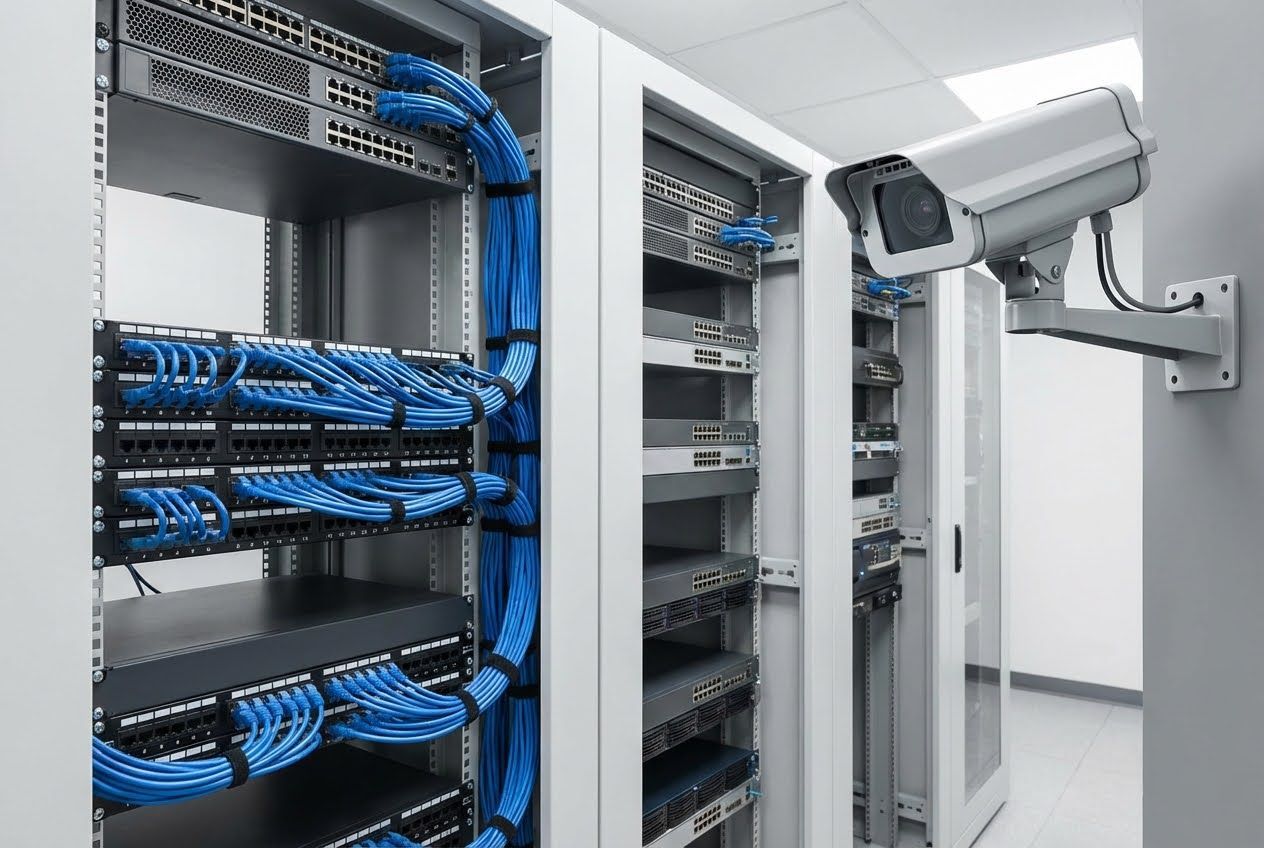

A wall-mounted security camera overlooks server racks with neatly bundled blue Ethernet cables.

Frequently Asked Questions


How much does an integrated camera and guard security cost compared to cameras alone?


Integrated systems typically cost 30-50% more than cameras alone initially, but reduce total security incidents by 50-70%. Most organizations achieve positive ROI within two years through loss prevention and reduced insurance premiums.


Can existing wireless cameras integrate with on-site guard operations?


Yes, though wired systems provide more reliable integration. Wireless cameras can connect to guard monitoring systems, but signal interruptions may create coverage gaps during critical moments.


What training do guards need to effectively use camera systems?


Effective integration requires training in monitoring software, threat recognition, alert response protocols, and evidence preservation.
Cascadia Global Security provides comprehensive training covering all integration aspects.


How many cameras per guard represents optimal coverage?


Ratios vary by facility type, but most commercial applications function well with 10-20 cameras per monitoring guard, supplemented by patrol personnel who respond to alerts.


Do wired camera systems work during power outages?


Professional installations include battery backup and generator connections. Properly designed systems maintain full functionality for at least several hours during outages, depending on UPS capacity and power prioritization, with critical cameras prioritized for extended backup periods.


What industries benefit most from integrated camera-guard security?


Warehouses, distribution centers, corporate campuses, retail locations, and construction sites see the highest returns from integration. Any facility with significant foot traffic or valuable assets benefits substantially.


Strengthening Your Security Strategy


The evidence supporting integrated security approaches continues to mount. Organizations that combine wired surveillance infrastructure with professional guard services consistently outperform those that rely on either element alone. The question is not whether integration works, but how quickly you can implement it.

For facilities ready to build comprehensive security programs, Cascadia Global Security offers professional guard services and security consulting backed by veteran leadership and local management teams. Contact us to discuss how integrated security can protect your operations.

By Josh Harris February 7, 2026
When alarms sound, and panic spreads, the difference between controlled evacuation and chaos often comes down to one factor: security personnel who know exactly what to do. Buildings empty in minutes during emergencies, but those minutes determine whether everyone reaches safety or whether bottlenecks, confusion, and secondary incidents claim lives. Effective evacuation planning assigns security teams a central role during emergencies, transforming guards from passive observers into active life-safety coordinators. Security officers positioned at critical points, trained in crowd psychology, and connected to real-time communication networks become force multipliers when seconds count. Understanding how security professionals contribute to emergency response reveals why their involvement must begin long before any alarm sounds. The Intersection of Physical Security and Life Safety Security and emergency management share a fundamental goal: protecting people and assets from harm. When these disciplines operate in silos, gaps emerge that cost lives during actual emergencies. Defining the Security Officer's Role in Crisis Management Security officers occupy a unique position during emergencies. They know the facility's layout intimately, recognize faces, and understand normal traffic patterns. This institutional knowledge proves invaluable when directing evacuees away from danger zones or identifying individuals who need assistance. Their responsibilities during crisis events typically include: Initial threat assessment and alarm verification Crowd direction at key decision points Access control to prevent re-entry into dangerous areas Communication relay between occupants and emergency responders Assistance coordination for individuals with mobility challenges Integrating Security Personnel into Emergency Action Plans (EAPs) Emergency action plans that treat security as an afterthought fail when tested. Cascadia Global Security emphasizes integrating guard services directly into client EAPs from the earliest stages of development. This means security officers participate in planning meetings, review evacuation routes, and provide input on potential obstacles. The result is a plan that accounts for real-world conditions rather than theoretical scenarios drawn on blueprints. Pre-Emergency Risk Assessment and Facility Hardening Effective emergency response begins months or years before any incident occurs. Security teams contribute critical ground-level intelligence during the assessment phase. Identifying Vulnerabilities in Egress Routes Security officers patrol facilities daily and notice problems that escape periodic inspections. Locked exit doors, blocked corridors, malfunctioning emergency lighting, and obstructed stairwells all create evacuation hazards. Regular vulnerability assessments should document: Exit door functionality and signage visibility Corridor widths and potential obstruction points Stairwell capacity and lighting conditions Assembly area accessibility and capacity Alternative routes when primary paths become compromised Strategic Placement of Security Assets and Wayfinding Where security officers position themselves during emergencies determines the efficiency of evacuations. Pre-planned posts at corridor intersections, stairwell entrances, and exit points ensure evacuees receive consistent direction. Wayfinding becomes critical when smoke, power outages, or unfamiliar visitors complicate navigation. Security personnel stationed at decision points prevent hesitation that can create dangerous crowding. Active Response: Crowd Control and Panic Mitigation The moment an emergency begins, security officers transition from monitoring to active intervention. Their visible presence and calm authority shape how evacuees behave. Directing Safe Movement and Preventing Bottlenecks Bottlenecks kill people during evacuations. Crowds compress at narrow points, creating crushing pressure that can cause injuries and block escape routes entirely. Security officers trained in crowd dynamics recognize early warning signs: slowing movement, increasing density, and rising noise levels. Effective interventions include: Redirecting flow to underutilized exits Maintaining spacing at merge points Physically positioning to prevent counterflow Using clear verbal commands that cut through ambient noise Research indicates that trained personnel can effectively influence nearby crowd behavior, though the effective distance varies based on environmental factors and acoustics. Managing Access Control During Mass Egress Normal access control protocols reverse during evacuations. Doors that typically require credentials must open freely for outbound traffic while preventing unauthorized re-entry. Security teams manage this transition by overriding electronic locks, propping doors appropriately, and stationing personnel to ensure one-way flow. The challenge intensifies when evacuations occur during active threats, requiring officers to balance rapid egress against the risk of admitting hostile actors. Communication Systems and Information Flow Information moves faster than people during emergencies. Security teams that control information flow can direct evacuations more effectively than those relying solely on physical presence. Security Operations Centers (SOC) as Information Hubs Centralized security operations centers aggregate data from cameras, access systems, fire panels, and field personnel into a unified picture. SOC operators track evacuation progress across multiple zones simultaneously, identifying areas where movement has stalled or where threats have emerged. This bird's-eye view enables: Real-time route adjustments based on developing conditions Resource reallocation to problem areas Accurate status reporting to emergency responders Documentation for post-incident analysis Liaising with First Responders and Law Enforcement When fire departments, police, or EMS arrive, security personnel serve as translators between institutional knowledge and external responses. Officers brief responders on building layout, occupant counts, hazard locations, and evacuation status. This handoff accelerates professional response and prevents duplication of effort. Cascadia Global Security trains personnel specifically in interagency communication protocols, ensuring smooth coordination when multiple organizations converge on an incident. Post-Evacuation Accountability and Site Security Evacuations don't end when occupants exit the building. The post-evacuation phase presents distinct security challenges that require continued vigilance. Assisting in Muster Point Verification Accountability determines whether rescue operations are necessary. Security officers assist department heads in verifying personnel at designated muster points, cross-referencing against access logs and visitor records. Missing persons trigger search protocols that put responders at risk, making accurate counts essential. Key accountability tasks include: Maintaining muster point perimeters to prevent wandering Recording arrivals and departure times Identifying individuals requiring medical attention Communicating headcount status to the incident command Securing the Perimeter Against Secondary Threats Empty buildings attract opportunistic threats. Looters, vandals, and individuals seeking shelter may attempt entry during the confusion following evacuations. Security teams establish perimeter control to protect assets and preserve the scene for investigation. This phase also involves preventing premature re-entry by employees eager to retrieve belongings or resume work before conditions are declared safe. Continuous Improvement Through Training and Drills Emergency response capabilities degrade without regular practice. Training transforms written procedures into reflexive actions that function under stress. Effective drill programs test specific capabilities rather than simply moving people outside. Scenario-based exercises might simulate blocked exits, injured evacuees, or communication failures to evaluate adaptive response. After-action reviews identify gaps between planned and actual performance, driving procedure updates, and targeted retraining. Organizations partnering with professional security providers like Cascadia Global Security benefit from personnel who arrive with baseline emergency response training and integrate quickly into site-specific protocols. Quarterly drills, annual full-scale exercises, and tabletop simulations each serve distinct purposes in maintaining readiness. The investment in training time pays dividends when real emergencies occur.
By Josh Harris February 7, 2026
A corporate executive receives a credible threat. A warehouse storing millions in inventory sits vulnerable overnight. A company must terminate a volatile employee with documented aggression issues. These scenarios share a common thread: the moment when internal resources prove insufficient and professional protection becomes essential. Knowing when to hire security professionals separates organizations that prevent incidents from those that react to them. The decision involves more than placing guards at doors. It requires understanding threat levels, matching personnel capabilities to specific risks, and building protection strategies that scale with organizational needs. For businesses facing genuine security concerns, the question isn't whether professional protection makes sense, but rather what type of coverage their situation demands. The Evolution of Private Security Needs Transitioning from Public to Private Protection Public law enforcement serves communities, not individual businesses. Police respond to crimes in progress or after they occur. They cannot provide dedicated surveillance, access control, or preventive presence for private property. This gap has driven organizations toward private security solutions that offer consistent, site-specific coverage. The shift reflects a practical reality: businesses need protection tailored to their operations, schedules, and vulnerabilities. A distribution center operating 24/7 requires different coverage than a corporate headquarters with standard business hours. Private security fills these needs with: Dedicated personnel assigned to specific locations Customized patrol schedules matching operational patterns Immediate response protocols for site-specific scenarios Direct accountability to the client organization Assessing Modern Threat Landscapes Today's security challenges extend beyond traditional concerns like theft and trespassing. Organizations face workplace violence, corporate espionage, activist disruptions, and cyber-physical threats where digital breaches enable physical access. Threat assessment has become more complex, requiring professionals who understand both traditional security principles and emerging risk categories. Effective assessment examines internal vulnerabilities, external threat actors, and their intersection. A retail location might prioritize shoplifting prevention, while a research facility focuses on intellectual property protection. Both require professional oversight, but the personnel, protocols, and technologies differ significantly. High-Risk Scenarios Requiring Professional Oversight Executive and VIP Close Protection Executives, public figures, and high-net-worth individuals face risks that standard security measures cannot address. Close protection requires specialized training in threat recognition, defensive driving, advanced site surveys, and emergency medical response. The personnel providing this coverage operate differently from static security guards. Close protection details typically include: Advance teams surveying venues before arrival Trained drivers with evasive maneuvering capabilities Real-time communication networks among team members Coordination with local law enforcement when appropriate High-Value Asset and Logistics Security Cargo theft costs U.S. businesses an estimated $1 billion to $2 billion annually, according to the FBI’s most recent estimates as of 2025. High-value shipments, whether electronics, pharmaceuticals, or luxury goods, attract organized criminal operations with sophisticated surveillance and interception capabilities. Protecting these assets requires security personnel who understand supply chain vulnerabilities and can implement countermeasures during transit and storage. Cascadia Global Security provides armed and unarmed personnel for warehouse protection, logistics security, and distribution center coverage where high-value inventory demands professional oversight. Crisis Management and Hostile Terminations Terminating employees with documented behavioral issues represents one of the highest-risk scenarios organizations face. HR departments often lack the training to assess genuine danger signals or implement protective measures during these interactions. Professional security personnel trained in crisis de-escalation can prevent situations from escalating into violence. The presence of trained security during hostile terminations serves multiple functions: it deters aggressive behavior, provides immediate response capability if situations escalate, and documents the interaction for potential legal proceedings. Corporate and Event Security Solutions Crowd Control and Venue Safety Protocols Large gatherings create unique security challenges. Crowd dynamics can shift rapidly, and minor incidents can escalate into dangerous situations within minutes. Professional event security involves more than positioning guards at entrances. It requires understanding crowd psychology, establishing communication protocols, and coordinating with emergency services. Effective event security programs address: Entry point screening and access credential verification Emergency evacuation route management Medical emergency response coordination VIP protection within larger venue settings Trade Secret and Intellectual Property Protection Corporate espionage costs American businesses an estimated $300 billion to $600 billion annually, according to the Commission on the Theft of American Intellectual Property’s 2024 update. Competitors, foreign actors, and disgruntled employees all represent potential threats to proprietary information. Physical security plays a critical role in protecting intellectual property, from controlling access to sensitive areas to monitoring visitor activities. Security personnel trained in intellectual property protection understand information security principles alongside physical security fundamentals. They recognize social engineering attempts, suspicious photography, and unauthorized access patterns that might indicate espionage activity. Evaluating Professional Security Personnel Licensing, Certification, and Specialized Training Not all security personnel possess equivalent qualifications. State licensing requirements vary significantly, and certifications indicate specialized training beyond minimum standards. Organizations hiring security services should verify: Current state licensing for all assigned personnel Background check procedures and standards Ongoing training requirements and schedules Specialized certifications relevant to the assignment type Cascadia Global Security maintains rigorous vetting procedures and provides personnel with training matched to specific client environments, from corporate offices to construction sites. Armed vs. Unarmed Security Considerations The decision to deploy armed versus unarmed security depends on threat levels, legal considerations, and organizational risk tolerance. Armed personnel provide enhanced deterrence and response capability but introduce additional liability considerations. Unarmed security often proves appropriate for access control, monitoring, and deterrence in lower-risk environments. Off-duty or former law enforcement officers operate under the same legal authority as private citizens unless acting in an official law enforcement capacity. They bring valuable training, judgment, and experience that benefit situations that may not require full-time armed security but benefit from personnel with law enforcement backgrounds. The Cost-Benefit Analysis of Outsourced Security Liability Reduction and Risk Mitigation Professional security services transfer significant liability from client organizations to security providers. This includes workers' compensation, training compliance, and incident response accountability. Insurance carriers may offer reduced premiums when professional security measures demonstrably lower risk exposure, though this is evaluated on a case-by-case basis and not guaranteed. The cost of a single serious incident, whether workplace violence, major theft, or premises liability claim, typically exceeds years of professional security investment. Risk mitigation calculations favor proactive protection over reactive response. Scalability and Resource Allocation Outsourced security provides flexibility that in-house programs cannot match. Organizations can: Scale coverage up during high-risk periods Reduce personnel during lower-threat seasons Add specialized capabilities without permanent hiring Access trained replacements during personnel absences This scalability is particularly valuable for organizations with variable security needs, such as retail operations that face seasonal fluctuations or construction companies that move between project sites.