Emergency Room Security for North Texas Healthcare Facilities
Josh Harris | May 14, 2026
The emergency department is the most operationally unpredictable space inside any hospital, and emergency room security in North Texas facilities has to match that reality. An ER never closes, never controls who walks through the door, and is federally required to evaluate every person who presents. That single rule sets the tone for everything that happens on the security side of the doors.
Hospital administrators across Dallas-Fort Worth tell us the same thing. The risks inside the main building are real, but the spikes happen at the ER. Family members in crisis, walk-ins with weapons, intoxicated patients, and behavioral holds waiting hours for a psychiatric bed all play out on a regular shift.
Why the ER post is different from any other healthcare assignment
The Emergency Medical Treatment and Active Labor Act (EMTALA) requires hospitals with an emergency department to provide a medical screening exam to anyone who arrives, regardless of insurance or ability to pay. That federal must-accept dynamic is the foundation of ER risk. A security officer at the ER door cannot turn anyone away the way a corporate lobby officer can. The screening still has to happen.
That changes the entire posture of the post. Officers are not gatekeepers. They are observers, de-escalators, and a clinical support function that has to manage risk while keeping the door legally open.
A few realities follow from this:
- Walk-in volume is unpredictable, especially evenings and weekends.
- Family members and friends arrive in the same emotional state as the patient, sometimes worse.
- Substance-affected and behavioral health patients arrive without notice.
- Concealed weapons show up in waiting room chairs, clothing bins, and personal effects.
- The same waiting room may hold a grieving family, a psychiatric hold, and a pediatric patient at once.
The Emergency Nurses Association has flagged workplace violence in the emergency department as one of the defining safety problems in the specialty, and the data backing that up has been consistent for years. ER nurses are assaulted at rates that would shut down most other workplaces. That is the environment your security team is stepping into.
The intake and triage zone
The first 30 feet inside the ER doors is where most incidents start. A patient or family member is in pain, frightened, or impaired. Now they hit a check-in window, a clipboard, and a question they do not want to answer.
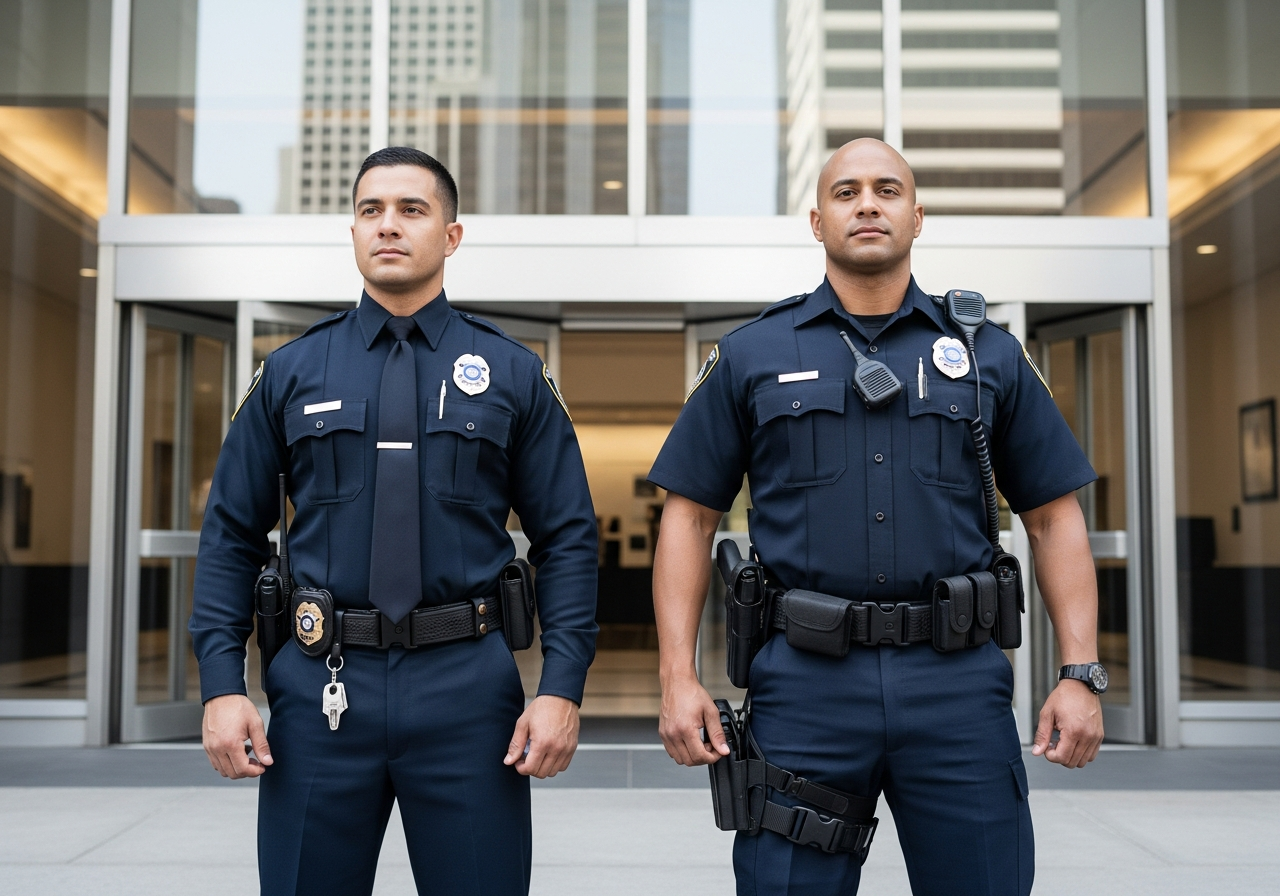
Officer positioning matters more here than almost anywhere else in the facility. The post should provide the officer with a clear view of the entrance, the check-in window, and the waiting room without standing directly behind the registration clerk, which could escalate a tense interaction. Visible presence reassures patients who feel unsafe. Static, confrontational posture provokes those who are already escalated.
Weapons screening at ER entrances is an active topic of discussion in DFW hospitals. Some North Texas systems have moved toward walk-through detection at the ER door; others rely on hand-held wanding triggered by behavior or triage protocols. Whatever the tool, the officer has to be trained to handle the screen without slowing down a genuine medical emergency. A patient in cardiac arrest is not stopping at a magnetometer.
Behavioral health holds and psychiatric patients
Behavioral health patients are one of the most demanding parts of the ER security workload, and most North Texas EDs have felt the volume climb. A psychiatric patient on a hold may wait hours, sometimes more than a day, for an inpatient bed to open. During that wait, they are physically in the ER, often in a designated safe room or a curtained bay, under continuous observation.
The security officer working that wait is in a clinical-adjacent role. Restraint decisions sit with physicians and nurses. Officers do not initiate restraint, but they are usually present when it happens, both as a safety witness and as physical backup if a patient becomes combative. De-escalation training and a steady tone matter more here than physical strength.
Coordinating with clinical staff is non-negotiable. The nurse running the bay decides when an officer steps in and when they step back. Officers who try to run the room get pushed out fast. Officers who can read the clinical rhythm and stay in support mode are kept on the schedule.
After-hours volume surges and substance-related cases
ER traffic in North Texas climbs on Friday and Saturday nights and on the front and back ends of major holidays. Substance-related presentations, assaults, motor vehicle trauma, and overdose calls cluster in those windows. Staffing security at midnight the same way it is staffed at 10 a.m. is a recipe for an overrun front desk.
A reasonable staffing model layers in a second officer during the highest-volume windows and adds mobile patrol coverage on the ED parking lot during the same hours. The parking lot piece matters because that is where ER incidents often start, before the patient or visitor reaches the door. Visible patrol presence outside the ambulance bay and on the visitor lot deters opportunistic crime and gives staff a safer walk to their cars at shift change.
Protecting staff during patient escalation
The Texas Health and Safety Code recognizes assault on hospital personnel as a heightened offense, and federal guidance through OSHA has long treated healthcare workplace violence as a serious occupational hazard requiring active prevention. Translating that into actual ER operations means working alongside nursing leadership on the practical layer:
- Panic alarms in nurses' stations, triage rooms, and behavioral safe rooms, tested on a known schedule.
- Clear sightlines from the security post to high-risk bays.
- A documented escort protocol for staff walking to parking after late shifts.
- Joint de-escalation training between security officers and clinical staff so both sides use the same verbal cues.
- An after-action process for every assault or near-assault, with security and nursing both at the table.
The training overlay matters. An officer who has only worked corporate lobbies will not de-escalate a manic patient the way an officer with healthcare-specific reps will. Officers running this post should rotate through ED-specific training, not just generic guard certification.
Integration with clinical leadership and the broader hospital security program
The ER post does not sit alone. It plugs into a larger healthcare security program covering the main lobby, the patient floors, and the loading dock. The ER officer needs working relationships with that supervisor, the charge nurse on shift, and the house supervisor.
Practical integration looks like:
- Radio interoperability between ER security, main hospital security, and EMS dispatch.
- A documented response plan when ER security calls for backup from other posts.
- Shared incident reporting so patterns visible to the ER show up in the hospital-wide picture.
- A point of contact in nursing leadership who can resolve friction before it becomes a complaint.
When these pieces are missing, ER officers improvise every shift. When they are in place, the ER post becomes a calm, predictable layer of the building.
Texas DPS licensing and the case for higher experience at the ER post
Every contract security officer working in a North Texas ER has to be licensed through the Texas DPS Private Security Bureau. The baseline credentials are well-defined: Level II is the 6-hour non-commissioned (unarmed) course, and Level III is the 45-hour commissioned (armed) course required for any officer carrying a firearm on post.
Those minimums are a floor, not a ceiling. Plenty of officers hold a valid license and have never set foot inside a hospital. For the ER specifically, the experience profile that holds up over time tends to include:
- Prior healthcare security work, not just retail or commercial guard work.
- Crisis prevention or verbal de-escalation training beyond the base curriculum.
- Comfort working alongside clinical staff under their direction.
- A clean record on use of force and patient interaction documentation.
Some North Texas hospitals also place off-duty law enforcement officers in the ER, especially overnight. Whether the right answer is unarmed, armed Level III, or off-duty police depends on patient population, prior incident history, and the surrounding neighborhood.
What this means for your North Texas ER
If you run an emergency department in DFW, the right security model is not a copy of the one used at the main hospital entrance. The ER needs its own staffing pattern, its own training overlay, and officers who are selected for the post rather than rotated through it.
Cascadia builds ER security programs around the department's operational realities, working with security directors, nursing leadership, and risk management. That includes unarmed officers for daytime triage support, armed officers where the risk profile warrants it, and off-duty law enforcement for the highest-risk windows.
Frequently asked questions
Should ER officers be armed or unarmed?
It depends on the patient population, the hospital's risk assessment, and the layered presence around the ER. Many North Texas EDs run unarmed officers during the day with armed coverage or off-duty law enforcement overnight. The decision lies with hospital leadership, working from incident data, not from a one-size policy.
Are off-duty police officers worth the cost in the ER?
For some hospitals, yes, particularly during overnight hours or in neighborhoods with higher violent-crime indicators. Off-duty officers carry the authority of their department and can write reports that move through the criminal justice system more quickly. They are not a substitute for trained healthcare security across the rest of the shift, but they fit well in the highest-risk windows.
How should we staff security for behavioral health holds?
Behavioral holds require consistent observation, and the officer must be selected for temperament, not seniority. Plan for the hold to last longer than expected, rotate officers so no one sits a hold for the full 12 hours, and document every interaction. Coordination with the nurse running the bay drives every decision in the room.
When are the busiest hours for ER security incidents in North Texas?
Most DFW emergency departments see incident clusters on Friday and Saturday evenings, on holiday weekends, and during weather events that surge call volume. Staffing models should reflect that pattern, with extra coverage layered in during those windows rather than spread evenly across the week.
Does ER security training overlap with clinical staff training?
It should. Joint de-escalation drills, shared crisis-prevention curricula, and after-action reviews that include both nursing and security build a common vocabulary. When officers and nurses use the same verbal cues during an escalation, the situation often de-escalates without physical intervention.
Talk to Cascadia about your ER security program
A safer emergency department is built post by post. If you are evaluating ER security partners for a North Texas hospital or freestanding emergency facility, Cascadia Global Security can walk through your risk profile and design a program that fits the department.
Request a quote through our quote form or call (800) 939-1549.