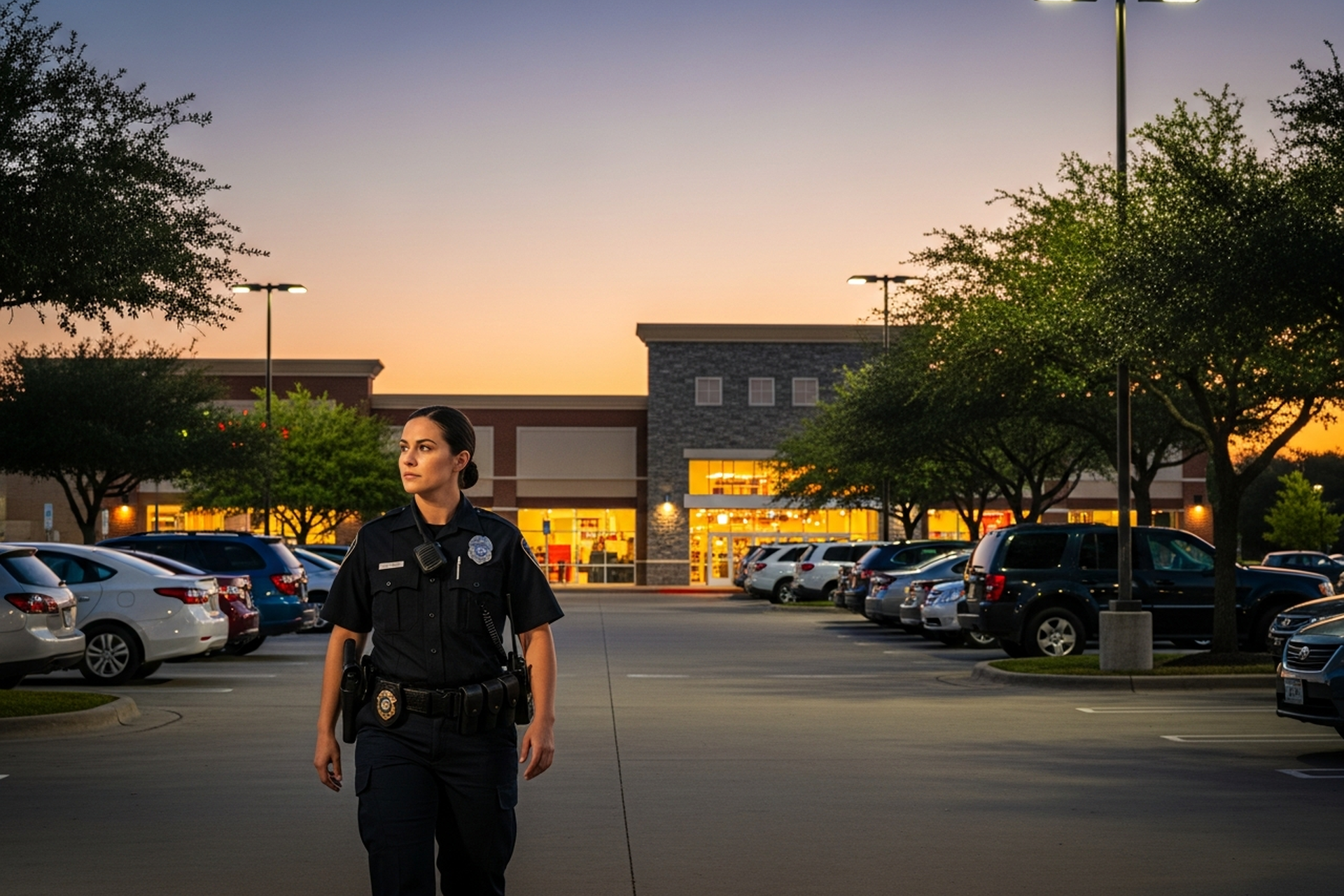
GPS-Tracked Mobile Patrols for Large DFW Commercial Sites
Josh Harris | May 21, 2026
If you manage a large commercial property in the Dallas-Fort Worth area, you have probably wondered at some point whether the patrol you are paying for actually happened. A guard logs a clipboard entry at 2:14 a.m., but you have no way to confirm the vehicle ever left the gatehouse. GPS-tracked mobile patrols DFW operators use today turn that question into a data point. Every stop, every timestamp, every route segment is recorded automatically, and the record lives in a report you can pull the next morning.
That shift from trust-me to verify-me is not a minor upgrade. For property managers overseeing multi-acre industrial campuses, business parks with dozens of buildings, or multifamily portfolios spread across several ZIP codes, verifiable patrol activity is the difference between a security contract and a security program.
How GPS-Tracked Patrols Work Day-to-Day
A GPS-tracked mobile patrol operates on a simple principle: the officer's position is logged continuously, and specific checkpoints require a physical confirmation that the vehicle or officer was present. In practice, this works one of two ways. The patrol vehicle carries an always-on GPS unit that records the route in real time. Alternatively, the officer uses a smartphone or dedicated device to check in at each stop by scanning a QR code, tapping an NFC tag, or confirming a geofenced location within a defined radius.
Checkpoints are set up during onboarding and mapped to the specific areas that matter most: main entrances, loading docks, parking structures, equipment yards, fire lanes, and any perimeter gates that require eyes-on verification. Each checkpoint generates a logged event with location coordinates, officer ID, date, and time.
Routes can be fixed or randomized. Fixed routes work well for properties with strict compliance requirements where specific locations must be documented at set times. Randomized routes are more effective for deterrence because they eliminate the predictable gap a fixed schedule creates. Most credible providers use a mix of both depending on the site and time of day.
What Data Property Managers Receive
The value of GPS-tracked patrol is not the tracking itself. It is the reporting layer on top of it. A well-built patrol program delivers three types of data to the property manager.
Patrol verification logs. A timestamped record of every checkpoint hit, every route segment driven, and any gaps in coverage. These logs are typically available as PDFs, spreadsheets, or through a client portal. They answer one question cleanly: did the patrol happen, and when?
Incident reports. When an officer encounters something requiring documentation, a report is generated on the spot. Modern systems capture photos directly from the officer's device, attach them to the incident, and push them to the property manager in close to real time. Industry trade organizations such as the Security Industry Association track and publish standards covering the connected technology and reporting systems that have become standard in commercial security deployments.
Shift summary reports. At the end of each shift, a consolidated summary covers the total number of checkpoints completed, incidents logged, mileage, and any deviations from the expected route. For a property manager overseeing multiple sites, a shift summary is the fastest way to confirm coverage across the portfolio without reviewing raw GPS data point by point.
The Accountability Shift: From Trust-Me to Verify-Me
Traditional mobile patrol runs on a paper-based accountability model. An officer signs in, writes down times and observations, and leaves the log at the guard shack. The record exists, but it is not independently verifiable. Nothing prevents a falsified entry, and nothing proves the officer was at the specific location they noted.
GPS-tracked patrol does not rely on the officer's self-report. The data is generated by the system, not the individual. If an officer skips a checkpoint, the system records the skip. If the vehicle sat in one spot for forty minutes, the route log shows it.
An anomalous sweep completed in five minutes on a property that normally takes eighteen will appear in the report and can be investigated.
Operational value for large sites. For DFW commercial properties where a security breach means significant financial exposure, this data creates direct accountability. Property managers can audit patrol performance against contract terms, raise documented concerns, and build a patrol history that matters in insurance conversations or post-incident reviews.
Why this matters for provider selection. When a company knows its patrol data is reviewed regularly, performance stays consistent. When no one is checking the log, consistency is optional. GPS verification changes the incentive structure on both sides of the contract.
Integration with Property Management Workflows
GPS patrol data does not have to live in a separate silo. Many providers deliver reports in formats that map directly to property management platforms, including scheduled CSV exports, integrations with Yardi, RealPage, or MRI, or email summaries for a shared operations inbox.
For large multi-site portfolios, this integration matters more than the technology itself. A property manager overseeing fifteen assets across DFW cannot log into a separate patrol portal for each site every morning. Consolidated reporting that aggregates incident flags and coverage summaries into a single view makes GPS patrol a usable tool rather than another system to monitor.
Ask any prospective provider specifically how data is delivered, at what frequency, and what format options are available. Providers that cannot answer this in concrete terms are likely delivering generic PDF reports by email, which is better than nothing but well short of what the technology can support.
A note on data privacy. GPS systems generate records that may involve tenant or employee location data. The National Institute of Standards and Technology cybersecurity guidance provides a useful framework for evaluating data minimization and access controls when reviewing how a provider stores and protects patrol records.
What GPS Tracking Does NOT Do
GPS-tracked patrol is a verification and accountability tool. It is not a deterrence multiplier on its own, and it does not compensate for weak human judgment in the field.
A patrol can hit every checkpoint on schedule and still miss an active break-in at a location not on the checkpoint list. GPS confirms the route was completed. It does not confirm everything in between was observed properly. Officer attention and training determine what actually gets caught.
Response time is not guaranteed. GPS also cannot promise real-time intervention. If an officer scans a checkpoint at 1:45 a.m. and an incident occurs two minutes later in the same area, the next pass may be thirty minutes away. GPS-tracked mobile patrols are a scheduled deterrence and documentation service, not a continuous monitoring solution.
For facilities requiring a faster response threshold, GPS patrol works best when combined with a monitored camera system or an alarm response protocol that dispatches an officer on trigger.
The honest provider test. Any security company that positions GPS tracking as the answer to every security gap is selling technology, not outcomes. Ask how they handle incidents that occur between scheduled checkpoint passes.
What This Means for Your DFW Property
Large commercial properties across the Dallas-Fort Worth area share a common challenge: coverage requirements that exceed what a single stationed guard can handle, and budget constraints that make full fixed-post staffing impractical. GPS-tracked mobile patrol services fill that gap with a service that is both scalable and auditable.
For a business park or industrial campus, GPS patrol means documented coverage, a verifiable standard to hold your provider to, and a patrol history that supports risk management and tenant confidence. For a multifamily portfolio, it means verified perimeter checks across multiple assets without deploying a guard at every property.
Accountability is no longer a premium feature in this market. It is a baseline expectation. If a provider cannot show you a GPS verification report, they are not operating at the standard the DFW market demands.
Frequently Asked Questions
How does GPS tracking verify mobile patrol activity?
GPS tracking logs the position of a patrol vehicle or officer continuously throughout a shift. At designated checkpoints, the system records a timestamped location confirmation through continuous GPS tracking, QR/NFC check-ins, or geofenced zone entries. This creates an independently generated record of when and where the officer was present, without relying on self-reported paperwork.
Can I see real-time patrol activity for my DFW property?
It depends on the provider. Some companies offer client portals with live tracking displays that show the patrol vehicle's current position on a map. Others deliver shift-summary and checkpoint reports at the end of each patrol cycle rather than in real time. Ask whether the provider offers live visibility and test the portal interface before signing a contract.
How is GPS-tracked patrol different from traditional mobile patrol?
Traditional mobile patrol relies on paper logs or officer-submitted reports to document activity. GPS-tracked patrol generates location data automatically, creating a record that exists independently of what the officer writes down. The practical difference is accountability: GPS-tracked logs can be audited for gaps, anomalies, and missed checkpoints in a way that a handwritten log cannot.
Does GPS tracking add to the cost?
GPS-capable patrol typically costs more than a basic mobile patrol service, but the gap has narrowed as the technology has become standard. Many providers include GPS verification in their core offering rather than as a premium add-on. The more meaningful cost factor is reporting quality. Clarify exactly what the GPS reporting includes before comparing quotes.
Can GPS-tracked patrols integrate with my property management software?
Many providers can deliver patrol data in formats compatible with major property management platforms, including scheduled exports, direct integrations with Yardi or RealPage, or API access. Integration capability varies significantly by provider. Ask what formats are available, how frequently reports are delivered, and whether a dedicated portal is included.
Ready to Verify Your DFW Patrol Coverage?
If your current mobile patrol provider cannot show you GPS-confirmed checkpoint logs, timestamped incident reports with photos, and a clear picture of route coverage, you are paying for a service you cannot audit.
Cascadia Global Security delivers GPS-tracked mobile patrol for commercial properties across the Dallas-Fort Worth area, with verified reporting built into every contract. Contact us to discuss your property's coverage requirements and what a GPS-verified patrol program looks like for your sites.
Contact Cascadia to get a quote and discuss coverage requirements for your DFW property.